
Citrus Medication Interaction Checker
Check Your Medication
Enter your prescription medication name to see if it interacts with pomelo or Seville orange.
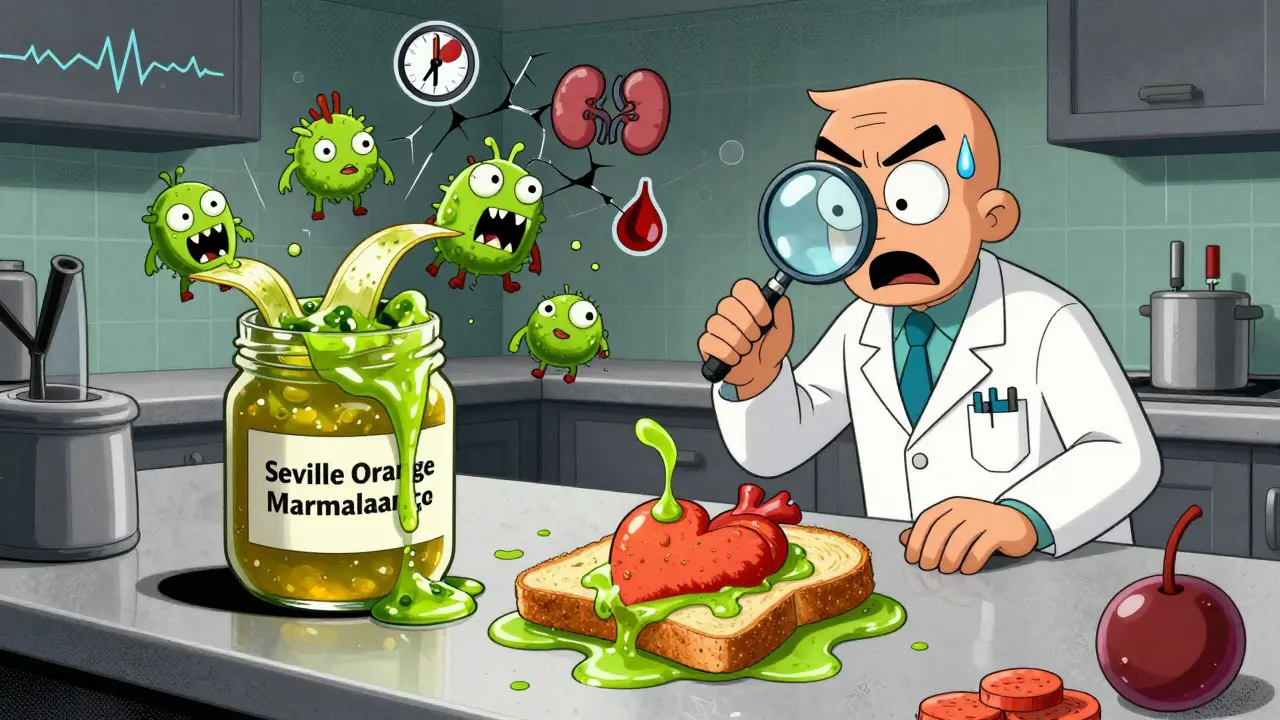
Most people know grapefruit can mess with their meds. But if you’re eating pomelo or savoring Seville orange marmalade, you might be at just as much risk - and no one’s warning you. These fruits aren’t just exotic snacks. They’re powerful, silent disruptors of how your body handles medicine. And the consequences can be serious: muscle damage, kidney failure, dangerous drops in blood pressure, or even organ rejection in transplant patients.
Why Pomelo and Seville Orange Are Just as Dangerous as Grapefruit
Pomelo and Seville orange don’t just resemble grapefruit - they share the same dangerous chemicals. The culprits are furanocoumarins, especially bergamottin and 6',7'-dihydroxybergamottin. These compounds shut down an enzyme in your gut called CYP3A4. That enzyme is responsible for breaking down more than half of all prescription drugs before they enter your bloodstream. When it’s blocked, your body absorbs way more of the drug than intended. It’s like turning up the volume on your medication without changing the dose. Studies show pomelo contains up to 2.5 micromoles per liter of bergamottin - higher than grapefruit’s 2.0. Seville orange? Some varieties hit 4.0. That’s 100% more than grapefruit. And it’s not just juice. The peel in Seville orange marmalade concentrates these compounds even further. One case report found a transplant patient’s tacrolimus levels spiked 400% after eating just two tablespoons of marmalade daily.How These Interactions Actually Happen
It’s not magic. It’s biochemistry. When you drink pomelo juice or eat Seville orange, the furanocoumarins bind to CYP3A4 in your small intestine. They don’t just block it temporarily - they permanently destroy the enzyme. Your body has to grow new enzymes to replace them, and that takes 72 hours. So even if you eat the fruit at breakfast and take your pill at night, the damage is already done. There’s another layer: OATP transporters. These are the gatekeepers that pull drugs into your cells. Naringin, a flavonoid in pomelo, blocks them too. That means less drug gets absorbed - but only for some medications. For others, like statins or calcium channel blockers, the CYP3A4 block is the main issue. The result? Toxic levels build up in your blood.Which Medications Are at Risk?
Not every drug is affected. But if you’re on any of these, you need to stop eating pomelo or Seville orange - now:- Statins: Simvastatin, lovastatin, atorvastatin - all can cause rhabdomyolysis (muscle breakdown) if levels spike. One study showed pomelo increased simvastatin exposure by 350% - worse than grapefruit.
- Calcium channel blockers: Amlodipine, felodipine, nifedipine - can cause dangerously low blood pressure or irregular heartbeat.
- Immunosuppressants: Tacrolimus, cyclosporine - even tiny increases can lead to kidney damage or rejection in transplant patients.
- Benzodiazepines: Midazolam, triazolam - can cause extreme drowsiness or breathing problems.
- Antiarrhythmics: Amiodarone, quinidine - risk of life-threatening heart rhythm changes.
Drugs like metformin, lisinopril, or levothyroxine? Generally safe. But if you’re unsure, don’t guess. Check with your pharmacist.
Why Nobody’s Talking About This
Grapefruit gets all the attention. Pomelo? Often labeled as “Chinese grapefruit” in supermarkets - and no warning sticker. Seville orange? Sold as marmalade, not juice. People think it’s just a sweet spread. It’s not. Only 37% of pomelo and Seville orange products carry interaction warnings. Compare that to 78% for grapefruit. Pharmacists? Only 42% routinely ask patients about these fruits. Patients? 68% say they were never warned. One Reddit user shared how their relative ended up in the hospital with rhabdomyolysis after eating pomelo daily for two weeks. No one told them it was as risky as grapefruit.Real Cases, Real Consequences
A 68-year-old man on simvastatin ate pomelo every morning. He woke up with severe muscle pain and dark urine. His CK levels - a marker of muscle damage - were 10 times normal. He needed IV fluids and a week in the hospital. His doctor never asked about citrus. A 52-year-old woman who had a kidney transplant ate Seville orange marmalade on her toast every day. Her tacrolimus levels rose from 8 ng/mL to 28 ng/mL - far above the safe range. She developed tremors, nausea, and kidney dysfunction. Her transplant team had to adjust her dose and ban the marmalade. These aren’t rare. Between 2018 and 2022, the FDA logged 217 adverse events linked to pomelo and Seville orange. That’s a 43% jump from the previous five years. And experts say the real number is at least three times higher - because most cases go unreported or misattributed.
What You Should Do Right Now
If you take any prescription medication:- Check your meds. Look up your drugs on the University of Florida’s Drug Interaction Checker - it lists 107 medications affected by pomelo and Seville orange.
- Ask your pharmacist: “Does my medication interact with pomelo or Seville orange?” Don’t just say grapefruit. Be specific.
- Read labels. If you see “bitter orange,” “Chinese grapefruit,” or “marmalade made from Seville oranges,” avoid it.
- Switch to safer citrus. Sweet oranges, tangerines, and clementines are fine. They don’t contain furanocoumarins.
- If you’ve eaten pomelo or Seville orange recently, wait 72 hours before taking your medication - even if you feel fine.
The Bigger Picture
Pomelo production has jumped 50% since 2015. Global consumption is rising. Yet, only 29% of pharmacy systems have these interactions flagged in their electronic alerts. The FDA is finally pushing for new warning labels - but that won’t be mandatory until 2025. Until then, you’re on your own. Healthcare providers need better training. Patients need clearer labels. But waiting for systems to fix themselves isn’t an option. If you’re on a medication that interacts with citrus, treat pomelo and Seville orange like poison. Because, in this context, they are.What’s Next?
A $2.1 million NIH study launched in late 2023 is now tracking exactly how much pomelo it takes to trigger interactions across different populations. Early results suggest genetics play a role - some people break down furanocoumarins faster than others. But until we know who’s at highest risk, the safest rule is simple: if your drug warns against grapefruit, avoid all similar citrus. Climate change might make this even trickier. A 2022 study in Nature Food found rising temperatures and droughts can boost furanocoumarin levels by up to 25% in citrus fruits. So next year’s pomelo might be more dangerous than this year’s - even if it looks the same.Can I eat pomelo if I’m not on any medication?
Yes. If you’re not taking any prescription drugs, pomelo and Seville orange are perfectly safe and even nutritious - high in vitamin C and antioxidants. The risk only exists when these fruits interact with medications that rely on the CYP3A4 enzyme for metabolism.
Is orange juice safe if grapefruit isn’t?
Yes. Sweet oranges (like Valencia or Navel) do not contain furanocoumarins. They’re safe to drink with most medications. Just avoid bitter orange juice, Seville orange juice, or anything labeled “bitter orange extract.” Those are dangerous.
Does cooking destroy the interaction risk?
No. Furanocoumarins are heat-stable. Boiling, baking, or making marmalade won’t reduce their potency. In fact, concentrating the peel in marmalade can make it stronger. Don’t assume cooking makes it safe.
How long should I wait after eating pomelo before taking my meds?
Wait at least 72 hours. The enzyme inhibition is irreversible. Even if you ate pomelo three days ago, your body still doesn’t have enough CYP3A4 to safely metabolize your drug. Don’t rely on feeling fine - the damage is internal.
Are there any citrus fruits that are completely safe?
Yes. Sweet oranges, tangerines, clementines, and mandarins are safe. They don’t contain furanocoumarins. Limes and lemons have very low levels and are generally considered low-risk - but if you’re on a high-risk drug like tacrolimus, even small amounts aren’t worth the gamble. Stick to sweet oranges for safety.
Siobhan Goggin
January 4, 2026 AT 12:25This is terrifying and I had no idea. I eat pomelo every weekend with my breakfast. I'm on a statin. I'm switching to oranges tomorrow. Thank you for sharing this - seriously, this could save lives.
Vikram Sujay
January 5, 2026 AT 08:35It is a profound oversight in public health communication that such a potent biochemical interaction remains largely unaddressed in consumer-facing labeling. The CYP3A4 enzyme system is not merely a metabolic pathway; it is a critical gatekeeper of pharmacological homeostasis. The fact that regulatory bodies have not mandated explicit warnings on pomelo and Seville orange products, despite documented clinical consequences, reflects a systemic failure in risk communication. One must question whether economic interests outweigh patient safety in this instance.
Jay Tejada
January 7, 2026 AT 02:11so like... grapefruit gets all the drama, but pomelo? chillin’ in the fruit aisle like it’s innocent. marmalade? ‘oh it’s just a spread’ - bro, that’s liquid poison with a side of toast. 😑
Shanna Sung
January 8, 2026 AT 17:11They don't want you to know this because Big Pharma and Big Citrus are in bed together. The FDA’s ‘2025 deadline’? That’s when the lobbyists finish their bribes. They’ve known about this since the 90s. Transplant patients dying? Coincidence. The real story? The government is letting people die so drug companies can sell more pills. Wake up. They’re hiding this from you.
mark etang
January 9, 2026 AT 05:07This is an excellent and urgently needed public service announcement. The biochemistry is sound, the case studies are compelling, and the call to action is both practical and necessary. I urge all healthcare professionals to incorporate this into routine medication counseling. Patient safety must supersede convenience. Thank you for the rigor and clarity of this post.
Brendan F. Cochran
January 11, 2026 AT 01:18frickin’ citrus is ruining america. first grapefruit now this? who even eats pomelo anyway? some fancy a$$ marmalade from some country that thinks bitter is better. my grandpa took blood pressure meds for 40 years and never ate none of that stuff. why are we making this a thing now? just stop being lazy and read the damn label.
Charlotte N
January 13, 2026 AT 00:03Wait so if I eat a little bit of Seville orange marmalade once a week and take my cyclosporine at night... does the 72 hour window mean I’m safe if I eat it Sunday and take it Thursday? or is it 72 hours after ingestion? and what if I only eat the peel? does that make it worse? I’m so confused now. I think I need to call my pharmacist but I’m scared to ask because I feel like I should’ve known this already
bob bob
January 13, 2026 AT 02:34Just wanted to say thank you for posting this. I’m a transplant recipient and my nurse never mentioned this. I’ve been eating that marmalade for years. I threw it out today. I’m so glad I found this before something happened. You saved me.
Uzoamaka Nwankpa
January 14, 2026 AT 03:57I’ve been taking tacrolimus for 8 years. I didn’t know. I didn’t know. I didn’t know. I’m crying right now. I’ve been eating that marmalade every morning. I thought it was healthy. I thought it was safe. I didn’t know. I didn’t know. I didn’t know.