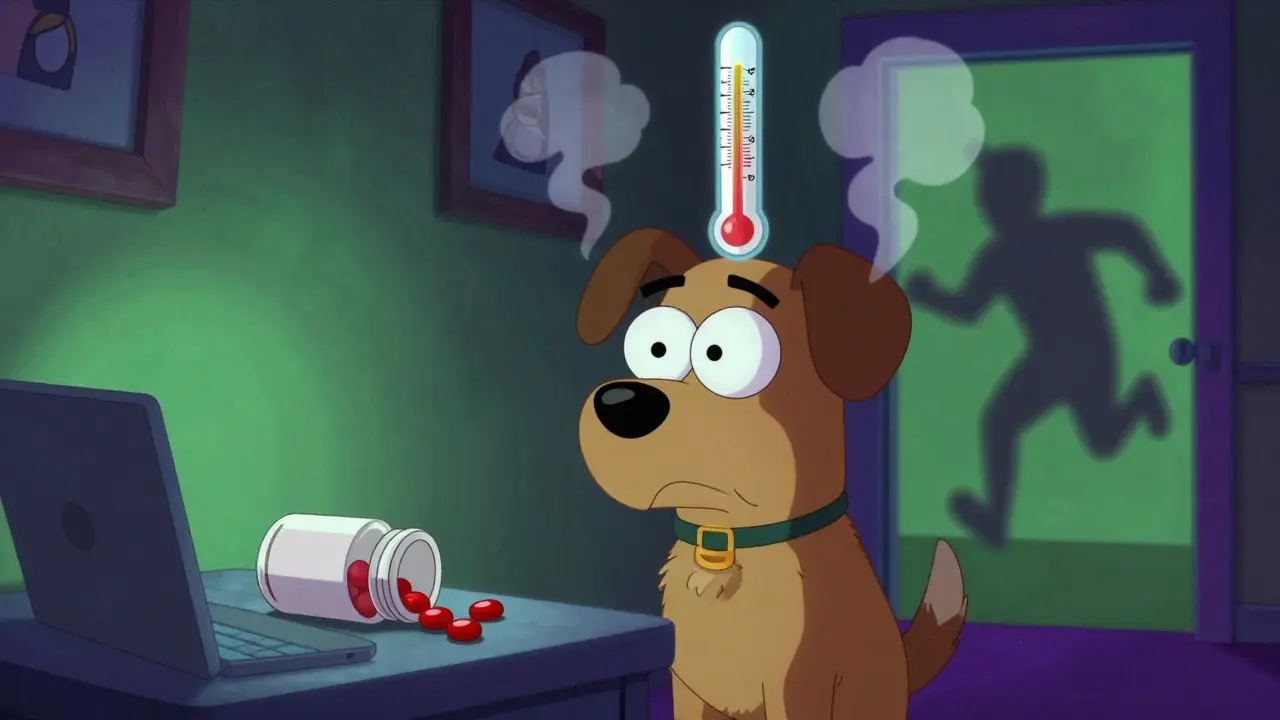
Every year, tens of thousands of pets end up in emergency vet clinics because they ate something they shouldn’t have-and most of the time, it’s not chocolate or grapes. It’s your medication. A pill left on the nightstand, a dropped capsule on the floor, a bottle left open on the counter. Your dog or cat doesn’t know it’s medicine. To them, it’s just a tasty little thing they found. And that’s how a simple mistake becomes a life-or-death situation.
What Happens When Pets Eat Human Medications?
| Medication Type | Common Brand Names | Primary Symptoms in Dogs | Primary Symptoms in Cats | Time to Onset |
|---|---|---|---|---|
| Antidepressants (SSRIs) | Prozac, Lexapro | Agitation, tremors, fever (103-106°F), seizures | Same as dogs, but more likely to develop liver damage | 30 min - 12 hours |
| ADD/ADHD Stimulants | Adderall, Concerta, Ritalin | Heart rate over 220 bpm, extreme hyperthermia (up to 107°F), tremors, collapse | Same as dogs-often fatal even with small doses | 15-60 minutes |
| Benzodiazepines | Xanax, Ambien | Paradoxical agitation (not sedation), wobbliness, vomiting | Severe liver failure, jaundice, lethargy | 1-4 hours |
| NSAIDs (Painkillers) | Ibuprofen, Naproxen | Vomiting, black tarry stools, loss of appetite, kidney failure | Same as dogs-but toxicity at 1/10th the dose | 1-6 hours (gut), 24-72 hours (kidneys) |
| Acetaminophen | Tylenol | Liver damage, swelling, brownish gums | Brown gums, difficulty breathing, swelling, death at 10mg/kg | 1-4 hours (cats), 24-72 hours (dogs) |
It’s not just about the pill. It’s about what that pill does inside your pet’s body. Dogs and cats don’t process drugs the same way we do. Their livers and kidneys handle chemicals differently-and sometimes, that difference is deadly. For example, cats lack a key enzyme needed to break down acetaminophen. Even one tablet can poison them. Dogs can handle more, but not much more. Ibuprofen might calm your headache, but it can shut down your dog’s kidneys in under 48 hours.
What to Look For: The Critical Symptoms
You don’t need to be a vet to spot trouble. You just need to know what to watch for-and when.
For antidepressants like Prozac or Lexapro, the first signs are often mistaken for excitement. Your dog might seem hyper, restless, or even aggressive. They may tremble, pant heavily, or have a fever. Their pupils might be wide. This isn’t just being overstimulated-it’s serotonin syndrome. Left untreated, it leads to seizures and death. In cats, liver enzymes can spike above 1,200 U/L (normal is under 100). That’s not a glitch-it’s organ failure.
For ADD/ADHD meds like Adderall or Ritalin, time is measured in minutes, not hours. These are powerful stimulants. Your pet’s heart rate can jump from 100 bpm to over 220 bpm. Their body temperature can hit 107°F. Their muscles shake uncontrollably. Their gums turn bright red. They might collapse or have seizures. This isn’t a bad day-it’s a cardiac emergency.
For NSAIDs like ibuprofen, the signs start in the gut. Vomiting, loss of appetite, dark or bloody stools. These aren’t just stomach bugs. They’re signs your pet’s stomach lining is being eaten away and their kidneys are shutting down. By the time they’re lethargic and not drinking, it’s often too late for simple treatment.
For acetaminophen, the red flag is color. In cats, their gums turn brown or gray. Their breathing gets shallow. Their face or paws swell. This isn’t a cold-it’s methemoglobinemia. Their blood can’t carry oxygen. In dogs, it’s more about the liver. Yellow eyes, vomiting, weakness. At 150mg/kg, it’s life-threatening. In cats, it’s life-threatening at 10mg/kg. That’s less than half a tablet.
For benzodiazepines like Xanax, dogs often react the opposite of what you’d expect. Instead of calming down, they become agitated, pace, bark, or act confused. Cats? They get quiet, stop eating, and their liver starts to die. It’s not sedation-it’s a silent poisoning.
Why Timing Matters More Than You Think
There’s a reason vets say, “Time is tissue.” If your pet ingests a toxic dose and you get them to a vet within two hours, their chances of survival jump from 40% to over 90%. That’s not a guess. That’s from a Merck Veterinary Manual study. Why? Because most toxins are absorbed in the first few hours. After that, they’re in the bloodstream, in the organs, doing damage.
For stimulants like Adderall, the clock starts ticking the moment the pill is swallowed. Symptoms can appear in 15 minutes. Waiting even an hour can mean the difference between activated charcoal and a ventilator.
For NSAIDs and acetaminophen, the damage isn’t always obvious right away. Your pet might seem fine for 12 hours. Then suddenly, they’re vomiting blood or struggling to breathe. That’s why if you suspect ingestion-even if they seem okay-you need to call a vet immediately. Don’t wait. Don’t hope it was a small amount. Don’t assume they’ll be fine.
Species Differences: Cats Are Not Small Dogs
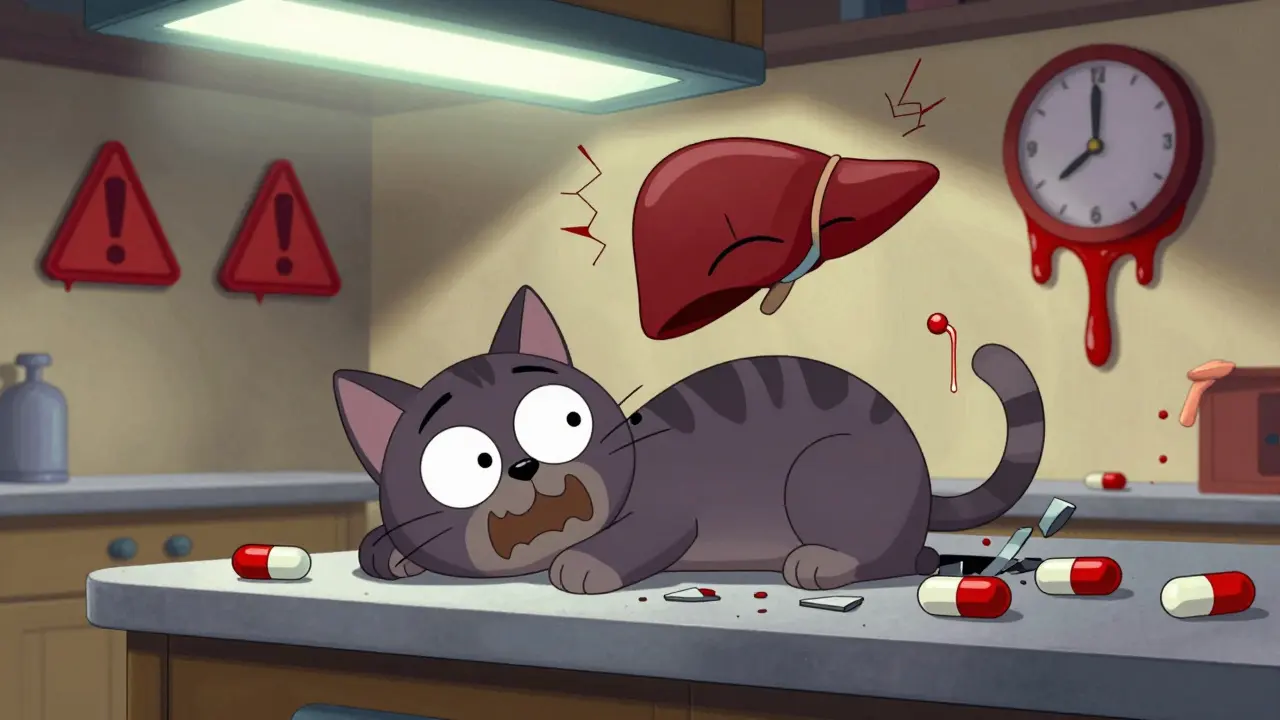
This is the biggest mistake people make. Cats aren’t just tiny dogs. Their bodies are wired differently. They can’t process acetaminophen at all. They can’t handle certain antidepressants the same way. A dose that might make a dog sick could kill a cat.
Effexor (venlafaxine) is one of the most dangerous pills for cats. Just one extended-release capsule can be fatal. Why? Because cats don’t have the liver enzymes to break it down. That sweet coating? It’s like candy to them. And they’ll eat the whole bottle.
Dogs, on the other hand, can sometimes tolerate small amounts of ibuprofen. But that doesn’t mean it’s safe. The line between a “safe” dose and a lethal one is razor-thin. And even if your dog seems fine, internal damage can be happening without visible signs.
What to Do Right Now
If you think your pet ate human medication:
- Don’t panic-but don’t wait. Stay calm so you can act fast.
- Check for clues. Are there pill fragments? A broken bottle? Empty packaging? Write down what you think they ate, how much, and when.
- Check their temperature. Use a rectal thermometer. Normal is 100-102.5°F. Anything above 103.5°F is a red flag.
- Look at their gums. Are they bright red? Brown? Blue? Pale? Brown gums in cats mean acetaminophen poisoning.
- Call immediately. Contact your vet or the Pet Poison Helpline at 1-800-213-6680. Have the medication name, dosage, and your pet’s weight ready.
Do not try to make them vomit unless a professional tells you to. Some toxins cause more damage coming back up. Some meds require specific antidotes. Guessing can kill.
How to Prevent This From Happening
The best treatment is prevention. Here’s what works:
- Keep all meds in closed, high cabinets-not on nightstands or counters.
- Use child-proof containers, even if you think your pet can’t reach them.
- Never leave pills on the floor after taking them. Pick them up immediately.
- Don’t let your pet watch you take medicine. Many will try to steal it.
- Ask your pharmacist about bitterant-coated pills. Some newer meds have a bitter taste to deter pets.
- Download the ASPCA Poison Control app. It has a symptom checker and instant access to poison control.
Most of these cases happen because someone thought, “It’s just one pill.” But one pill is all it takes. Especially for cats. Especially for stimulants. Especially for NSAIDs.
What’s Changing in 2026
Things are getting better-but not fast enough. Veterinary clinics are now using AI-powered apps to help owners recognize symptoms in real time. The American College of Veterinary Emergency and Critical Care launched a tool in late 2023 that analyzes your pet’s behavior and symptoms to give you a risk level. It’s not a replacement for a vet, but it can help you decide whether to rush to the ER or wait.
Pharmaceutical companies are starting to add bittering agents to pills, but it’s not required. Only about 30% of human meds have them now. That’s changing, slowly.
But the real progress? It’s in awareness. More owners are learning the signs. More vets are training staff. More emergency clinics have protocols in place. The goal is simple: no pet should die because someone left a pill on the nightstand.
What should I do if my dog ate ibuprofen?
Call your vet or the Pet Poison Helpline immediately. Do not wait for symptoms. Ibuprofen can cause stomach ulcers and kidney failure within hours. If caught early, activated charcoal and IV fluids can prevent serious damage. If you see vomiting, black stools, or lethargy, get to a vet right away-these are signs of advanced poisoning.
Can my cat die from one Tylenol pill?
Yes. A single 500mg Tylenol tablet can be fatal to a cat. Cats lack the enzyme needed to break down acetaminophen. Even a small amount causes methemoglobinemia, which stops their blood from carrying oxygen. Symptoms include brown gums, difficulty breathing, and swelling. This is a medical emergency. Do not wait-call a vet immediately.
My dog ate an antidepressant and seems hyper. Is that normal?
No. Hyperactivity, tremors, high fever, and rapid breathing are signs of serotonin syndrome, a dangerous condition caused by too much serotonin in the brain. This is not excitement-it’s poisoning. Dogs can have seizures or die without treatment. Call your vet now. Even if they seem okay now, symptoms can worsen over the next few hours.
Why do some pets get agitated instead of sleepy from Xanax?
In dogs, benzodiazepines like Xanax can cause a paradoxical reaction. Instead of calming them down, they become hyperactive, restless, or aggressive. This happens in over half of canine cases. Cats don’t usually show this-they just get lethargic and develop liver damage. Either way, it’s toxic. Don’t assume it’s working as intended.
How fast can a pet die from a human medication overdose?
It can happen in under an hour with stimulants like Adderall or in 12-24 hours with acetaminophen in cats. For NSAIDs, death can occur within 2-3 days if untreated. The faster you act, the better the chance. Most pets that survive are treated within two hours. Waiting even 6-8 hours can turn a treatable case into a fatal one.
Final Thought: One Pill Can Change Everything
You didn’t mean for this to happen. No one does. But your pet doesn’t know that. They don’t know the difference between your medicine and their treat. That’s why prevention isn’t optional. It’s the only thing that saves lives. Keep meds locked up. Know the signs. Act fast. Your pet’s life might depend on it.
Diana Dougan
January 31, 2026 AT 18:27So let me get this straight-I’m supposed to lock up my Adderall like it’s cocaine and not just, y’know, take my meds like an adult? 🙄 My cat’s smarter than half the people on this thread. Also, why is this post 10 pages long? I read the first 3 sentences and already want to nap.
Bobbi Van Riet
February 1, 2026 AT 16:09I can’t tell you how many times I’ve caught my rescue cat staring at my ibuprofen bottle like it’s a treat. She’s got this little head tilt, like, ‘Is this the good stuff?’ I started keeping everything in a locked cabinet after she licked a dropped Xanax last year. Took 3 hours of IV fluids and $1,200 to save her. Don’t wait for symptoms. Even if they seem fine, the damage is already inside. I keep the Pet Poison Helpline number on my fridge next to the pizza delivery number now. Better safe than sorry-your pet doesn’t have a Google search bar.
Natasha Plebani
February 1, 2026 AT 18:45The ontological dissonance here is fascinating: human pharmaceuticals are designed to modulate neurochemical pathways in Homo sapiens, yet we casually expose phylogenetically divergent mammals-canids and felids-with vastly different cytochrome P450 enzyme expression profiles-to these compounds. The result isn’t ‘accidental ingestion’; it’s a biochemical mismatch of catastrophic proportions. Cats lack glucuronidation pathways for acetaminophen. Dogs have reduced CYP2C9 activity for NSAIDs. This isn’t negligence-it’s evolutionary incompatibility masked as domesticity. We treat pets like furry children, then act surprised when their biochemistry doesn’t conform to our pharmacological assumptions.
Eliana Botelho
February 2, 2026 AT 09:44Okay but have you considered that maybe pets just need to learn boundaries? Like, if you don’t want your dog stealing pills, maybe stop leaving them on the nightstand like a toddler’s candy stash. I mean, if I left my laptop open on the couch, would I be mad if my cat jumped on it? No. I’d just get a laptop stand. Same thing. Also, why are we acting like this is some new discovery? My grandma had a dog in the 70s and she never had a problem. Maybe we’re just over-medicated and over-reacting?
Darren Gormley
February 4, 2026 AT 05:53LOL so the solution is to lock up your meds? 😂 Meanwhile my neighbor’s dog ate 12 Adderalls and survived because the vet had a ‘pet ER’ in the basement. 🤡 Also, why is everyone acting like cats are magic snowflakes? I’ve seen a tabby eat a whole bottle of Tylenol and nap like nothing happened. Coincidence? Maybe. Or maybe the internet is just scared of everything. 🐱💊 #OverreactingNation
Mike Rose
February 6, 2026 AT 01:17Bro this is wild. My dog ate a single ibuprofen and he was fine. Like, he just laid down and slept. So why are we acting like this is the end of the world? I think people just wanna panic about something. Also, who has time to lock up pills? I’m tired. Just don’t leave them out. Done. 🤷♂️
Sheila Garfield
February 6, 2026 AT 08:51I really appreciate how detailed this is. I used to think my cat was just being weird when she’d stare at my antidepressant bottle. Now I know she was probably wondering why it tasted like candy. I’ve started using those bitter-coated pills now, and honestly? It’s made me feel more responsible. Not because I’m scared, but because I care. I also keep a list of emergency numbers on my phone’s home screen. Small changes, big difference. Thanks for sharing this.
Shawn Peck
February 7, 2026 AT 20:26YOU DIDN’T EVEN MENTION VITAMIN D3! 🚨 My cousin’s dog ate a whole bottle of vitamin D pills last month-50,000 IU each-and he went into kidney failure in 18 HOURS. VETS DON’T TELL YOU THIS BECAUSE THEY’RE TOO BUSY CHARGING YOU $300 FOR AN ULTRASOUND. THIS IS A MASSIVE COVER-UP. I’VE BEEN POSTING ABOUT THIS FOR YEARS. NOW YOU KNOW. SHARE THIS POST OR YOUR PET DIES.
Niamh Trihy
February 9, 2026 AT 14:03Just wanted to add-when you call the Pet Poison Helpline, have your pet’s weight ready. They ask for it immediately. Also, if you’re unsure what was ingested, take a photo of the bottle or packaging. Even if it’s empty, the label helps. And please, don’t Google it. You’ll panic and end up reading about rats and liver transplants. Call a professional. You’re not alone in this.