
When you're living with Crohn's disease or ulcerative colitis, standard treatments like steroids or immunomodulators often fall short. That’s where IBD biologics come in - targeted drugs that stop the immune system from attacking your gut. These aren’t one-size-fits-all. Each type works differently, has unique risks, and fits different lifestyles. Understanding the three main classes - anti-TNF, anti-integrin, and IL-12/23 inhibitors - can help you make smarter choices with your doctor.
Anti-TNF Inhibitors: The First Line of Defense
Anti-TNF drugs were the first biologics approved for IBD, starting with infliximab in 1998. They block tumor necrosis factor-alpha, a key driver of gut inflammation. Today, the main players are infliximab (Remicade), adalimumab (Humira), golimumab (Simponi), and certolizumab pegol (Cimzia). Biosimilars like Inflectra and Cyltezo now offer lower-cost options.
Infliximab is given by IV infusion every 8 weeks after three initial doses. It works fast - many patients feel better in 2 to 4 weeks. Adalimumab is a self-injected shot every other week. It’s more convenient but may take longer to kick in. Studies show infliximab has slightly better results than adalimumab in people who’ve never used a biologic before, especially for healing the gut lining. But for many, the difference in effectiveness is small enough that convenience wins.
That’s why some patients switch from infliximab to adalimumab after infusions become too hard to fit into their lives. One downside? Anti-TNF drugs raise your risk of serious infections, including tuberculosis and fungal infections. They also carry a small risk of lymphoma and other cancers. That’s why doctors test for TB before starting treatment and keep an eye on your health closely.
Anti-Integrin Therapies: Gut-Selective Action
Vedolizumab (Entyvio) works differently. Instead of calming the whole immune system, it blocks white blood cells from entering the gut. That means fewer side effects elsewhere - no increased risk of brain infections like PML, which can happen with other drugs like natalizumab.
Vedolizumab is given by IV infusion at weeks 0, 2, and 6, then every 8 weeks. It’s slower to work - most patients don’t feel full relief until week 10. But once it kicks in, it’s durable. In patient reviews, 72% say it’s effective, and only 18% report side effects. That’s much lower than the 42% who get infusion reactions with infliximab or the 58% who struggle with injection site pain from adalimumab.
It’s especially helpful for people with a history of infections, multiple sclerosis, or latent TB. It’s also preferred if you have psoriasis - anti-TNF drugs can sometimes make that worse. But if you need fast results, vedolizumab might not be your first pick. One patient wrote on Reddit: “Switched from Humira to Entyvio after 5 years - no more weekly injections but had to wait 10 weeks for full effect, which was brutal.”

IL-12/23 and IL-23 Inhibitors: The New Generation
The newest wave of IBD biologics targets interleukins. Ustekinumab (Stelara) blocks IL-12 and IL-23. It’s given as a shot under the skin - first at weeks 0 and 4, then every 8 or 12 weeks depending on your weight. It was approved for Crohn’s in 2016 and ulcerative colitis in 2019. About 60% of patients report good results, and side effects are generally mild.
The real breakthrough came with risankizumab (Skyrizi) and mirikizumab (Omvoh), which block only IL-23. Risankizumab got FDA approval for ulcerative colitis in June 2024, making it the first IL-23 inhibitor approved for both major IBD types. In trials, 29% of UC patients went into remission at 52 weeks - nearly triple the placebo rate. Mirikizumab is already approved for UC and is being tested for Crohn’s.
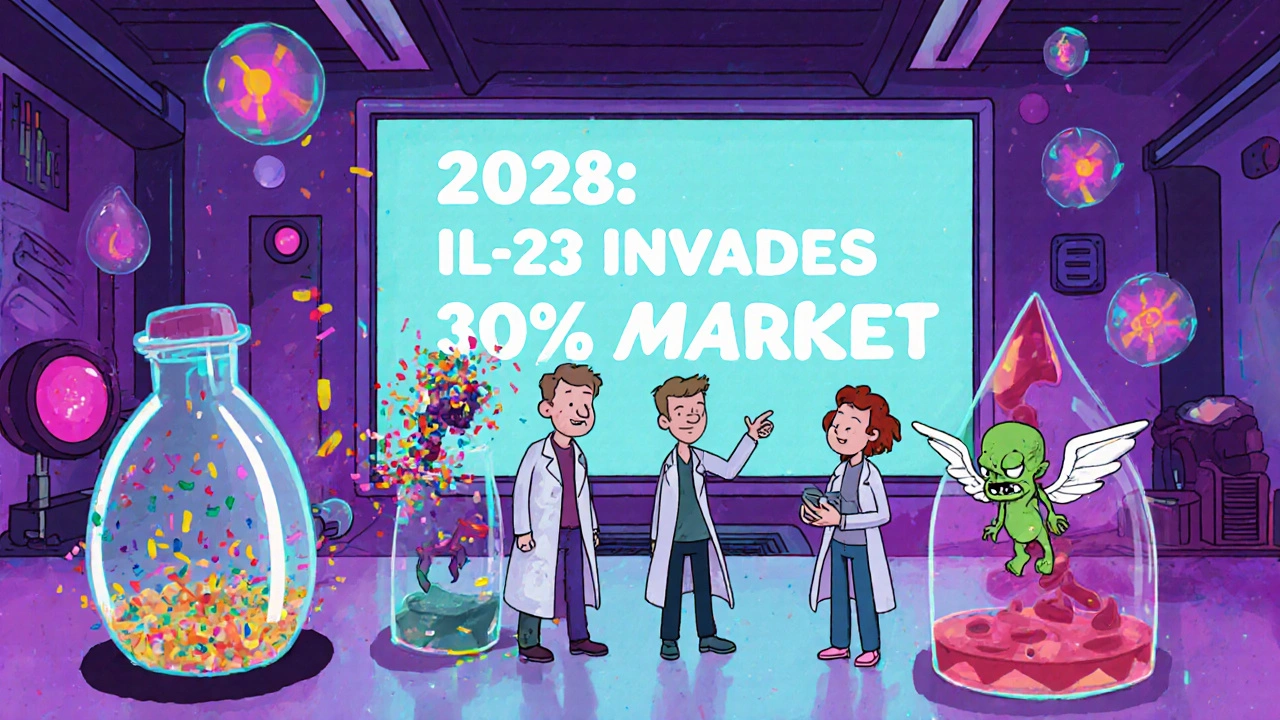
These drugs are proving safer than anti-TNFs. No increased risk of serious infections or cancer in long-term studies. They’re also easy to use: monthly or bi-monthly injections you can do at home. That’s why they’re growing fastest in the market - up 25% annually. Experts predict they’ll make up 30% of the biologic market by 2028.
Which One Works Best? The Evidence
There’s no single “best” biologic. It depends on your disease, lifestyle, and risks.
For someone with moderate to severe Crohn’s who’s never tried a biologic, infliximab still has the strongest evidence for getting you into remission. In head-to-head comparisons, it outperforms adalimumab in healing the gut and reducing hospitalizations. But if you hate clinics and want to manage your treatment at home, adalimumab or ustekinumab might be better.
Vedolizumab shines for people who need a safer option - especially if they’ve had infections before or have other autoimmune conditions. It’s less likely to cause systemic side effects. IL-23 inhibitors like risankizumab are becoming the go-to for patients who’ve failed other biologics or want long-term safety without constant monitoring.
One thing to remember: network meta-analyses - the studies that compare drugs across different trials - have limits. They can’t account for individual differences in how your body responds. That’s why real-world experience matters. A 2023 survey found that 78% of patients care more about effectiveness than convenience. But 63% would switch just to avoid infusions.
Cost, Access, and Practical Hurdles
These drugs aren’t cheap. A single dose of vedolizumab costs about $5,500. Ustekinumab runs around $7,200. Even with insurance, out-of-pocket costs can hit $500 a month. But most manufacturers offer assistance programs - Janssen’s Janssen CarePath helps 95% of eligible patients pay $0-$5 per infusion.
Time is another hidden cost. Infusions take 2-4 hours, plus travel. You need to be at the clinic every 8 weeks. Self-injections take minutes but require training and steady nerves. About 22% of patients develop injection anxiety. Apps like MyTherapy help 68% stay on track.
Insurance barriers are real. One in four IBD patients report being denied coverage for biologics. If you’re stuck, the Crohn’s & Colitis Foundation’s IBD Help Center (888-694-8872) can guide you through appeals.
What Comes Next?
The future of IBD treatment is personalization. Researchers are looking at biomarkers - like blood tests or stool samples - to predict who will respond to which drug. Trials like RHEA and VEGA are comparing biologics head-to-head, with results expected by 2026.
Drugs like etrolizumab (targeting a different gut-specific pathway) are in late-stage trials. New oral options are also coming, which could replace injections entirely. But for now, biologics remain the most powerful tools we have to get people off steroids, into remission, and back to living.
What’s clear is that no one drug fits everyone. Your choice should match your disease severity, your tolerance for side effects, your daily life, and your long-term goals. Talk to your gastroenterologist about your priorities - not just what’s newest, but what’s right for you.


Sammy Williams
November 21, 2025 AT 18:23Been on Humira for 3 years now and honestly? It’s been a game-changer. No more midnight cramps, no more running to the bathroom during Zoom calls. Yeah, the injections suck, but I’d rather poke myself than go back to steroids.
Julia Strothers
November 23, 2025 AT 12:25Biologics? More like Big Pharma’s latest money grab. They don’t care if you live or die - they just want you hooked on $7k/month shots while they lobby Congress to keep prices sky-high. The CDC’s own data shows these drugs spike cancer rates, but you won’t hear that from your GI. They’re paid off.
Nikhil Purohit
November 24, 2025 AT 09:43As someone from India where these meds are almost unaffordable without assistance programs, I’m so glad you mentioned Janssen CarePath. My cousin got Stelara for $5/month through it. Also, vedolizumab is way more accessible here now thanks to biosimilars. Big thanks for the practical info - this is what real patient help looks like.
Franck Emma
November 26, 2025 AT 00:37I hate infusions. Like, deeply, soul-crushingly hate them. The waiting room, the nurses, the IV leak last time - I cried in the car afterward. Switched to Skyrizi and now I do it in my pajamas while watching Netflix. Best decision ever.
Noah Fitzsimmons
November 27, 2025 AT 01:55Wow, another article that sounds like a drug rep wrote it. ‘IL-23 inhibitors are safer?’ Sure. And I’m the Queen of England. You think they didn’t cherry-pick trials where patients didn’t get PML or liver failure? They bury the bad data in supplements nobody reads. Wake up.
Eliza Oakes
November 28, 2025 AT 02:52Wait - so you’re telling me the ‘newest’ drug is actually better than the ‘first-line’ one? That’s not how medicine works. If infliximab was so great, why did they invent 3 new ones? Coincidence? Or is this just corporate obsolescence dressed up as progress?
Erika Sta. Maria
November 30, 2025 AT 02:49Biologics are just a fancy way to say ‘your immune system is broken so we’ll pay Big Pharma to babysit it’… also, why do they always say ‘talk to your doctor’ like that’s a magic spell? My doc just shrugs and says ‘try the one your insurance covers’…
Mark Kahn
November 30, 2025 AT 10:36Hey, if you're thinking about switching - don’t rush. Give each drug at least 12 weeks. I switched from Humira to Stelara too early and thought it wasn’t working. Turned out I just needed time. Your body’s not a light switch.
Daisy L
December 2, 2025 AT 04:57Let’s be real - if you’re still on steroids, you’re basically playing Russian roulette with your kidneys, bones, and sanity. Biologics aren’t perfect, but they’re the only thing keeping me off a feeding tube. And yes - I cried when I got my first infusion. But I also cried when I ate pizza without pain for the first time in 5 years. Worth it.
Anne Nylander
December 2, 2025 AT 06:25i switched to entyvio after 2 yrs of humira and now i dont even think about my iBD most days. its slow but its real. also the nurse at my clinic gave me stickers for my injection log and i love it??
Swati Jain
December 3, 2025 AT 05:19Let’s not ignore the pharmacoeconomic elephant in the room: IL-23 inhibitors are the future because they’re cost-effective at scale. The marginal benefit-to-cost ratio is 3.7x better than anti-TNFs in real-world cohorts. Also - ‘injection anxiety’? That’s just fear of needles. Get over it. Or use numbing patches. Problem solved.
Florian Moser
December 4, 2025 AT 10:17For anyone nervous about starting biologics - you’re not alone. But the data doesn’t lie: remission rates jump from 15% with conventional therapy to 50%+ with biologics. This isn’t a luxury - it’s a lifeline. Trust the science, not the fear.
jim cerqua
December 5, 2025 AT 21:10My mom got sepsis from a biologic. She was 62. They told her it was ‘rare.’ Rare doesn’t mean ‘won’t happen to you.’ Now I’m terrified to even look at a needle. And you want me to trust a 29% remission rate? What about the 71% who still suffer? What about the ones who die?
Donald Frantz
December 6, 2025 AT 04:08Just read the FDA’s 2023 safety report on Skyrizi - no increased malignancy signal across 1,200 patients over 2 years. The data’s solid. Stop conflating anecdotal fear with population-level risk. Your doctor isn’t lying - you’re just scared of progress.
Debanjan Banerjee
December 7, 2025 AT 00:41From India - I’ve seen patients in rural clinics get biosimilar infliximab for $120 per dose. The system here is broken, but access is possible if you know where to look. Also - the real hero is not the drug, it’s the nurse who teaches you to inject yourself. Never underestimate the human touch in this fight.