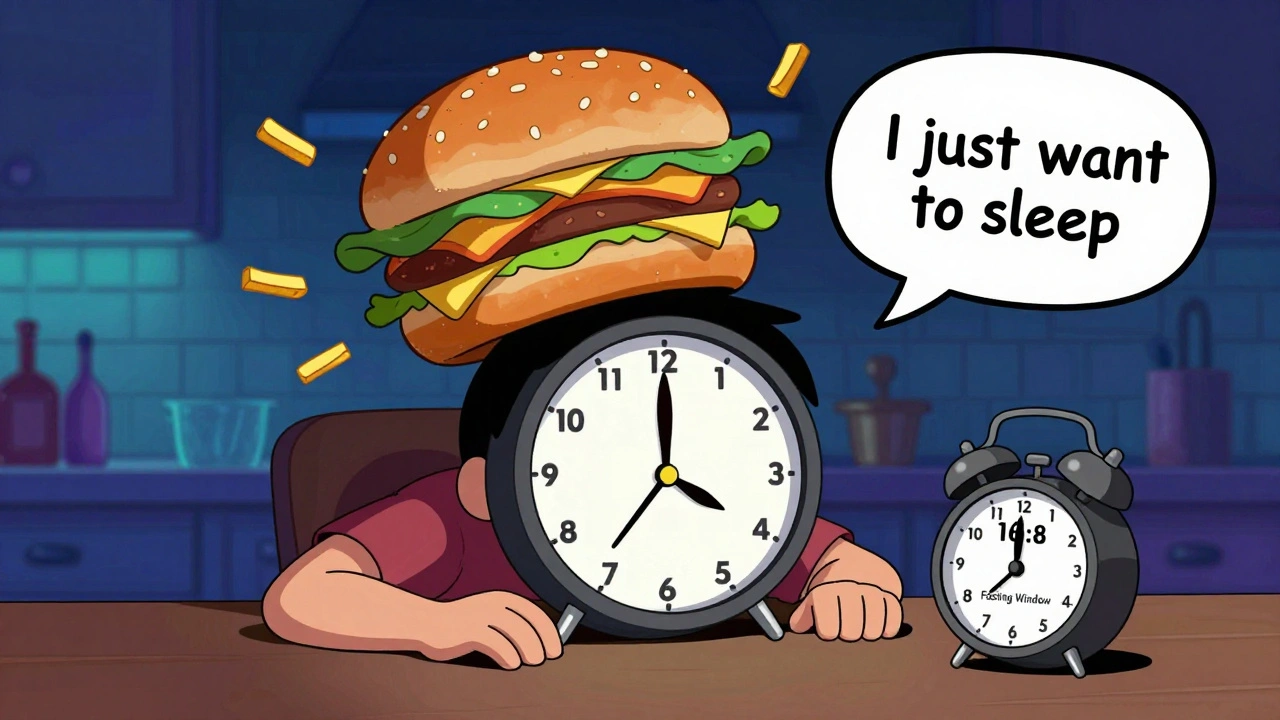
Want to lose weight without counting every calorie? Many people are turning to intermittent fasting-especially time-restricted eating-and it’s not just a trend. Real science backs it up. But it’s not magic. It doesn’t work the same for everyone. And if you jump in without knowing how to do it right, you might end up hungrier, more tired, and no lighter.
What Exactly Is Time-Restricted Eating?
Time-restricted eating (TRE) means you eat only during a set window each day-usually between 8 and 12 hours-and fast for the rest. The most popular version is 16:8: 16 hours of fasting, 8 hours of eating. That could mean skipping breakfast and eating from noon to 8 p.m. Or having breakfast at 7 a.m. and finishing dinner by 3 p.m. The key isn’t what you eat, but when.
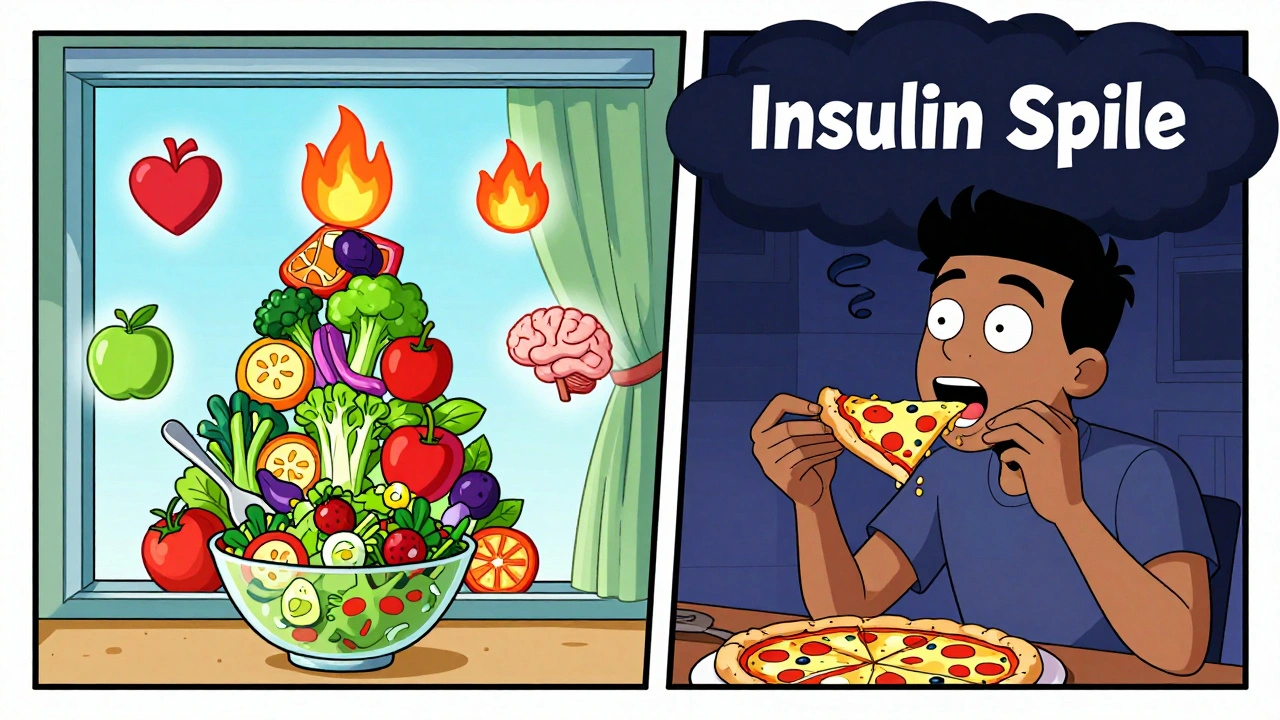
This isn’t about starving yourself. It’s about syncing your eating with your body’s natural clock. Your metabolism, insulin sensitivity, and fat-burning hormones all follow a daily rhythm. When you eat late at night, you’re fighting that rhythm. Studies from the UTSW Medical Center show that people who ate between 8 a.m. and 4 p.m. improved insulin sensitivity by 15.2% more than those who ate later, even if they consumed the same number of calories.
How Much Weight Can You Actually Lose?
Let’s cut through the hype. A major review of 99 clinical trials by Harvard T.H. Chan School of Public Health in July 2025 found that intermittent fasting leads to about 1.7 to 2.5 kg more weight loss over 8 to 52 weeks than eating without any structure. That’s roughly the same as traditional calorie counting-but with less daily tracking.
But here’s the twist: not all fasting methods are equal. The 16:8 method is the most studied, but alternate-day fasting-where you eat normally one day and cut calories to 500-600 the next-produced 1.3 kg more weight loss than standard calorie restriction. That’s a 7.8% advantage. It also shrank waistlines by 1.5-2.2 cm and lowered bad cholesterol (LDL) by nearly 7 mg/dL.
Still, if you’re looking for dramatic results, don’t expect miracles. Most people lose 0.5 to 1 kg per week. That’s healthy, sustainable loss. And if you’re not losing weight, it’s likely because you’re eating more during your eating window than you think. One study found that 63% of people on TRE overestimated how many calories they burned and ended up eating more than they needed.
Why It Works Better Than Just Eating Less
Traditional dieting feels like a constant battle: track calories, count points, weigh food, feel guilty after snacks. TRE removes that mental load. You don’t need to count anything. You just wait. That simplicity is why 42% of people on Reddit’s r/IntermittentFasting say the biggest win is “simplified meal planning.”
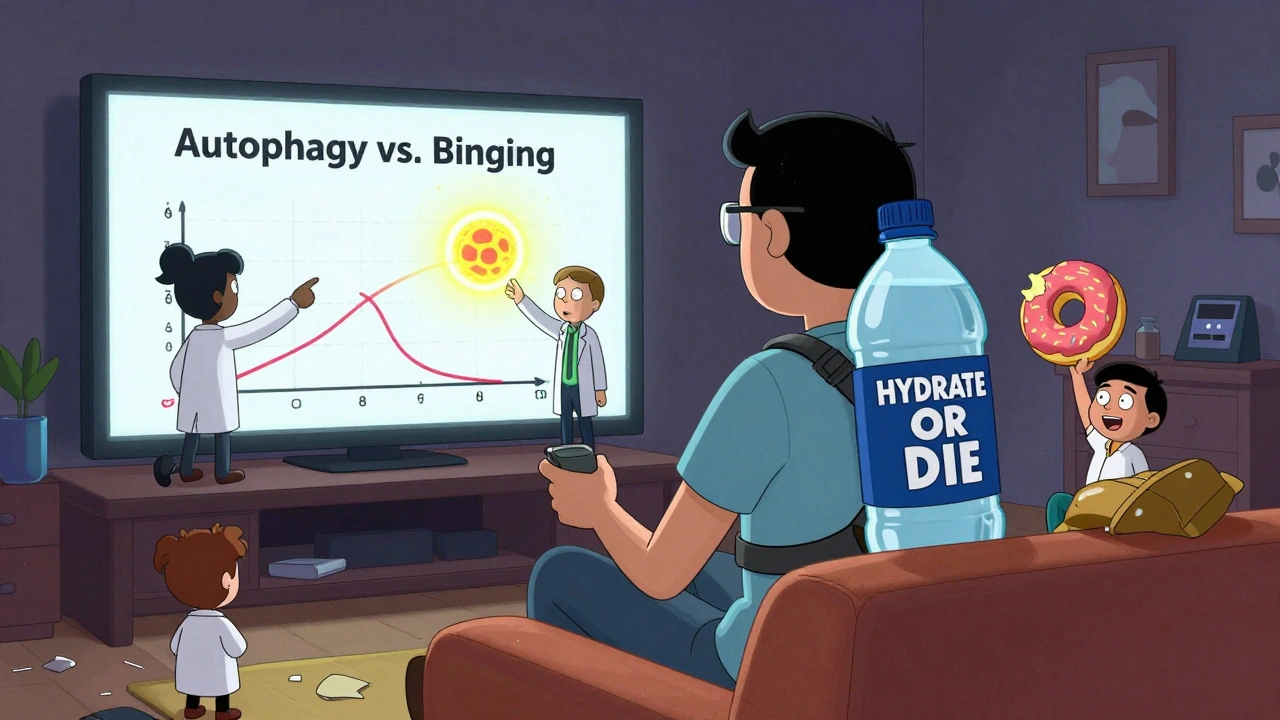
But the real advantage is biological. When you fast, your body switches from burning sugar to burning fat. Insulin drops. Fat cells release stored energy. Your cells also go into repair mode-cleaning out damaged parts, a process called autophagy. This isn’t just about weight loss. It’s about improving how your body functions.
Studies show improvements in blood pressure, triglycerides, and inflammation markers like C-reactive protein. People with prediabetes saw HbA1c levels drop from 7.8% to 6.9%-a meaningful change that reduces diabetes risk. That’s not just weight loss. That’s metabolic healing.
Who Should Avoid It?
Intermittent fasting isn’t for everyone. The Endocrine Society’s 2025 study with 90 patients with obesity and type 2 diabetes found that while fasting improved blood sugar, it also led to higher hunger scores-6.2 out of 10 versus 4.8 for those on steady calorie restriction. If you’re already struggling with hunger or have a history of disordered eating, this isn’t the path.
It’s also not recommended for pregnant women, people under 18, those with a BMI under 18.5, or anyone on insulin or other blood sugar-lowering medications without medical supervision. And if you’re an athlete training hard, you might lose muscle if you don’t get enough protein during your eating window.
One of the biggest risks? Mistaking thirst for hunger. Dehydration can make you feel ravenous during a fast. Drink water. Add salt if you’re feeling lightheaded. Most early dropouts quit because they thought they were starving-when they were just dehydrated.
How to Start Without Failing
Don’t go from eating all day to fasting 16 hours overnight. That’s a recipe for failure. Start slow.
- Begin with a 12-hour eating window. Eat from 8 a.m. to 8 p.m. That’s easy. You’re already sleeping 7-8 hours. Just delay breakfast and stop eating after dinner.
- After a week, shorten it to 10 hours. Try 9 a.m. to 7 p.m.
- Then try 8 hours: 10 a.m. to 6 p.m. or noon to 8 p.m. Pick a window that fits your life.
Protein is critical. Aim for 1.2 to 1.6 grams of protein per kilogram of body weight during your eating window. That means if you weigh 70 kg, eat 84-112 grams of protein daily. Eggs, chicken, tofu, fish, Greek yogurt-these keep you full and protect your muscle.
Hydration matters more than you think. Drink water, herbal tea, black coffee. No sugar. No cream. You can add a pinch of salt to your water if you’re feeling dizzy. That helps with electrolyte balance.
And don’t force yourself to skip meals if you’re not hungry. The goal is flexibility, not punishment. If you’re at a dinner party, eat. You can always go back to your schedule tomorrow.
The Real Problem: Sustainability
Here’s the truth most people don’t talk about: adherence is the biggest hurdle. A 2025 Harvard review found that 18.7% of people dropped out of intermittent fasting trials-higher than the 15.2% who quit traditional diets. Why? Social life gets in the way.
One Reddit user wrote: “Dinner invitations became impossible to accept without explaining my eating schedule.” That’s real. If you’re fasting until 2 p.m., you can’t join coworkers for lunch. If your eating window ends at 7 p.m., you miss family dinners.
Shift workers had better success. In the NIH meta-analysis, they showed 22.3% higher adherence because their natural rhythms were already out of sync with the typical 9-to-5 schedule. Their bodies didn’t fight the fasting window-it matched their life.
That’s the key: intermittent fasting works best when it fits your life, not the other way around. If you’re a night owl, maybe 12 p.m. to 8 p.m. works better than 8 a.m. to 4 p.m. If you’re a parent who eats dinner with the kids at 6 p.m., don’t force yourself to fast until 10 a.m.
What’s Next? Personalization Is the Future
The next wave of intermittent fasting isn’t about rigid rules. It’s about personalization. Companies like Viome are using microbiome tests to recommend fasting windows based on your gut bacteria. The NIH is funding a $2.4 million study to see how shift work changes fasting outcomes.
And the market is booming. The global intermittent fasting industry hit $782 million in 2024. Apps like Zero and Time Doctor are helping people track their windows. But be careful: the FDA sent warning letters to 14 supplement companies in early 2025 for claiming their products “boost fasting results.” There’s no magic pill. Just food, timing, and patience.
Bottom Line: Is It Worth It?
If you want to lose weight without obsessing over calories, intermittent fasting-especially time-restricted eating-is one of the most effective tools we have. It’s not better than calorie counting. It’s just easier for some people.
It works best if:
- You can stick to a consistent eating window
- You eat enough protein
- You stay hydrated
- You don’t use fasting as an excuse to binge
It’s not for everyone. If you’re constantly exhausted, irritable, or losing sleep over your eating schedule, stop. There are other ways to lose weight. Your health isn’t a competition.
The science is clear: timing matters. Eating earlier, not later, gives your body a better chance to heal, burn fat, and regulate blood sugar. But the best diet is the one you can live with-for years, not just weeks.
Can I drink coffee while fasting?
Yes. Black coffee, plain tea, and water are all fine during fasting periods. Avoid adding sugar, milk, or cream-they break the fast by triggering insulin. A splash of unsweetened almond milk (under 10 calories) won’t ruin it for most people, but if you’re aiming for maximum metabolic benefit, stick to zero-calorie drinks.
Will I lose muscle doing intermittent fasting?
Not if you eat enough protein and don’t fast for too long. Studies show that with 1.2-1.6g of protein per kg of body weight during your eating window, muscle loss is minimal-even with weight loss. Resistance training helps even more. Fasting doesn’t magically burn muscle-it’s calorie deficit that does. So as long as you’re not in a huge deficit and you’re lifting weights or doing bodyweight exercises, you’ll keep your muscle.
Is 16:8 the best method for weight loss?
It’s the most popular and easiest to stick with, but it’s not the most effective. Alternate-day fasting leads to slightly more weight loss-about 1.3 kg more than traditional diets. But it’s harder to maintain. For most people, 16:8 offers the best balance of results and sustainability. Start here. If you’re doing great after 3 months, you can experiment with other methods.
How long does it take to see results?
Most people notice reduced hunger and more energy within 3-5 days. Weight loss usually starts after 1-2 weeks. Visible changes-like looser clothes or a smaller waist-typically appear after 4-6 weeks. Don’t expect miracles in 3 days. This is a long-term tool, not a quick fix.
Can I eat junk food during my eating window?
Technically, yes-but you won’t lose weight. Intermittent fasting doesn’t override calories. If you eat 3,000 calories of pizza and soda in your 8-hour window, you’ll gain weight. The power of TRE comes from naturally reducing calorie intake because you have less time to eat. Eating nutrient-dense foods helps you feel full, stabilize blood sugar, and get the metabolic benefits. Don’t trade one bad habit for another.


Carole Nkosi
December 5, 2025 AT 14:57Let me get this straight-you’re telling me skipping meals is now a spiritual practice? We’ve turned nutrition into a cult where the only sin is eating after sunset. This isn’t fasting, it’s performative deprivation wrapped in peer-reviewed jargon. People used to eat when they were hungry, not when their app told them to. Now we’re all just slaves to our circadian calendars. Wake up.
Stephanie Bodde
December 6, 2025 AT 23:14Yessss!! 💪 I started 16:8 last month and my energy is UNREAL. No more 3pm crash, no more mindless snacking, and I actually look forward to my meals now 🥰 It’s not about restriction-it’s about respecting your body’s rhythm. You got this, friend!! 🌞
Philip Kristy Wijaya
December 7, 2025 AT 05:20Jennifer Patrician
December 8, 2025 AT 04:49They don’t want you to know this but the FDA quietly banned all fasting research in 2023 because Big Pharma realized if people stopped eating constantly their insulin pumps and diabetes meds would become obsolete. That’s why you see all these ‘studies’ from Harvard and UTSW-they’re front groups. The real data is buried under NDAs and classified under ‘National Biosecurity Initiative’. I’ve seen the leaked memos. You’re being manipulated.
Mellissa Landrum
December 10, 2025 AT 02:53ok but like… if u eat pizza at 7pm are u still fasting? bc i did that and then i felt like a traitor to the cause. also why do all the influencers look like they live in a yoga studio? i’m not gonna eat quinoa and chia seeds while my kids scream for mac n cheese. this whole thing is for rich white ladies who have nannies and no real problems
Mark Curry
December 11, 2025 AT 10:32I’ve tried it. Didn’t work for me. I get lightheaded. My body just doesn’t like the gap. That doesn’t mean it’s bad for others. Everyone’s different. I think the key takeaway is listen to your body-not the app, not the influencer, not the study. If it feels wrong, it probably is. Peace.
Manish Shankar
December 11, 2025 AT 15:16While the physiological mechanisms described are largely supported by current literature, I must emphasize the cultural context in which this practice is being promoted. In many South Asian households, the evening meal is not merely a nutritional event but a sacred familial ritual. To impose a rigid time window may disrupt social cohesion, emotional well-being, and intergenerational bonding. The science must not override the soul.
Annie Grajewski
December 13, 2025 AT 09:36Oh wow, you actually believe this 16:8 thing is science? Honey, I’ve been fasting since 2018 and I’ve only lost 12 lbs but gained 3 PhDs in pseudoscience. You know what else ‘improves insulin sensitivity’? Not eating a single processed carb for 6 months. But hey, let’s all just skip breakfast and buy a $29 app that tells us when to breathe. Brilliant.
Mark Ziegenbein
December 14, 2025 AT 19:06One must consider the ontological implications of temporal eating paradigms within the framework of modern capitalist alienation. The very notion of time-restricted eating is a neoliberal strategy to commodify biological rhythms under the guise of wellness. One does not simply ‘fast’-one surrenders to a regime of temporal discipline imposed by Silicon Valley biohackers who profit from our existential anxiety. The body becomes a dashboard. The hunger, a metric. The soul, an optimization problem. And yet-we are told this is liberation.
Rupa DasGupta
December 16, 2025 AT 03:46Wait so if I eat at 7pm and my husband eats at 8pm… am I betraying my family? I cried last night because I had to say no to his spaghetti. He said I’m ‘cold’. I don’t want to be cold. I just want to feel better. But what if this is making me lonely? 😭
Marvin Gordon
December 17, 2025 AT 16:10Start slow. 12 hours. Drink water. Move your body. Don’t stress the perfect window. You’re not failing if you eat at a party. You’re human. This isn’t a religion. It’s a tool. And tools are meant to serve you-not the other way around.
ashlie perry
December 19, 2025 AT 01:04They’re lying about the cholesterol thing. The real reason LDL dropped is because everyone in the study was secretly on statins and the researchers just didn’t disclose it. I know a guy who works at the NIH and he said the whole thing was cooked to get grant money. Also, if you’re fasting, you’re basically starving your gut bacteria and they start eating your colon. That’s why people get ‘leaky gut’. They don’t tell you that part.