When your heart skips, races, or feels like it’s fluttering in your chest, it’s not just uncomfortable-it’s dangerous. Atrial fibrillation (AFib) is the most common heart rhythm disorder, affecting millions worldwide. Left untreated, it raises your risk of stroke by four to five times and increases your chance of dying by nearly double. But here’s the thing: not all AFib treatments are the same. Two main strategies exist-rate control and rhythm control-and the choice between them isn’t just about medication. It’s about your age, symptoms, heart health, and long-term survival.
What Is Rate Control?
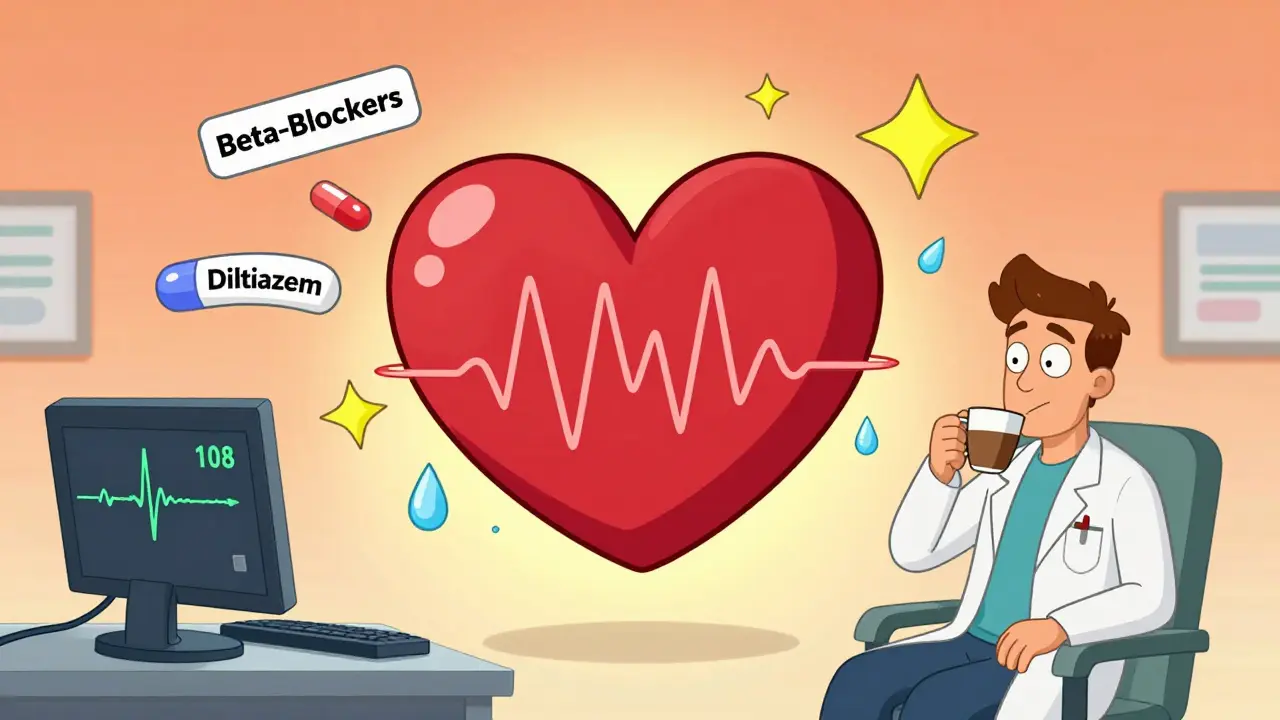
Rate control means letting your heart stay in AFib but slowing down how fast it beats. You’re not trying to fix the rhythm. You’re managing the damage. The goal? Keep your resting heart rate below 110 beats per minute. Surprisingly, you don’t even need to get it down to 80. The RACE II trial proved that lenient control-keeping it under 110-is just as safe as strict control under 80 when it comes to preventing hospital stays, heart failure, or strokes.Doctors usually start with beta-blockers like metoprolol or calcium channel blockers like diltiazem. These drugs calm the electrical signals between your upper and lower heart chambers. Digoxin is another option, especially for older patients or those with heart failure, but it’s less effective in active people. Amiodarone, though powerful, is reserved for emergencies because of its long-term side effects on the lungs, liver, and thyroid.
Rate control is simple. It’s often the first move for people over 75, those with few symptoms, or those with other serious health problems. Why? Because antiarrhythmic drugs used in rhythm control can be risky. They can cause new rhythm problems, make heart failure worse, or even trigger dangerous heart rhythms. For many, rate control is the smart, safe starting point.
What Is Rhythm Control?
Rhythm control is the opposite: you’re trying to restore and keep your heart in its normal rhythm-sinus rhythm. This isn’t just about feeling better. New evidence shows it can save lives.There are two ways to do this: drugs or procedures. Antiarrhythmic drugs like flecainide, propafenone, or dronedarone help maintain normal rhythm. But they’re not magic. They can cause side effects, and over time, many people’s AFib comes back. Then there’s catheter ablation-a procedure where doctors use heat or cold to destroy tiny areas of heart tissue causing the faulty signals. Today, complications are under 5%, down from over 20% in the early 2000s. Electrical cardioversion, a quick electric shock to reset the rhythm, is often used first to get you back into rhythm, then drugs or ablation help you stay there.
The big shift came in 2020 with the EAST-AFNET 4 trial. Researchers followed nearly 2,800 people with newly diagnosed AFib for over five years. Half got early rhythm control-within 12 months of diagnosis. The other half got standard rate control. The results? Those who got early rhythm control had 21% fewer heart-related deaths, strokes, heart failure hospitalizations, or heart attacks. That’s not a small win. It’s a game-changer.
Stroke Prevention: The One Thing Both Strategies Share
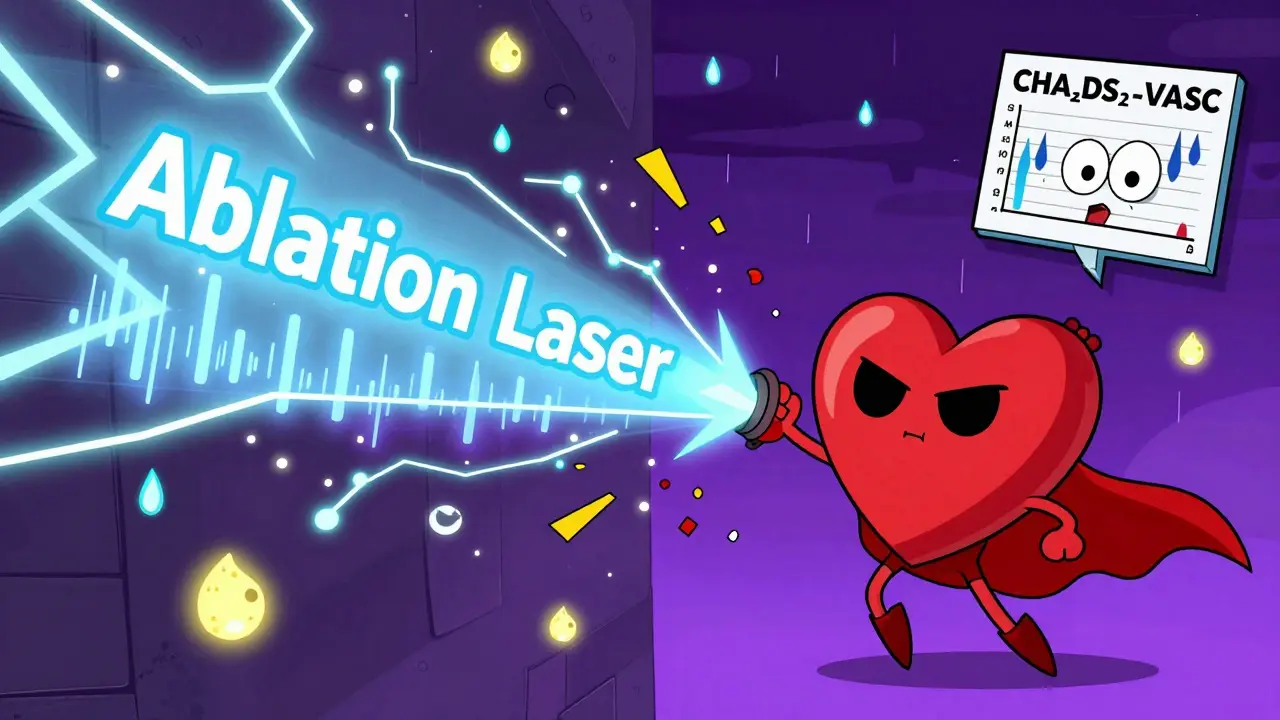
No matter which path you take-rate or rhythm control-you still need anticoagulants. Why? Because AFib doesn’t just mess up your heartbeat. It lets blood pool in the heart’s upper chambers, where clots can form. If one breaks loose, it can travel to your brain and cause a stroke.The AFFIRM trial showed most strokes happened when patients stopped their blood thinners or didn’t take them properly. That’s why doctors use the CHA₂DS₂-VASc score to figure out your stroke risk. If your score is 2 or higher, you’re almost always on a blood thinner like apixaban, rivaroxaban, or dabigatran. Even if your rhythm is normal after ablation, you still need to stay on anticoagulation for at least a few months-sometimes longer.
Here’s the truth: rhythm control doesn’t eliminate stroke risk. It reduces it slightly by keeping your heart in rhythm longer, but anticoagulation remains the cornerstone. Skipping it because you “feel fine” or “got your rhythm back” is a dangerous mistake.
Who Gets Which Treatment?
There’s no one-size-fits-all. Your treatment depends on your life, your body, and your goals.Rate control is often best for:
- People over 75
- Those with few or no symptoms
- Patients with multiple health problems (like kidney disease or lung disease)
- Those with permanent AFib that’s unlikely to go back to normal
Rhythm control is preferred for:
- People under 65
- Those with paroxysmal AFib (comes and goes)
- Anyone with heart failure-even if their pumping strength is normal
- Patients with high CHA₂DS₂-VASc scores (2 or more)
- Anyone whose quality of life suffers despite rate control
The 2023 European Society of Cardiology guidelines now say: if you’ve been diagnosed with AFib, consider rhythm control early-no matter how mild your symptoms. That’s a huge change from just a few years ago, when rhythm control was seen as a last resort.
Why the Change? New Tools, New Evidence
The old trials-AFFIRM, RACE, AF-CHF-were done in the 2000s. Back then, ablation was risky. Drugs like amiodarone were the only real option, and they came with heavy side effects. The results? No big difference in survival between rate and rhythm control.But today? Ablation is safer, faster, and more effective. New drugs like dronedarone and vernakalant have fewer side effects. And the EAST-AFNET 4 trial proved that acting early-before AFib damages your heart further-makes a real difference.
Think of it like high blood pressure. You don’t wait until you have a heart attack to start treatment. You act early to prevent damage. The same logic now applies to AFib. If you’re diagnosed, especially under 75, getting rhythm control within the first year might protect your heart long-term.
The Future: Personalized Care
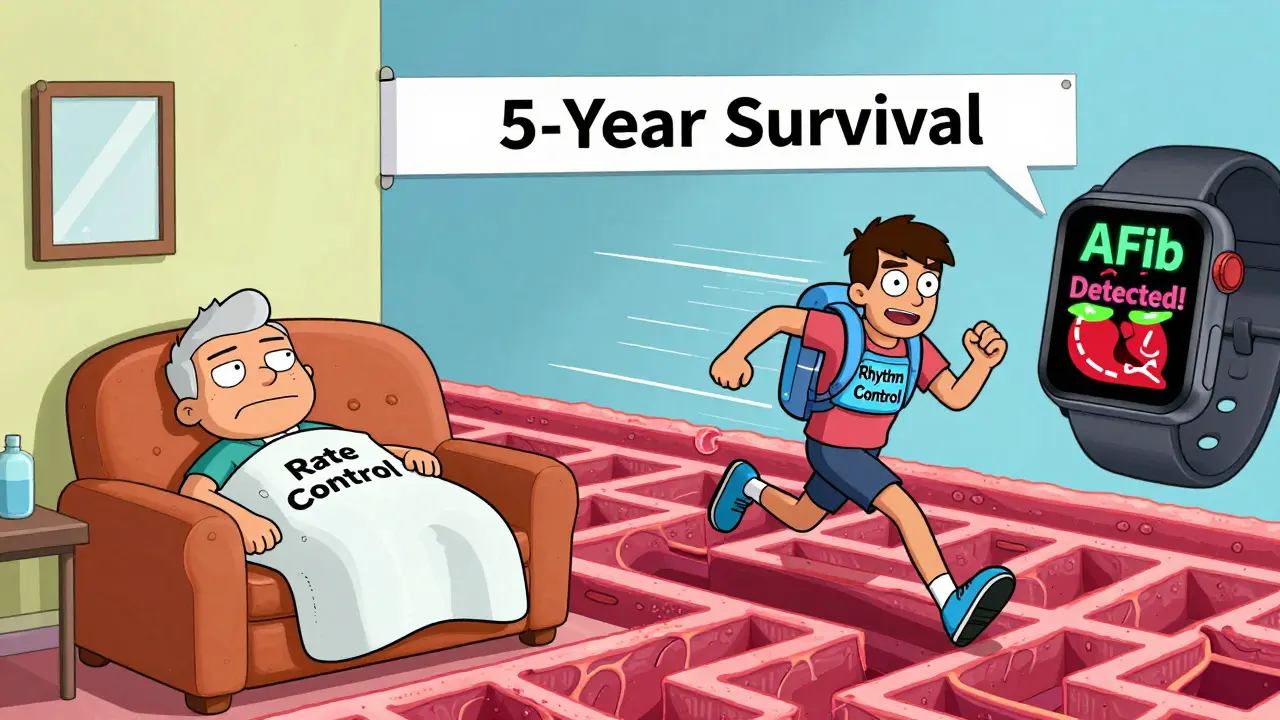
The next frontier is personalization. Not everyone benefits equally from rhythm control. Younger patients with no other heart disease respond best. Older patients with advanced heart failure? The data is still mixed. That’s why trials like ASSERT II are underway-testing whether early ablation helps people with AFib and preserved heart pumping function.Doctors are also using AI and wearable tech to catch AFib earlier. Smartwatches now detect irregular pulses, and some can even flag AFib before you feel anything. That means more people are being diagnosed at the earliest stage-when rhythm control works best.
One thing’s clear: the days of treating all AFib the same are over. Rate control isn’t outdated-it’s still vital for many. But rhythm control is no longer a backup plan. It’s a frontline option, especially when started early.
What Should You Do?
If you’ve been diagnosed with AFib, ask your doctor these questions:- What’s my CHA₂DS₂-VASc score? Do I need a blood thinner?
- Is my AFib paroxysmal, persistent, or permanent?
- Am I under 75? Do I have heart failure or other heart disease?
- Do my symptoms affect my daily life?
- Is early rhythm control-like ablation-an option for me?
Your heart doesn’t need to be perfect. But it does need to be protected. Whether you choose rate or rhythm control, the goal is the same: live longer, feel better, and stay out of the hospital.
Is rate control safer than rhythm control?
Rate control is generally safer in the short term because it uses fewer high-risk drugs and avoids invasive procedures. But rhythm control, especially with modern ablation, has become much safer than it was 20 years ago. For younger, healthier patients, the long-term benefits of rhythm control-like fewer hospitalizations and lower stroke risk-often outweigh the risks.
Can I stop taking blood thinners if my rhythm is restored?
No, not right away. Even if ablation or cardioversion successfully restores normal rhythm, your stroke risk doesn’t vanish overnight. Guidelines recommend continuing anticoagulants for at least 4 weeks after the procedure, and often longer if your CHA₂DS₂-VASc score is 2 or higher. Always follow your doctor’s advice-stopping blood thinners too soon is a leading cause of AFib-related strokes.
Does rhythm control cure atrial fibrillation?
Not always. Ablation can eliminate AFib for years, especially in younger patients with paroxysmal AFib and no other heart disease. But for many, AFib returns over time. Success rates vary: about 70-80% for paroxysmal AFib after one procedure, and lower for persistent AFib. Multiple procedures may be needed. Rhythm control is about managing the condition, not necessarily curing it.
Why do some doctors still recommend rate control?
Because it works well for many. Older patients, those with multiple health issues, or people with permanent AFib often do fine with rate control. It’s simpler, cheaper, and avoids the risks of drugs or surgery. Guidelines still support it as a first-line option for these groups. The shift to rhythm control doesn’t mean rate control is obsolete-it means we now have better tools to offer more people a better long-term option.
What’s the biggest mistake people make with AFib treatment?
Assuming that if they feel fine, they don’t need treatment. AFib can be silent-no symptoms, but still high stroke risk. Another big mistake is stopping blood thinners because they feel better after cardioversion or ablation. The third is waiting too long to consider rhythm control. Early intervention, especially before the heart changes structurally, gives the best chance for long-term success.
Solomon Ahonsi
February 2, 2026 AT 15:03Rate control is just giving up. Why settle for letting your heart misfire when we’ve got ablation that works? This whole 'it's safer' crap is just old docs clinging to their 2005 textbooks.
George Firican
February 3, 2026 AT 14:10The paradigm shift here is profound-not because the science is new, but because we’ve finally stopped treating AFib as a nuisance to be managed and started treating it as a progressive structural disease that demands early intervention. The EAST-AFNET 4 trial didn’t just add data; it rewrote the moral calculus of care. Delaying rhythm control isn’t just conservative-it’s negligent in patients under 75 with preserved ejection fraction. We’re no longer choosing between comfort and survival; we’re choosing between delayed decline and preserved function. The heart isn’t a car engine you tune up occasionally-it’s a living organ that remodels itself under stress, and every month of uncontrolled fibrillation etches irreversible changes into its tissue.
Matt W
February 5, 2026 AT 06:41My dad had AFib for years on rate control. Felt fine until he had a stroke. Now he’s on anticoagulants, had ablation, and actually walks without getting winded. Don’t wait until you’re in the ER to realize feeling okay doesn’t mean you’re safe.
Becky M.
February 5, 2026 AT 16:26so i just got diagnosed and like... do i really need to be on blood thinners if i dont even feel bad? my doc said yes but i was like wait but my watch says im back to normal now??
jay patel
February 5, 2026 AT 23:00lol at the 'rate control is safer' crowd. you know what's safer? not having your brain turned to mush because you thought 'i feel fine' meant you were cured. ablation isn't magic but neither is ignoring your CHA2DS2-VASc score like it's a spam email. also why is everyone pretending amiodarone is still a good idea? that stuff turns your skin orange and your thyroid into a broken radio.
Ansley Mayson
February 6, 2026 AT 20:49Another overhyped medical trend. Ablation is expensive. Drugs are cheaper. You think the system wants you healthy? No. They want you coming back. Rhythm control is a cash grab dressed up as science.
Chinmoy Kumar
February 7, 2026 AT 05:19Really appreciate this breakdown. I’m 58, had paroxysmal AFib for 3 years, tried metoprolol but still felt like my heart was trying to escape. Did ablation last year-no more episodes, no meds, and I’m back hiking. Still on apixaban for now, but my doc says I might stop in 6 months. This isn’t about being young or old-it’s about listening to your body before it screams.
Brett MacDonald
February 7, 2026 AT 20:47so like... if your heart is out of rhythm but you dont feel it... is it even real? like if a tree falls in the forest and no one feels it... does the stroke still happen?