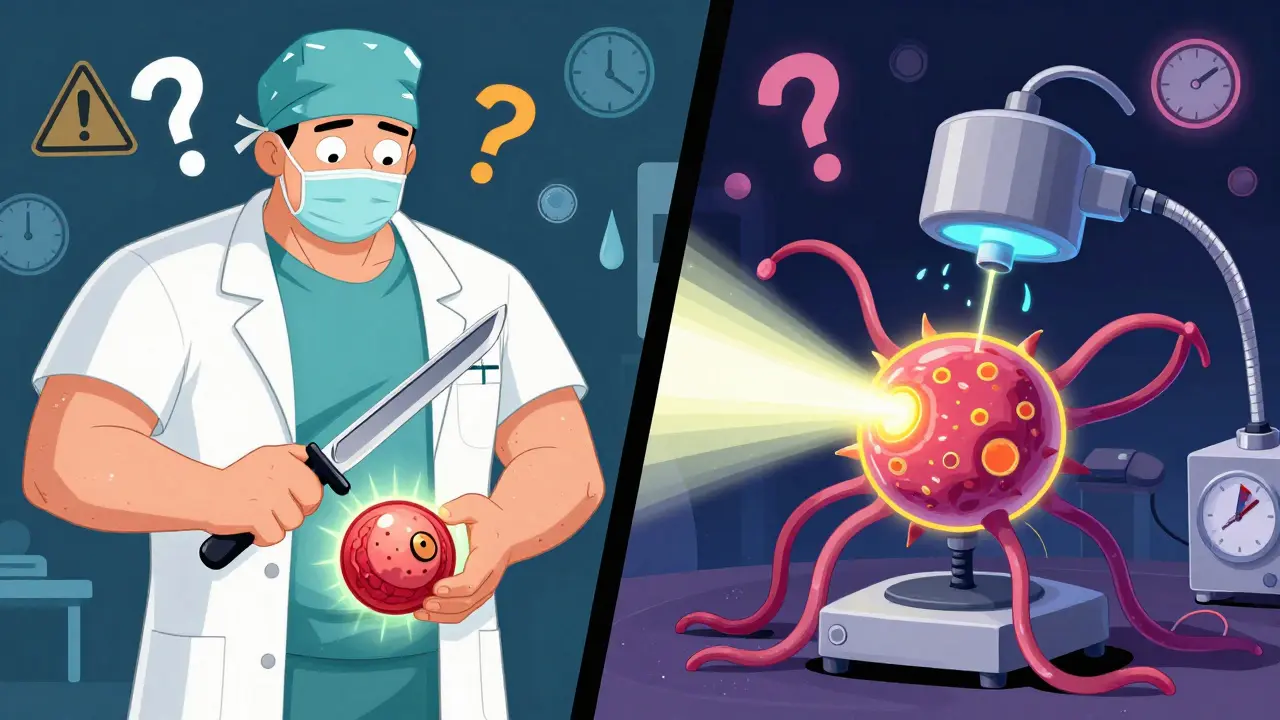
When you’re first told you have localized cancer, one of the first big questions isn’t about survival rates or chemo-it’s about radiation vs. surgery. Which one is right for you? Both aim to remove or destroy the tumor where it started, but they do it in completely different ways. And the choice isn’t just medical-it’s personal.
What Does Local Control Even Mean?
Local control means stopping the cancer where it began. It doesn’t mean curing the whole body-just making sure the tumor in your prostate, lung, or other organ doesn’t keep growing. For many early-stage cancers, that’s the main goal. And for that, radiation and surgery are the two most common tools doctors reach for.
Neither is better across the board. The right choice depends on your cancer type, your age, your other health issues, and even how you feel about spending weeks in and out of a clinic versus recovering from an operation.
Surgery: Remove It All at Once
Surgery means cutting out the tumor and sometimes surrounding tissue. For prostate cancer, that’s a radical prostatectomy. For lung cancer, it could be removing a lobe-or even a whole lung. The idea is simple: if you take it out, it can’t come back.
It’s a one-time event. Most prostate surgeries take 2-4 hours. Lung surgeries can take 3-5 hours. You’ll usually spend a few days in the hospital. Recovery? About 4-8 weeks before you feel like yourself again.
The big advantage? Pathology. When they take out your prostate or lung tissue, they can examine every bit of it under a microscope. That gives you a clear picture of exactly how aggressive the cancer was, whether it had spread just outside the organ, and if you need more treatment after surgery.
But there’s a cost. For prostate cancer, urinary leakage and erectile dysfunction are common in the first year. The NIH study of 1,692 men found that 14% of surgery patients had urinary leakage 10 years later-double the rate of radiation patients. For high-risk cases, that number jumps to 25%. Bowel problems? Less common after surgery than radiation.
For lung cancer, surgery can mean losing lung function. That’s a big deal if you’re older or have COPD. But if you’re healthy enough, it’s often the best shot at long-term survival. One 2022 study of over 30,000 patients showed 71.4% of surgical patients were alive five years later-compared to 55.9% for those who got SBRT radiation instead.
Radiation: Targeted Destruction Without Cutting
Radiation therapy doesn’t remove anything. It kills cancer cells with high-energy beams-like X-rays or protons-focused precisely on the tumor. Modern machines can hit a spot as small as 1-2 millimeters. That’s the size of a grain of rice.
For prostate cancer, it’s usually daily treatments, five days a week, for 7-9 weeks. Each session takes 15-30 minutes. You walk in, lie down, get zapped, and walk out. No hospital stay. No incisions.
For lung cancer, especially if you’re not a surgical candidate, stereotactic body radiation therapy (SBRT) delivers powerful doses in just 1-5 sessions. No cutting. No hospitalization. Recovery? Most people feel fine within days.
The downside? Side effects show up slowly. Radiation damages tissue over time. For prostate cancer, bowel problems are more common after radiation than surgery. About 8% of radiation patients had serious bowel issues 10 years later, compared to 3% after surgery. For high-risk patients on radiation plus hormone therapy, that number climbs to 7%.
And unlike surgery, you don’t get a full tissue sample. You’re trusting the imaging and biopsies done before treatment. That means you can’t be 100% sure how far the cancer spread until it comes back-or doesn’t.
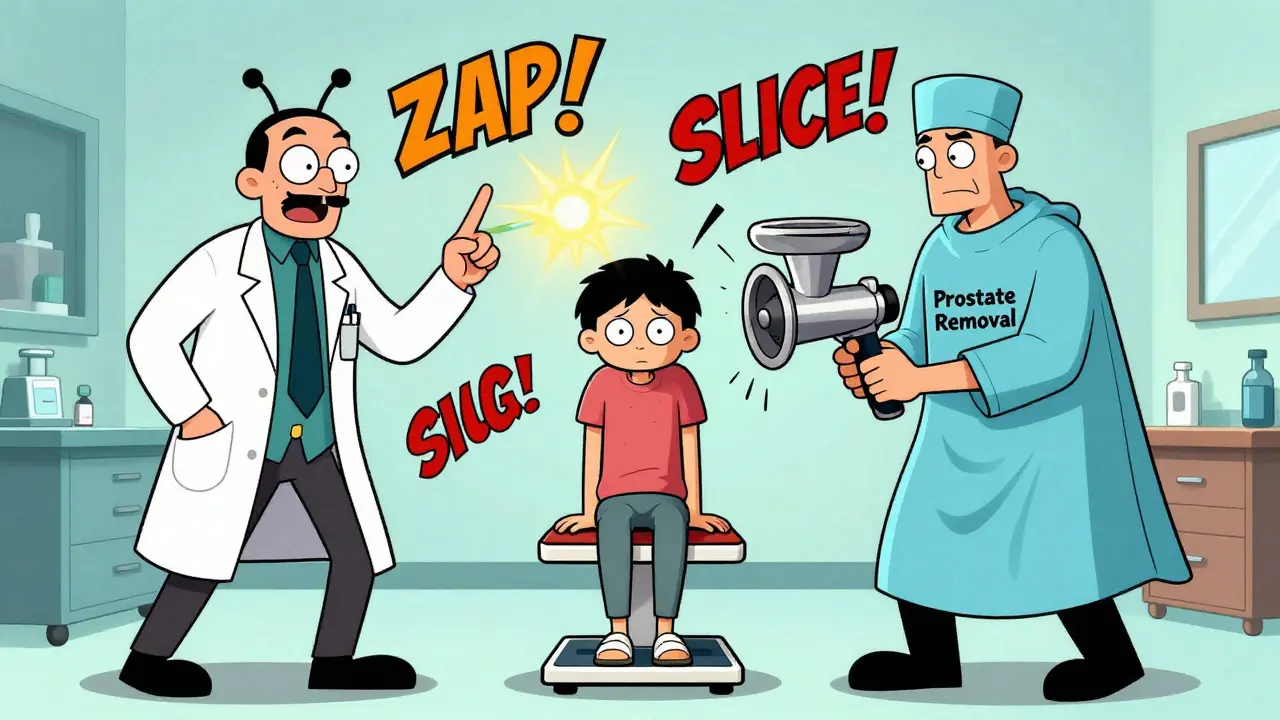
Prostate Cancer: The Data Tells a Nuanced Story
The big 2016 ProtecT trial followed 1,643 men with early-stage prostate cancer for 10 years. Survival was nearly identical: 96.8% after surgery, 95.7% after radiation, 95.8% with active monitoring. So if your goal is just staying alive, both work.
But here’s the twist: cancer came back more often after radiation (13.4%) than after surgery (12.9%). That doesn’t mean you’ll die from it-but it might mean more treatments down the road.
Then there’s the 2010 UCSF study of 91,000 men. It found surgery had better survival for high-risk cases: 62% alive at 15 years vs. 52% for radiation. Why the difference? ProtecT mostly included low-risk men. UCSF’s group had more aggressive cancers.
So if you’re low-risk? Radiation and surgery are both excellent. If you’re high-risk? Surgery might give you a longer edge.
And side effects? Surgery hits sexual and urinary function harder early on. Radiation hits your bowel harder over time. Neither is easy. But if you’re young and active, you might prefer radiation to avoid permanent incontinence. If you’re older and want to avoid weekly trips to the clinic, surgery might be worth the recovery.
Lung Cancer: Surgery Still Leads-If You Can Handle It
For early-stage non-small cell lung cancer, surgery is still the gold standard-if you’re healthy enough. The 2022 analysis of 30,000 patients showed a clear win: 71.4% five-year survival with surgery versus 55.9% with SBRT.
But here’s the catch: SBRT is for people who can’t have surgery. Think heart disease, severe COPD, or just too frail for anesthesia. For those patients, 40-50% five-year survival is still better than most other options.
So if your doctor says you’re operable, surgery is usually the best bet. If you’re not? SBRT is a powerful, non-invasive alternative that’s improved dramatically in the last decade.
What About Newer Options?
Focal therapy for prostate cancer-targeting just the tumor, not the whole gland-is still experimental. The PARTICLE trial, expected to finish in 2025, is comparing it to standard treatments. If it works, it could reduce side effects even further.
Proton beam therapy is another option. It delivers radiation with even less damage to nearby tissue. But it’s expensive and not widely available. For most people, traditional photon radiation works just as well.
How Do You Decide?
There’s no one-size-fits-all answer. But here’s how to think about it:
- Want to get it over with? Surgery is a single event. Radiation takes weeks.
- Prefer to avoid cutting? Radiation lets you keep your organs intact.
- Worried about urinary problems? Radiation has lower risk of leakage, but higher risk of bowel issues.
- High-risk cancer? Surgery may offer a survival advantage.
- Other health problems? If you can’t handle surgery, radiation is your best shot.
And here’s the most important step: talk to both a surgeon and a radiation oncologist. Not just one. The American Society of Clinical Oncology says every patient with localized prostate cancer should have access to both. Why? Because each specialist sees the problem through their own lens. The surgeon sees the tumor as something to cut out. The radiation oncologist sees it as something to zap. Neither has the full picture alone.
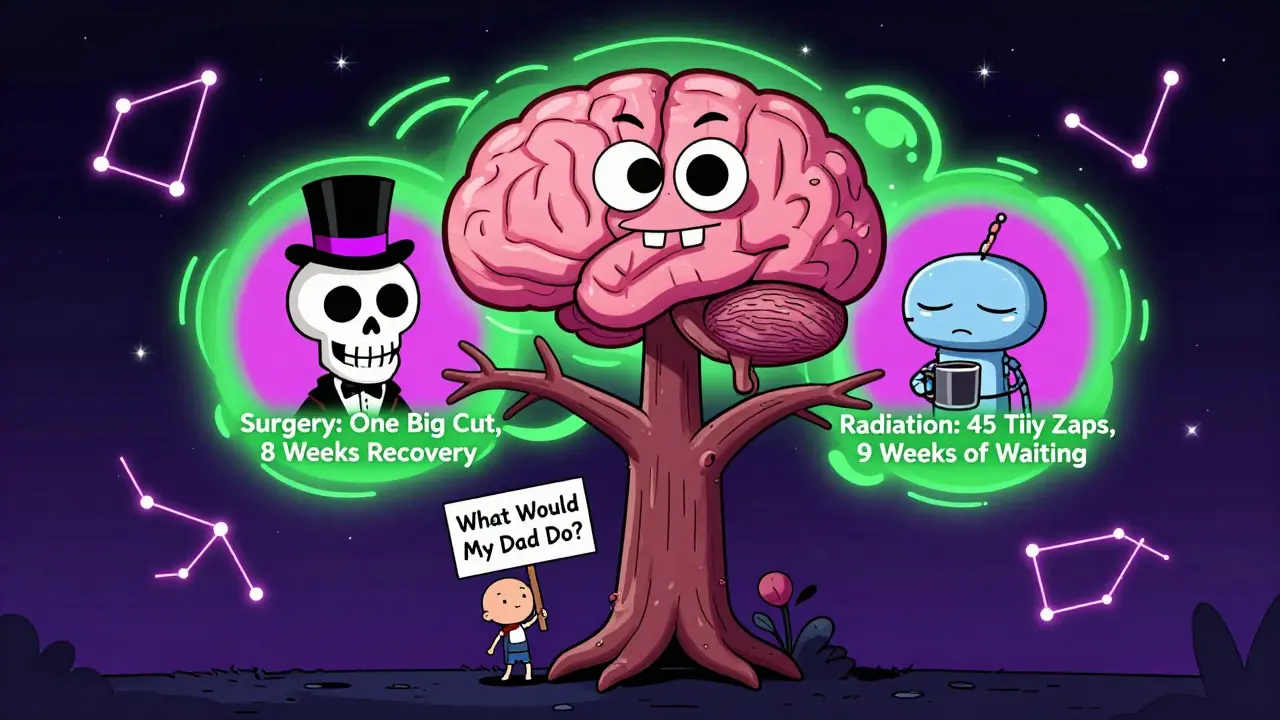
Ask them: “If this were your father or mother, what would you recommend?” That question cuts through the jargon.
Final Thought: It’s Not About Being Right-It’s About Being Right for You
Some people worry they’ll regret their choice. But studies show that most patients are satisfied with whichever path they pick-so long as they understood the trade-offs before starting.
Don’t let fear of surgery push you into radiation if you’re healthy enough to handle it. Don’t let fear of radiation make you choose surgery if you’d rather avoid an operation.
The goal isn’t to pick the “best” treatment. It’s to pick the one that fits your life, your body, and your values. And that’s something only you can decide-with the right information.
Is radiation therapy as effective as surgery for prostate cancer?
For low- and intermediate-risk prostate cancer, radiation and surgery have nearly identical survival rates over 10 years. The ProtecT trial found no significant difference in death rates. But surgery has a slightly lower chance of cancer returning, while radiation has fewer early urinary side effects. For high-risk cases, surgery may offer better long-term survival.
Can I choose radiation if I’m too old for surgery?
Yes. Radiation, especially SBRT, is a standard option for older patients or those with heart or lung conditions that make surgery risky. For early-stage lung cancer, SBRT gives a 40-50% five-year survival rate for patients who can’t have surgery-making it a life-saving alternative.
What are the long-term side effects of radiation for prostate cancer?
The most common long-term side effects are bowel problems, like chronic diarrhea or rectal bleeding, affecting about 8% of patients 10 years after treatment. Urinary issues are less common than after surgery, but erectile dysfunction still occurs in up to 40% of men, depending on age and nerve-sparing techniques.
Does surgery always mean removing the whole prostate?
For localized prostate cancer, yes-standard surgery removes the entire prostate and nearby seminal vesicles. But newer experimental techniques like focal therapy aim to destroy only the tumor area. These are still in clinical trials and not yet standard care.
How long does recovery take after lung cancer surgery?
Hospital stay is usually 3-7 days. Full recovery takes 6-8 weeks. You’ll feel fatigued for months. Breathing exercises and physical therapy help. Most people return to normal activities by 3 months, but heavy lifting and strenuous exercise may need to wait longer.
Why do I need to see both a surgeon and a radiation oncologist?
Each specialist is trained to recommend their own treatment. Surgeons see the tumor as something to remove. Radiation oncologists see it as something to destroy with beams. Only by hearing both sides can you understand the full range of options, risks, and trade-offs. The American Society of Clinical Oncology recommends this dual consultation as standard care.



sue spark
December 16, 2025 AT 10:40Been through both radiation and surgery for prostate cancer and honestly the biggest thing nobody talks about is how much your mental game changes. You think it's about the physical stuff but it's the waiting that breaks you. Radiation feels like a slow drip of dread. Surgery is a punch in the gut and then silence. Neither is easy. I chose surgery because I couldn't stand the idea of going back week after week. Now I'm five years out and I don't regret it. Just know it's not just a medical decision it's an emotional one too.
Tiffany Machelski
December 17, 2025 AT 22:44i read this whole thing and my head is spinning. i have early stage lung cancer and my doc said surgery is best but i have copd and i’m scared. sbrt sounds like a dream but is it really as good? anyone else pick radiation because they were too scared to go under the knife?
Arun ana
December 19, 2025 AT 08:28As a medical professional from India, I have witnessed both modalities in clinical practice, and I must emphasize that the decision must be individualized. The data presented here is robust and aligns with global guidelines. However, access to advanced radiation technology like proton therapy remains limited in low-resource settings, making conventional photon radiation the pragmatic choice. For patients who are operable, surgical resection continues to offer superior oncological outcomes, especially in early-stage non-small cell lung cancer. The key is not to delay decision-making, but to ensure multidisciplinary evaluation.
Kayleigh Campbell
December 19, 2025 AT 23:08So let me get this straight. You’re telling me the best way to survive cancer is to either get sliced open like a Thanksgiving turkey or get microwaved for 8 weeks? Cool. Cool cool cool. And the real kicker? Both options come with a side of lifelong embarrassment. I mean, who knew your prostate could be the source of both your dignity and your downfall?
Dave Alponvyr
December 20, 2025 AT 06:05Surgery’s the move if you can handle it. Radiation’s for people who don’t want to deal with recovery. Simple.
Cassandra Collins
December 21, 2025 AT 16:48Did you know the FDA is hiding the truth about radiation? They’ve been suppressing studies that show it causes more secondary cancers than surgery. Big Pharma doesn’t want you to know radiation is a cash cow. Hospitals make more money from 30 sessions than one surgery. They’re lying to you. I know someone who died because they trusted radiation. Don’t be next.
Joanna Ebizie
December 23, 2025 AT 16:07Wow. So you’re telling me people actually choose radiation over surgery? Like… what are you even doing with your life? If you’re healthy enough to read this, you’re healthy enough to get cut open. Stop being weak. You’re not a fragile flower.
Elizabeth Bauman
December 25, 2025 AT 04:18I’m proud to say I chose surgery. I’m American. We don’t let foreign radiation techs zap our insides. We cut it out. Clean. Direct. No compromises. If you’re not willing to fight with steel and scalpels, you’re not ready to win. This isn’t just medicine-it’s patriotism.
Dylan Smith
December 26, 2025 AT 08:58I’m 62 and had prostate cancer. Chose radiation because I didn’t want to be incontinent for the rest of my life. But now I’m having weird bowel issues and I’m terrified it’s going to get worse. I keep reading about people who had surgery and never looked back. Am I just a coward? Should I have just sucked it up?
sue spark
December 28, 2025 AT 06:29You’re not a coward. I was scared too. I chose surgery because I thought I’d regret not doing it. But now I see people who chose radiation and they’re living full lives. It’s not about being brave or weak. It’s about what you can live with. My bladder still leaks sometimes. But I’m alive. And I’m not spending my weekends at a clinic. That’s my win.