Colesevelam GI Side Effects Risk Calculator
Assess Your Risk
This tool estimates your risk of constipation and bloating when taking colesevelam based on clinical guidelines.
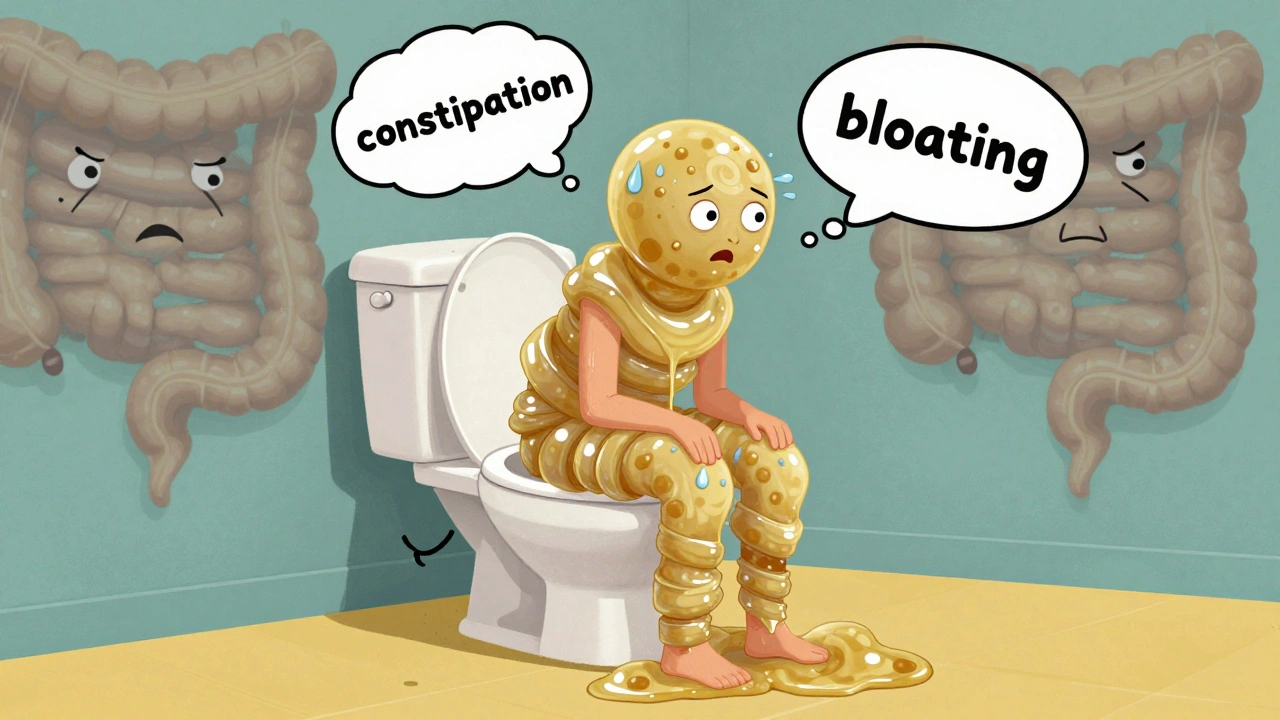
When you start taking colesevelam - sold as Welchol or Cholestagel - for diabetes or high cholesterol, you might expect better blood sugar control or lower LDL. But for many, the real challenge isn’t the medication’s purpose - it’s what happens in your gut. Constipation and bloating aren’t rare side effects. They’re common. And if you’re not prepared, they can make you want to stop the drug altogether.
Why Colesevelam Causes Constipation
Colesevelam works by binding bile acids in your intestines. That’s how it lowers cholesterol and helps some types of diarrhea. But here’s the twist: the same mechanism that softens loose stools in people with bile acid malabsorption can harden normal stools in others. It’s not a mistake. It’s how the drug functions.Unlike older bile acid sequestrants like cholestyramine, colesevelam doesn’t turn into a gritty, chalky sludge in your gut. It forms a soft, gel-like mass that traps bile acids. But that gel still slows down movement in the colon. And if you’re already prone to slow digestion, it can push you over the edge into full-blown constipation.
Studies show about 10-15% of people taking colesevelam develop constipation. That’s not a small number. In clinical trials, 1 in 7 patients reported difficulty passing stool. And while some people tolerate it fine, others end up in the ER. One patient on WebMD reported fecal impaction after just five days - a situation that could’ve been avoided if their doctor had asked about their history of slow transit constipation.
Bloating and Gas: The Other Unwanted Guest
Bloating and flatulence aren’t just annoying - they’re frequent. About 11% of users report them, according to the European Medicines Agency. That’s nearly as common as constipation.Why does this happen? When colesevelam binds bile acids, it changes how gut bacteria break down food. The result? More gas production. It’s not because you’re eating something wrong. It’s because your gut microbiome is reacting to a new chemical environment.
Many patients notice bloating starts within the first week. It often peaks around day 10 and then eases - if you stick with it. But for some, it never fades. And if you’re already dealing with IBS or bloating from other causes, colesevelam can make it worse.
Who’s at Highest Risk?
Not everyone gets these side effects. But certain people are much more likely to.- People with a history of chronic constipation - even mild
- Those taking opioids for pain
- Patients with slow intestinal motility
- Anyone with a Bristol Stool Scale score of 3 or lower before starting (meaning hard or lumpy stools)
A 2024 study in Alimentary Pharmacology & Therapeutics found that patients with baseline stool scores ≤3 had over three times the risk of developing severe constipation on colesevelam. That’s not a coincidence. It’s a red flag.
That’s why the FDA and Mayo Clinic now warn against using colesevelam in people with bowel blockages or motility disorders. If your gut doesn’t move well already, this drug isn’t the fix.
How to Prevent and Manage Constipation
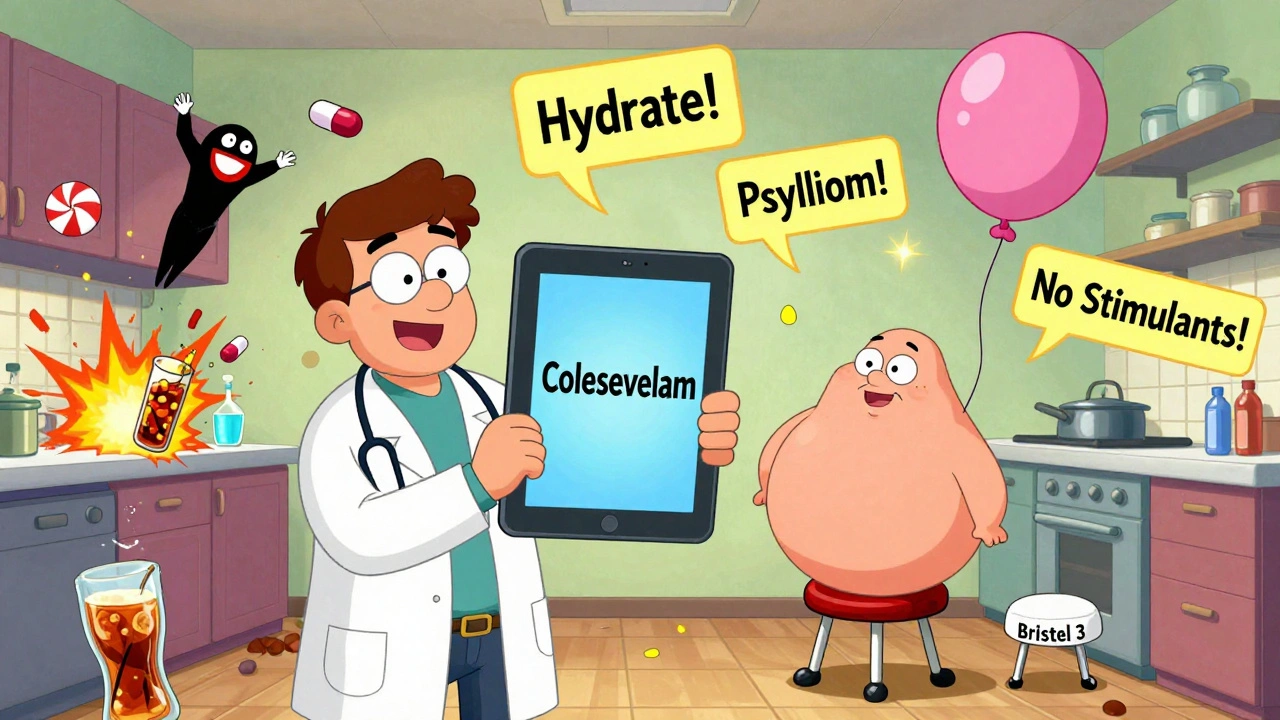
The good news? You don’t have to suffer. There are proven ways to manage this.Start low, go slow. Don’t jump to the full 3.75g daily dose. The Royal Marsden NHS protocol recommends starting with 1.25g (two 625mg tablets) once a day with your largest meal. After seven days, increase to 2.5g. After another week, go to 3.75g. This gives your gut time to adjust.
Hydrate like your life depends on it. Colesevelam absorbs water. If you’re not drinking enough, it pulls moisture from your colon, making stools harder. Aim for at least 2 liters of water daily. More if you’re active or in a warm climate.
Add soluble fiber - not just any fiber. Insoluble fiber like wheat bran can make constipation worse. Stick to soluble fiber: psyllium husk (Metamucil), oats, flaxseed, or chia seeds. One patient on the IBS Patient Network reported needing 17g of psyllium daily to stay regular while on colesevelam. That’s not unusual.
Use stool softeners, not stimulants. Docusate sodium (Colace) is safe and effective. It helps water get into stools without irritating your gut. Avoid stimulant laxatives like senna or bisacodyl. They can cause cramps, electrolyte loss, and dependency.
Try prune juice. It’s not a miracle cure, but it’s a gentle, natural option. Two ounces daily can help keep things moving. Some patients swear by it.
What About Bloating? Can You Reduce It?
Yes. Here’s what works:- Take colesevelam with meals - it reduces gas spikes
- Avoid carbonated drinks and chewing gum
- Try peppermint oil capsules (enteric-coated) - they help relax gut muscles
- Walk after meals - light movement helps gas pass
One caveat: taking colesevelam with food can interfere with other medications. The drug binds to pills too. So if you’re on metformin, levothyroxine, or birth control, take them at least 4 hours before or after colesevelam. That’s non-negotiable.
When to Call Your Doctor
You don’t need to panic over every change. But if you see these signs, reach out:- No bowel movement for 3 days or more
- Severe abdominal pain or swelling
- Vomiting or inability to pass gas
- Blood in stool
These aren’t normal side effects. They could mean impaction or obstruction. Don’t wait. Call your provider.

Is There a Better Alternative?
If constipation keeps you off colesevelam, you’re not out of options.Cholestyramine is cheaper - about $30 a month - but causes constipation in up to 39% of users. It’s grittier, harder to swallow, and worse tolerated overall.
For bile acid diarrhea, some doctors now use elobixibat (not available in the U.S.) or rifaximin (off-label). But colesevelam still leads in tolerability among approved drugs. A 2021 review found only 12% of patients quit colesevelam due to GI issues - compared to 29% for cholestyramine.
And here’s the real kicker: even though colesevelam costs $300-$400 a month, it saves money long-term. Fewer ER visits, fewer doctor appointments, fewer missed workdays. That’s why 65% of new bile acid diarrhea prescriptions in the U.S. are for colesevelam.
What’s Next for Colesevelam?
Sanofi is working on a new version - a modified-release tablet that releases the drug farther down the gut. Early trials suggest it could cut constipation risk by nearly half. Phase I testing starts in early 2025.Meanwhile, doctors are getting smarter about who gets this drug. Blood tests for serum C4 (a marker of bile acid production) are now being used to predict who’s likely to develop constipation. Patients with low C4 levels have a 40% risk. Those with high C4? Just 8%.
This isn’t science fiction. It’s happening now. Better testing means fewer people get stuck with side effects they can’t handle.
Final Takeaway
Colesevelam isn’t perfect. But for many, it’s the best tool they’ve got. The key isn’t avoiding side effects - it’s managing them before they manage you.If you’re starting this drug, talk to your doctor about your bowel history. Start low. Drink water. Add psyllium. Don’t wait until you’re blocked to act. Constipation on colesevelam is preventable - but only if you act early.
It’s not about giving up on the medication. It’s about working with it - and your body - so it actually helps you live better, not worse.


Jennifer Blandford
December 8, 2025 AT 00:58Okay but can we talk about how this is basically the medical version of buying a fancy treadmill and then using it as a clothes rack? 🤦♀️ I started this med last month and thought ‘oh cool, cholesterol fix!’ Turns out my colon just threw a tantrum and quit. Psyllium husk saved my life though - now I drink it like a smoothie. You’re not broken, your gut just needs a new playlist.
Rich Paul
December 9, 2025 AT 13:42bro i took this for 3 days and felt like my intestines were filled with cement. i thought it was just me. turns out i’m not the only one who’s a walking colon brick? lol. psyllium is the real MVP here. also, drink water like your life depends on it - because it kinda does. 2l minimum. i went from 1 to 4L and now i’m not scared to poop anymore. 🤓
Ruth Witte
December 11, 2025 AT 02:21YESSSS this is the info I needed!! 🙌 I was about to quit because I felt like a balloon full of rage. Started the slow dose + psyllium + prune juice and boom - regular again. Also, peppermint oil capsules? Game changer. I’m not just surviving, I’m thriving. You’re not weird for needing help - you’re smart for finding it. Keep going!! 💪💩✨
Raja Herbal
December 12, 2025 AT 22:11So you’re telling me the drug that’s supposed to fix my cholesterol turns my gut into a slow-moving swamp? And the solution is to drink more water and eat fiber like it’s a job? Wow. Medicine in 2025: just add water and hope. I’m impressed. 😏
Katherine Rodgers
December 14, 2025 AT 09:00LOL at the ‘start low, go slow’ advice. That’s what they say when they know the drug is a dumpster fire but they’ve already sold 2 million bottles. 10-15% constipation? That’s not a side effect, that’s a feature. And don’t get me started on the $400/month price tag. You’re not getting healthcare - you’re getting a luxury constipation subscription.
Lauren Dare
December 14, 2025 AT 23:36Let’s be real - if your C4 levels are low, you shouldn’t even be on colesevelam. This isn’t a one-size-fits-all drug. It’s a biomarker-driven intervention. If your provider didn’t test you, they’re practicing guesswork with side effects. And yes, the cost is insane, but the ER visits for impaction? Even more so. This isn’t pharma greed - it’s precision medicine trying to catch up with reality.
Asset Finance Komrade
December 16, 2025 AT 10:38The entire pharmacological paradigm here is a metaphysical paradox: a molecule engineered to bind bile acids, thereby altering gut microbiota dynamics, yet the human body is left to interpret this as a violation of its natural homeostatic equilibrium. One might argue that the constipation is not a side effect - it is the drug’s ontological truth made manifest through the medium of the colon. We are not patients. We are conduits of biochemical irony. 🌌
And yet, we are told to drink water. To eat psyllium. As if the universe could be corrected by hydration and soluble fiber. How quaint. How tragic. How… human.
Perhaps the real cure is not in the tablet, but in the silence between the doctor’s question and the patient’s answer - the unspoken history of slow transit, the forgotten bowel movements, the shame of bloating at dinner parties.
So I sip my water. I take my psyllium. I walk after meals. And I wonder: are we treating disease - or are we merely learning to live with the consequences of modernity’s biochemical hubris?
Still, I’ll take the constipation over the LDL.
At least I know I’m alive. Even if my colon doesn’t.
Delaine Kiara
December 17, 2025 AT 18:17Okay but the fact that Sanofi’s working on a modified-release version that cuts constipation by half? That’s the real story here. 🎉 This isn’t just a drug - it’s a whole industry slowly realizing ‘maybe we shouldn’t make people poop bricks to fix their cholesterol.’ The future is slow-release, biomarker-guided, and actually tolerable. And honestly? I’m here for it. Also, I’m not mad anymore. I’m just… impressed. 🤯