
Sudden shortness of breath could be more than just being out of shape
If you’ve ever felt like you can’t catch your breath after walking up a flight of stairs - and it came out of nowhere - you might be dismissing it as stress, anxiety, or aging. But that sudden, unexplained gasping for air could be a pulmonary embolism (PE), a blood clot blocking an artery in your lungs. It doesn’t always come with chest pain or swelling. Sometimes, it’s just breathlessness that doesn’t make sense. And if it’s not caught fast, it can kill you.
According to the National Institutes of Health, sudden shortness of breath is the most common symptom of PE, showing up in 85% of cases. That’s more than chest pain, more than coughing, more than fainting. It’s the silent alarm most people ignore. And because it looks like asthma, anxiety, or even a bad cold, it’s often missed. In fact, a 2022 survey found that nearly 7 out of 10 people with PE saw a doctor at least twice before getting the right diagnosis.
What exactly is a pulmonary embolism?
A pulmonary embolism happens when a blood clot - usually from a deep vein in your leg - breaks loose and travels to your lungs. This clot blocks blood flow through the pulmonary arteries. Your lungs can’t oxygenate blood properly. Your heart has to work harder. Oxygen levels in your blood drop. And if the clot is large enough, your heart can’t keep up. That’s when things turn critical.
Most of these clots start in the deep veins of the lower legs or thighs. About 70% of confirmed PE cases trace back to deep vein thrombosis (DVT). Less common sources include clots from the arms, often after having a central line or IV catheter. Once that clot reaches the lungs, it doesn’t just cause discomfort - it can trigger shock, heart strain, or sudden death.
It’s not rare. In the U.S., about 60 to 70 people out of every 100,000 get a PE each year. That adds up to roughly 100,000 deaths annually. The good news? Most of these deaths are preventable - if you catch it early.
The symptoms aren’t always dramatic
People imagine PE as a dramatic collapse on the floor. But that’s only true in the most severe cases. Most of the time, symptoms creep in quietly.
- Sudden shortness of breath - the #1 sign. It doesn’t improve with rest. It gets worse with movement.
- Chest pain - sharp, stabbing, worse when you breathe in or cough. Often mistaken for a heart attack.
- Cough - sometimes dry, sometimes with blood (hemoptysis). Seen in over half of cases.
- Leg swelling or pain - usually in one leg. About 44% of patients have this.
- Rapid heartbeat - over 100 beats per minute, even when sitting still.
- Fast breathing - more than 20 breaths per minute.
- Fainting or dizziness - happens in about 14% of cases, often the first warning before collapse.
Here’s what’s dangerous: if you’re over 50, have cancer, are on birth control, recently had surgery, or have been sitting still for hours (like on a long flight), your risk goes up. And if you’ve had a clot before, your chance of another one within 10 years is one in three.
One patient on a medical forum described it: "I was sitting watching TV, and suddenly I couldn’t breathe. I thought I was having a panic attack. My doctor said it was anxiety. Two days later, I passed out. That’s when they found the clot."
Diagnosis isn’t just a scan - it’s a process
You can’t diagnose PE with a single test. It’s a puzzle. Doctors start by asking: "Does this make sense?" They use tools like the Wells Criteria or the Geneva Score to estimate how likely PE is based on symptoms, risk factors, and exam findings.
These aren’t guesswork tools. They’re validated across thousands of cases. A score that puts you in the "low risk" category means there’s a 97% chance you don’t have PE - if your D-dimer test is negative.
That’s where the D-dimer blood test comes in. It measures a protein fragment that’s released when a clot breaks down. If the level is below 500 ng/mL, and you’re low risk, PE is almost certainly ruled out. But here’s the catch: D-dimer goes up with age, infection, pregnancy, or cancer. So if you’re over 50, a normal D-dimer doesn’t rule out PE. That’s why doctors don’t rely on it alone in older patients.
That’s where imaging takes over.
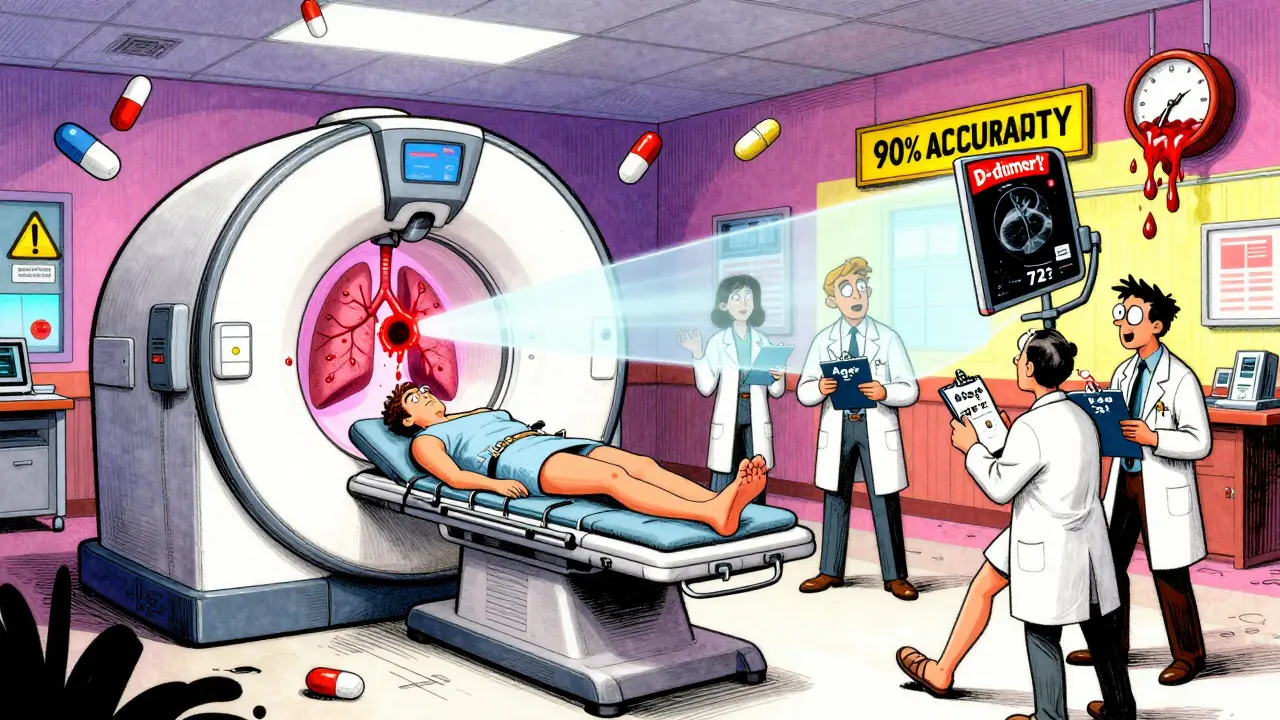
CTPA: The gold standard for confirming PE
If your risk is moderate or high, or your D-dimer is elevated, the next step is almost always a CT pulmonary angiography (CTPA). This is a specialized CT scan that uses contrast dye to show the blood vessels in your lungs. It’s fast, accurate, and widely available.
CTPA finds PE in 95% of cases where it’s present. It also shows how big the clot is, where it is, and whether your right heart is under strain - which tells doctors how dangerous it is.
But it’s not perfect. You need iodine contrast, which can be risky for people with kidney problems. You also get a small amount of radiation - about the same as a year of natural background exposure. Still, for most people, the benefits far outweigh the risks.
For those who can’t have contrast - like people with severe kidney disease or allergies - doctors turn to a ventilation/perfusion (V/Q) scan. It’s less common, because it requires special nuclear medicine equipment. Only about 78% of major hospitals in developed countries have it. But when available, it’s 95% specific for PE.
Ultrasound: Checking for the source
While CTPA looks at the lungs, doctors also check your legs. A compression ultrasound of the deep veins can find clots in the thighs or calves with over 90% accuracy. If they find a clot in your leg, and you have symptoms like shortness of breath, they don’t need a CTPA to confirm PE - the diagnosis is strong enough to start treatment.
That’s why many emergency rooms now do leg ultrasounds right away. It’s quick, safe, and can avoid unnecessary radiation. One hospital system cut the time to diagnosis from over two hours to under 45 minutes by doing leg scans and CTPA together.
What about echocardiograms?
If you’re crashing - low blood pressure, fainting, rapid heart rate - time is critical. In those cases, doctors skip the CT and go straight to a bedside echocardiogram. This ultrasound of the heart can show if the right side is swollen or struggling. That’s a sign of massive PE. It doesn’t show the clot itself, but it tells you the clot is big enough to be life-threatening. That means you need emergency treatment - clot-busting drugs or even surgery - right away.
Why do so many cases get missed?
Because the symptoms look like other things. Shortness of breath? Must be asthma. Chest pain? Must be heartburn. Fatigue and dizziness? Must be stress.
And doctors are human. They see hundreds of patients a week. If you’re young and healthy, they assume you’re not at risk. But PE doesn’t care. It can strike anyone. Even people who seem fine.
One study found that 41% of PE patients were first diagnosed with pneumonia or asthma. Another found that patients with cancer - who are at much higher risk - often had their symptoms dismissed because "it’s just the cancer." That’s dangerous. Cancer increases your PE risk nearly fivefold. And in those patients, D-dimer is less reliable.
The fix? Better training. Hospitals that use structured PE pathways - checklists, protocols, team huddles - cut their death rates in half. One U.S. hospital reduced mortality from 8.2% to 3.1% just by speeding up imaging and standardizing care.

New tools are changing the game
Artificial intelligence is now helping radiologists read CTPA scans faster and more accurately. One AI tool called PE-Flow correctly identified clots in 96% of cases - matching expert human readings.
Doctors are also using age-adjusted D-dimer thresholds. Instead of using the same cutoff for everyone, they now raise the level for older patients. For example, if you’re 70, a D-dimer under 700 ng/mL might be normal. This reduces unnecessary CT scans by over a third, without missing more clots.
And then there’s the Pulmonary Embolism Response Team (PERT). It’s not a single test - it’s a team. Radiologists, pulmonologists, hematologists, and emergency doctors meet in real time to decide the best treatment for complex cases. Hospitals with PERT see patients get treatment 3 days faster and have 4% lower death rates.
What happens after diagnosis?
If you’re diagnosed with PE, you’ll start anticoagulants - blood thinners - right away. These don’t dissolve the clot. They stop it from growing. Your body slowly breaks it down over weeks or months.
Most people take pills like rivaroxaban or apixaban for at least 3 months. If you had a clear trigger - like surgery or a long flight - you might stop after that. But if you have cancer, a genetic clotting disorder, or have had PE before, you may need to stay on them for years - or for life.
Recovery isn’t just about medication. You’ll need to move. Sitting still increases your risk of another clot. Walking, even short distances, helps your blood flow. Compression stockings can help if you still have leg swelling.
Can you prevent it?
Yes. And it’s simpler than you think.
- Stay active. Don’t sit for hours. Get up every hour on long flights or car rides.
- Wear compression socks if you’re at high risk.
- Drink water. Dehydration thickens your blood.
- Talk to your doctor if you’re on birth control or hormone therapy, especially if you smoke or are over 35.
- If you’ve had a clot before, ask about long-term prevention.
Clots don’t just happen. They’re often preventable. And catching them early? That saves lives.
When to go to the ER
If you have sudden shortness of breath - especially if it’s worse than usual, doesn’t improve, and you have any risk factors - don’t wait. Don’t call your GP. Go to the emergency room.
Same if you have:
- Chest pain that gets worse when you breathe
- One swollen, painful leg
- Fainting or feeling like you’re going to pass out
- Fast heartbeat with no obvious cause
There’s no harm in being checked. But waiting could cost you your life.
Can you have a pulmonary embolism without knowing it?
Yes. Small clots in the outer parts of the lungs may cause no symptoms at all. These are often found by accident during scans for other reasons. But even small clots can grow or break off again. That’s why doctors treat even minor PE - not because it’s dangerous right now, but because it could become life-threatening later.
Is a pulmonary embolism the same as a heart attack?
No. A heart attack is caused by a blocked artery in the heart, cutting off blood to heart muscle. A pulmonary embolism is a clot in the lungs, blocking blood flow to the lung tissue. They can both cause chest pain and shortness of breath, but they’re different organs, different causes, and different treatments. Confusing them delays the right care.
Can exercise cause a pulmonary embolism?
No. Exercise actually helps prevent clots by improving circulation. But if you’ve been inactive for a long time - like after surgery or a long flight - then suddenly starting intense exercise can sometimes dislodge a clot that’s already forming. That’s why doctors recommend gentle movement after long periods of rest, not sudden bursts of activity.
Does being overweight increase my risk of PE?
Yes. Obesity increases the pressure in your veins and slows blood flow, especially in the legs. People with a BMI over 30 have a 2 to 3 times higher risk of developing deep vein thrombosis, which can lead to PE. Losing weight reduces that risk - but even without weight loss, staying active helps.
Can you get a pulmonary embolism from a long flight?
Yes. Sitting still for more than 4 hours increases your risk, especially if you have other factors like pregnancy, birth control, or a history of clots. This is sometimes called "economy class syndrome," but it’s not about the seat size - it’s about immobility. Walking every hour, doing ankle circles, and staying hydrated can reduce the risk significantly.
How long does it take to recover from a pulmonary embolism?
Most people start feeling better within days to weeks after starting blood thinners. But full recovery - meaning the clot is fully dissolved and lung function returns to normal - can take weeks to months. Some people have lasting lung damage, especially if the clot was large. Follow-up scans and breathing tests are often needed to monitor progress.
Are blood thinners dangerous?
They carry a risk of bleeding, which is why doctors carefully weigh the benefits. But modern blood thinners like rivaroxaban or apixaban are safer than older ones like warfarin. They don’t require frequent blood tests, and the risk of serious bleeding is low - about 1 to 2% per year. The risk of dying from another clot without them is much higher.
Can a pulmonary embolism come back?
Yes. About one in three people who’ve had a PE will have another within 10 years. That’s why doctors look for underlying causes - cancer, genetic disorders, autoimmune diseases - and adjust treatment accordingly. If you’ve had one, you’re in a higher-risk group. Don’t ignore new symptoms.

Wade Mercer
December 15, 2025 AT 23:58Edward Stevens
December 16, 2025 AT 12:49Natalie Koeber
December 18, 2025 AT 05:02Thomas Anderson
December 19, 2025 AT 03:54Daniel Thompson
December 20, 2025 AT 22:43Alexis Wright
December 22, 2025 AT 13:07Dwayne hiers
December 23, 2025 AT 12:47Sarthak Jain
December 24, 2025 AT 06:53Rich Robertson
December 24, 2025 AT 21:40Daniel Wevik
December 24, 2025 AT 23:38Jonny Moran
December 26, 2025 AT 03:04Tim Bartik
December 26, 2025 AT 08:02Sinéad Griffin
December 27, 2025 AT 11:55jeremy carroll
December 28, 2025 AT 15:28Rulich Pretorius
December 30, 2025 AT 02:58