If you’ve ever had stomach cramps that wouldn’t go away, or noticed your child scratching their bottom at night like crazy, you might be dealing with something more than just bad food or a rash. Two of the most common parasitic infections in humans - giardia and pinworms - are silent, widespread, and often misunderstood. They don’t make headlines, but they’re in your water, on your doorknob, and possibly in your home right now.
What Giardia Is and How You Catch It
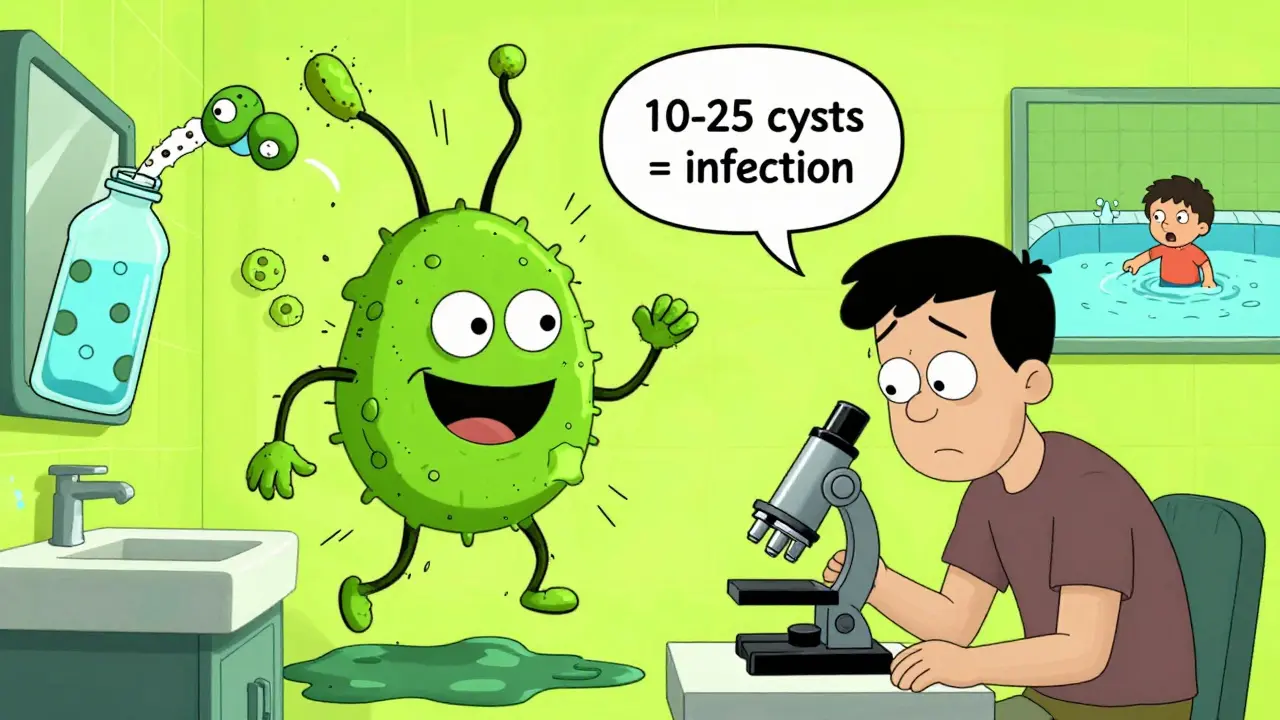
Giardia is a tiny, pear-shaped parasite called Giardia lamblia. It doesn’t look like much under a microscope - just a little swimmer with four flagella - but it can turn your digestive system upside down. You get it by swallowing cysts, which are like hard-shelled eggs the parasite uses to survive outside the body. These cysts can live for months in cold water, even in mountain streams or backyard wells. One study found that drinking just 10 to 25 cysts is enough to cause infection.
Most people catch giardia from contaminated water, but it’s also spread through food handled by someone who didn’t wash their hands after using the bathroom. Daycare centers, campsites, and households with young kids are hotspots. Even swimming in a poorly chlorinated pool can do it. The CDC says giardia is the most common parasitic cause of diarrhea in developed countries, with over 1.2 million cases reported each year in the U.S. alone.
Symptoms usually show up 1 to 14 days after exposure - most often around day 7. You might get watery, greasy diarrhea that smells awful, bloating, gas that won’t quit, nausea, and fatigue. Some people lose weight because their gut can’t absorb nutrients properly. In rare cases, it lasts for months or even years, especially in people with weak immune systems. And here’s the kicker: up to half of infected people show no symptoms at all. That’s why it spreads so easily.
What Pinworms Are and Why They’re So Annoying
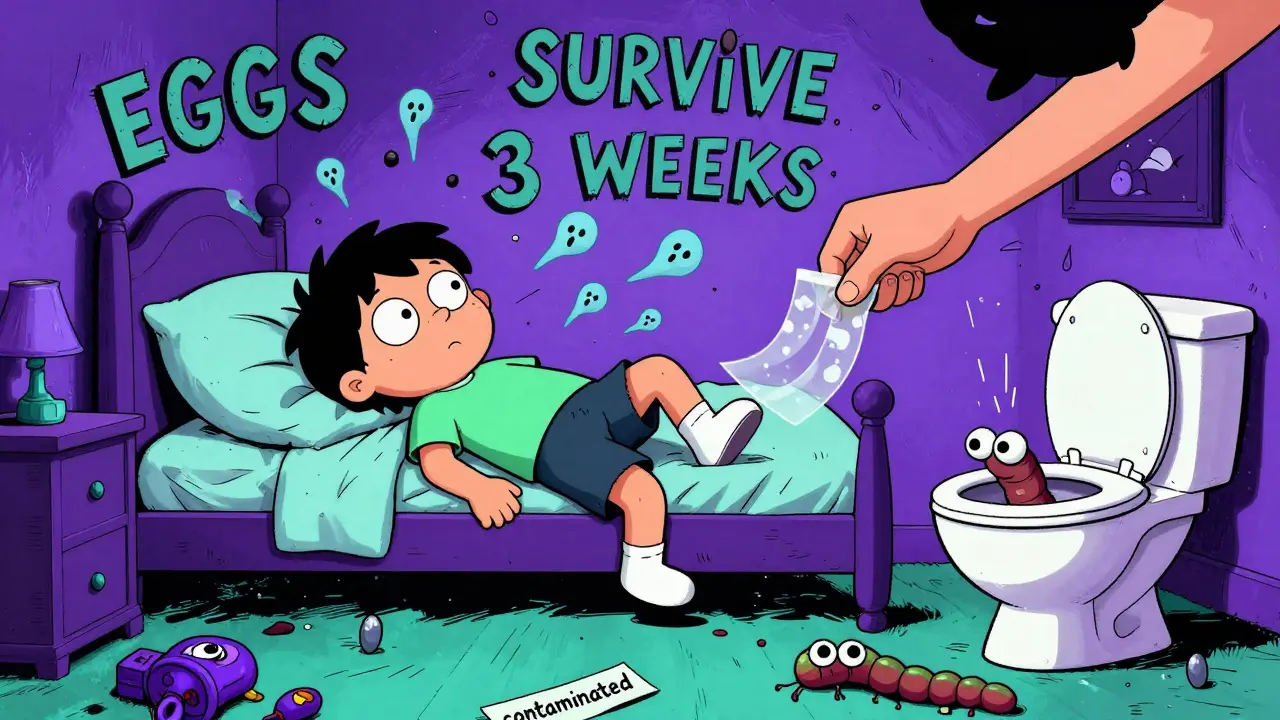
Pinworms are tiny white worms, about the length of a staple. They live in your large intestine and come out at night - not to eat, but to lay eggs. The female worm crawls out of the anus and deposits thousands of eggs on the skin around it. That’s when the itching starts. It’s intense, especially at night, and it’s why kids wake up crying or rubbing their bottoms. The eggs become infectious within hours and can survive on bedding, toys, or even in the air for up to three weeks.
Pinworms are the most common worm infection in the U.S. The CDC estimates 40 to 80 million Americans have them at any given time. Kids between 5 and 10 are the most affected, but anyone living with a child is at risk. It’s not about being dirty - it’s about how easily the eggs transfer. A child scratches, touches a doorknob, and the next person picks it up. You don’t need to eat contaminated food. Just touching your face after brushing your hand against a contaminated surface is enough.
Unlike giardia, pinworms rarely cause serious illness. But the itching can lead to sleepless nights, skin infections from scratching, and stress for the whole family. Some people never even realize they have them until someone else gets infected - and then the whole household starts itching.
How Doctors Diagnose These Infections
Diagnosing giardia isn’t always straightforward. Old-school stool tests - looking for the parasite under a microscope - miss up to 30% of cases. The gold standard now is a stool antigen test, which looks for giardia proteins. It’s 95% accurate and gives results in hours. If you’ve had diarrhea for more than a week, especially after hiking, camping, or traveling, ask your doctor for this test.
For pinworms, the trick is the “scotch tape test.” First thing in the morning, before bathing or using the toilet, press a piece of clear tape against the skin around the anus. Then stick it to a slide and take it to the lab. The eggs stick to the tape and show up clearly under a microscope. One test catches about half the cases. Three tests done on consecutive days catch 90%.
Doctors don’t usually test for both at once. If a child has itching but no diarrhea, they check for pinworms. If someone has persistent watery diarrhea, especially after water exposure, giardia is the first suspect. But if treatment fails, it’s worth checking for both.
Treatment: What Actually Works
Both infections are treatable - but only if you do it right.
For giardia, the most common drugs are:
- Metronidazole: 250 mg three times a day for 5 to 7 days. Works in 80-95% of cases, but can cause a strong metallic taste, nausea, and dizziness. Don’t drink alcohol while taking it - it causes severe reactions.
- Tinidazole: A single 2-gram dose. Just as effective, fewer side effects, and easier to take. Often preferred for adults.
- Nitazoxanide: 500 mg twice a day for 3 days. Safe for kids as young as 1 year old. Good for families.
For pinworms, the go-to treatments are:
- Mebendazole: One 100 mg pill, repeated after 2 weeks. Available over the counter in many places.
- Albendazole: One 400 mg pill, repeated after 2 weeks. Often used in outbreaks.
- Pyrantel pamoate: One dose based on weight (11 mg per kg), repeated in 2 weeks.
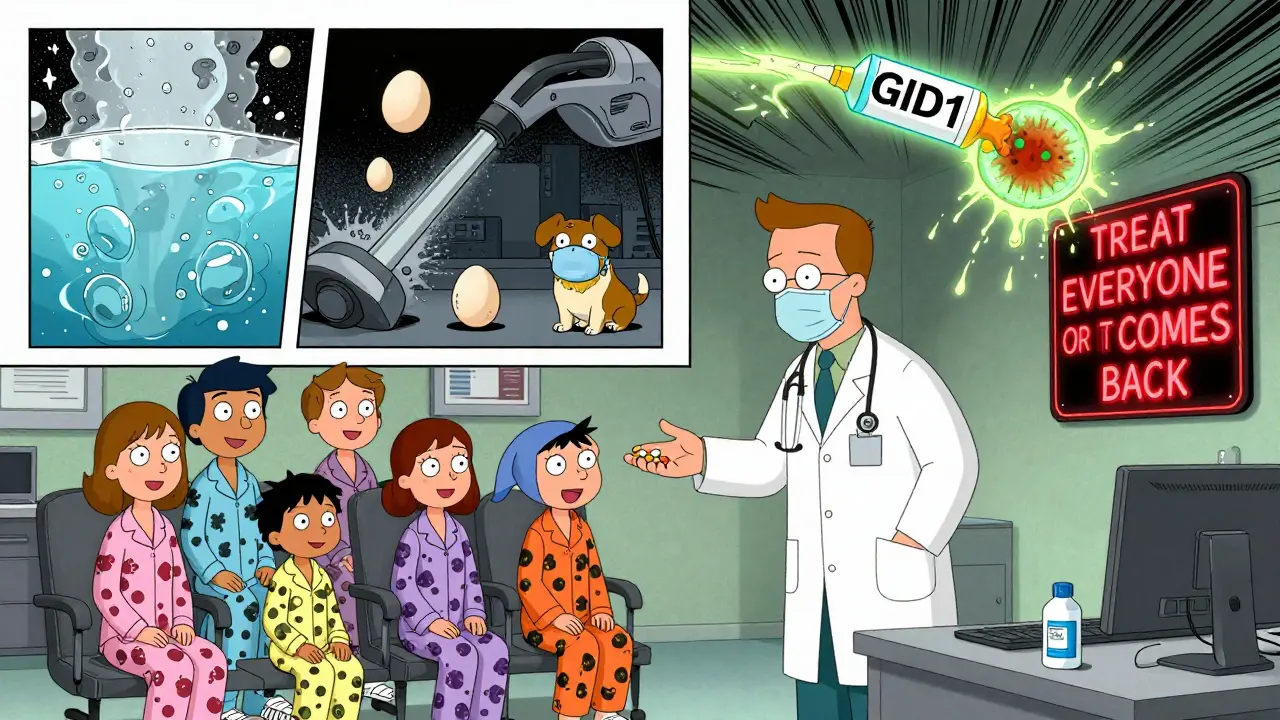
Here’s what most people get wrong: treating just the person who’s sick. That’s a recipe for reinfection. The CDC says 75% of household members are infected when one person has pinworms. So everyone - parents, siblings, even the dog’s caretaker if they’re helping with cleanup - needs to be treated at the same time. Same goes for giardia if someone else in the house has symptoms.
Stopping the Cycle: Prevention Is Everything
Medication alone won’t fix this. If you don’t clean up the environment, the infection comes back.
For giardia:
- Boil water for at least 1 minute if you’re unsure of the source.
- Use a water filter labeled to remove cysts (pore size of 1 micron or smaller).
- Wash hands thoroughly with soap and water after using the bathroom, changing diapers, or before eating.
- Keep kids with diarrhea out of pools and daycare for at least 2 weeks after symptoms stop.
For pinworms:
- Wash all bedding, pajamas, and towels in hot water on the day of treatment.
- Shower in the morning to wash off any eggs laid overnight.
- Keep fingernails short and discourage nail-biting or scratching the anal area.
- Wipe down doorknobs, toys, and toilet seats daily for at least a week after treatment.
- Use a vacuum with a HEPA filter - pinworm eggs can become airborne.
A 2023 Parents.com survey found that families who followed both the double-dose treatment and full cleaning routine had a 92% success rate. Those who only took medicine? Only 40% stayed clear after a month.
What Happens If You Don’t Treat It
Pinworms rarely cause long-term damage. But constant scratching can lead to skin infections. In girls, eggs can migrate into the vagina, causing irritation or discharge.
Giardia is more dangerous long-term. If it sticks around, it can damage the lining of your small intestine. That means you can’t absorb vitamins, fats, or lactose properly. People with chronic giardia often develop lactose intolerance that lasts for months - even after the parasite is gone. In immunocompromised people, like those with HIV, giardia can become life-threatening, lasting for months and causing severe weight loss and dehydration.
And here’s something new: a 2024 study found that metronidazole resistance is rising. In Southeast Asia, 15% of cases don’t respond to the usual treatment. In North America, it’s still around 5%. That means if you’ve been treated before and it came back, you might need a different drug.
What’s Changing in 2025
The CDC updated its pinworm guidelines in January 2024. For cases that keep coming back, they now recommend a triple dose of albendazole - 400 mg on day one, day eight, and day fifteen. Early trials show 98% cure rates.
Water treatment is also evolving. WHO’s 2023 guidelines now push point-of-use filters in high-risk areas. A trial in Bangladesh cut giardia cases by 42% in just six months.
And there’s hope on the horizon: a giardia vaccine called GID1 is in early trials. Phase I results in 2023 showed 70% of people developed protective antibodies. It’s still years away, but it’s the first real step toward preventing giardia instead of just treating it.
Climate change is making things harder too. Warmer winters and heavier rains are increasing water contamination in places that used to be safe. Experts predict giardia will spread into 20-30% more temperate regions by 2040.
Final Thoughts: Don’t Panic, But Don’t Ignore It
Parasitic infections aren’t glamorous. They don’t make for viral TikTok videos. But they’re real, common, and treatable. If you or your child has persistent diarrhea, unexplained weight loss, or nighttime itching - don’t shrug it off. Ask for the right tests. Treat everyone in the house. Clean everything. Follow up.
These aren’t infections of poverty or poor hygiene. They’re infections of modern life - of backpacking trips, daycare centers, and well-meaning but unclean hands. The good news? With the right knowledge, you can stop them in their tracks - and keep them from coming back.


Siobhan K.
December 20, 2025 AT 23:41Giardia cysts surviving in mountain streams for months? That’s not science-that’s nature’s way of trolling hikers. I’ve seen people drink straight from creeks like it’s a free spa day. No wonder we’ve got outbreaks every summer.
Jackie Be
December 21, 2025 AT 13:15my kid scratched his butt so bad he bled last week and we thought it was eczema 😭 turns out it was pinworms. the scotch tape test was wild-like a tiny science experiment in our kitchen. now we’re all on mebendazole and i’m washing every sock in the house. no more bedtime cuddles without a shower first.
Jon Paramore
December 22, 2025 AT 02:34Metronidazole’s 80–95% efficacy is misleading without context. The real issue is bioavailability in the proximal small intestine, where Giardia trophozoites adhere to microvilli via the ventral disc. Tinidazole’s longer half-life improves compliance, but resistance mechanisms involving pyruvate:ferredoxin oxidoreductase (PFOR) downregulation are emerging. Nitazoxanide remains underutilized in pediatric populations due to dosing confusion.
Brian Furnell
December 22, 2025 AT 10:27Wait-so you’re telling me that if my kid touches a toy at daycare, and then touches his mouth, he’s basically ingesting a biological Trojan horse? And these eggs can hang in the air for three weeks?! That’s not a hygiene issue-that’s a biohazard protocol failure. Why aren’t daycares mandated to use HEPA filters and UV-C sanitizers? I’m not asking for a clean room-I’m asking for basic epidemiological safeguards.
And don’t even get me started on the fact that 50% of giardia cases are asymptomatic. That’s not silent-it’s sneaky. It’s the silent pandemic we ignore because it doesn’t make people die in dramatic ways. But chronic malabsorption? Lactose intolerance that lingers for months? That’s not a side effect-that’s a life-altering consequence.
And now you’re telling me metronidazole resistance is creeping up? That’s not just a medical concern-that’s a public health emergency. We’re treating this like it’s a minor stomach bug, but we’re basically playing Russian roulette with gut flora. Why isn’t this on the CDC’s front page? Why isn’t it in the news?
I’ve read studies showing that point-of-use filters in Bangladesh cut incidence by 42%. So why aren’t we deploying those in rural Appalachia or Native American reservations? Why do we treat this like a personal failure instead of a systemic failure?
And don’t even get me started on the fact that we’re still using tape tests for pinworms in 2025. That’s like diagnosing diabetes with a sugar cane test. We have PCR, antigen detection, even AI-assisted microscopy-why are we still sticking tape to butts like it’s 1987?
I’m not mad-I’m just disappointed. We have the tools. We have the data. We just don’t care until it’s our kid scratching their skin raw at 3 a.m.
And the vaccine? GID1? That’s the first real hope I’ve seen in a decade. But if we don’t fund Phase II trials properly, it’ll die in a lab somewhere while another kid gets infected because no one thought to flush the toilet after changing a diaper.
Someone needs to write a letter to Congress. Or at least a viral TikTok. Because this isn’t just about worms and protozoa-it’s about how we value public health when it’s invisible.
John Hay
December 23, 2025 AT 13:22My wife and I both got treated for giardia after a camping trip. We did the meds. We washed everything. We boiled water. But we didn’t treat our dog. Two weeks later, she was sick. We tested her. She had it. We treated her. We cleaned again. We’re good now. Don’t forget the pets.
Erika Putri Aldana
December 23, 2025 AT 19:38so like… are you saying the government is hiding this? because i feel like if this was a big deal, we’d be hearing about it on the news. instead we get memes about ‘coronavirus is fake’ and then boom-pinworms in the school and no one says a word. 🤡
Dan Adkins
December 24, 2025 AT 08:54It is imperative to note that the dissemination of parasitic organisms such as Giardia lamblia and Enterobius vermicularis constitutes a significant public health concern, particularly in regions where sanitation infrastructure is suboptimal. The assertion that these infections are merely 'common' is an understatement; they are endemic in populations lacking access to potable water and hygienic waste disposal systems. One must consider the sociopolitical implications of such infections: they are not merely medical phenomena, but indicators of systemic neglect. The CDC's data, while statistically robust, fails to account for underreporting in marginalized communities. Therefore, the true prevalence is likely an order of magnitude higher than cited. The use of over-the-counter anthelmintics without medical supervision is a dangerous precedent that undermines clinical governance. I urge all readers to consult a licensed physician before initiating any therapeutic regimen.
Grace Rehman
December 25, 2025 AT 03:58It’s funny how we treat parasites like they’re some kind of moral failure. Like if you get giardia you didn’t wash your hands enough. But what if you’re a single mom working two jobs and your kid’s daycare doesn’t have hot water? What if you’re hiking because you can’t afford a vacation? What if you’re just trying to survive and now you’re being told you’re the problem because your kid has worms? We’re not talking about hygiene here-we’re talking about class. And no one wants to admit that.
Michael Ochieng
December 25, 2025 AT 10:45My cousin in Nigeria gets giardia every rainy season. They don’t have filters or fancy meds-just boiled water and neem leaves. It’s not perfect, but it works. We think we need tech solutions, but sometimes the oldest remedies are the most accessible. Maybe we should stop looking for the next drug and start sharing what already works.
Teya Derksen Friesen
December 27, 2025 AT 10:39As someone who works in environmental health policy, I can confirm that climate-driven water contamination is accelerating. The 2040 projection of giardia spreading into 20–30% more temperate regions is not speculative-it’s modeled from precipitation and temperature trends observed since 2010. We are witnessing a slow-motion epidemiological shift. The infrastructure in many North American municipalities is not equipped to handle increased cyst loads in aquifers. This is not a future problem-it is unfolding now.
Adrian Thompson
December 29, 2025 AT 09:34They say giardia spreads through water-but what if it’s not the water? What if it’s the chemicals they’re adding to it? Fluoride? Chlorine? Maybe the parasite is just hiding from the toxins. And why do they always blame the hiker? What if the government’s been dumping something in the rivers for years and now they want us to think it’s just dirty water? I’ve seen the videos. The water’s too clear. Too clean. Something’s off.
And pinworms? Why do they only test kids? What if it’s the school lunches? What if it’s the vaccines? I’m not saying it’s all connected-but I’m saying we’re not being told the whole story.
Cara C
December 30, 2025 AT 06:49Just wanted to say thank you for writing this. I was so scared when my daughter got pinworms-I thought I was a bad mom. Turns out, half the class had it. We all treated together, cleaned everything, and now it’s gone. No shame. Just science. And a lot of laundry.