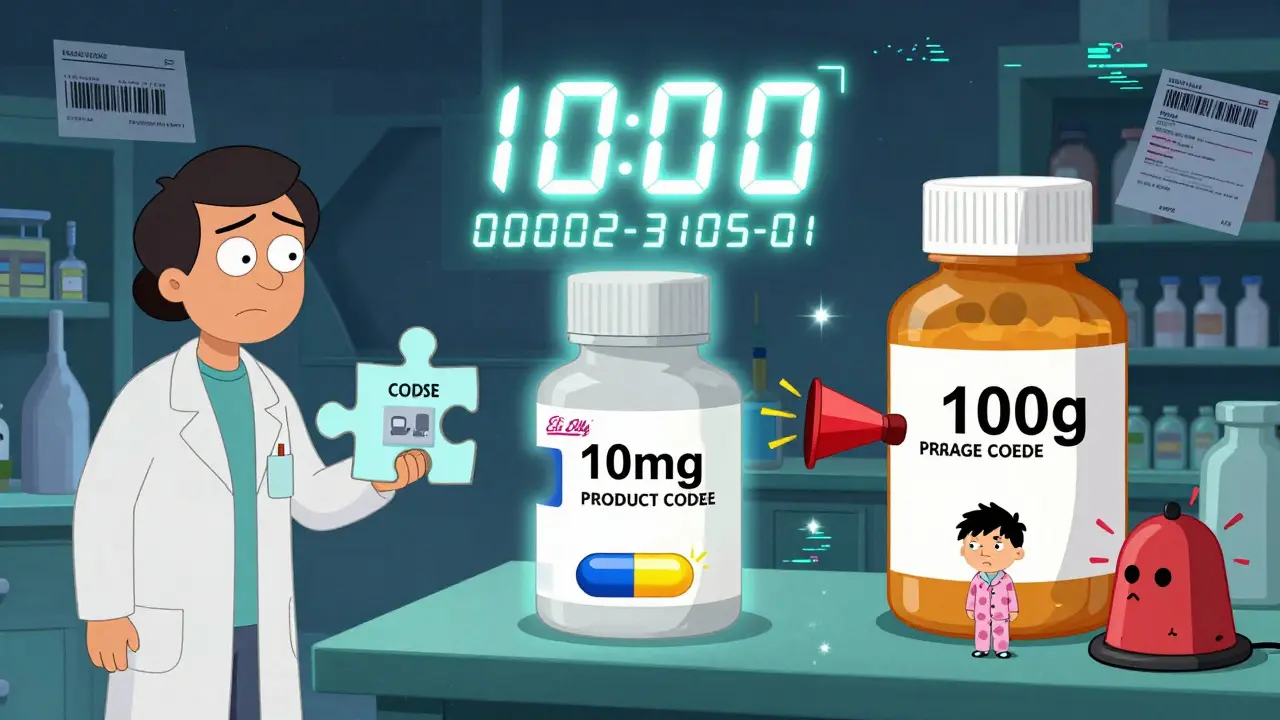
Getting the right medication isn’t just about the name on the bottle. One small mistake in reading the NDC number can lead to a deadly error - giving a patient 20mg of a drug when they were supposed to get 10mg. The National Drug Code (NDC) is the key that unlocks the full identity of every prescription and over-the-counter medicine in the U.S. But most people - even some pharmacists - don’t know how to read it properly. If you work in healthcare, handling meds daily, learning to decode this number isn’t optional. It’s the last line of defense against a preventable mistake.
What Exactly Is the NDC Number?
The NDC is a 10-digit number, split into three parts, printed on every medication package in the U.S. It’s not just a barcode number. Each segment tells you something specific: who made it, what it is, and how it’s packaged. The Food and Drug Administration (FDA) assigns these codes to every drug product under the Drug Listing Act of 1972. Without an NDC, a drug can’t be legally sold or billed to Medicare or private insurers. As of October 2023, over 152,000 active NDCs were listed in the FDA’s public directory.
The NDC isn’t random. It’s built like a fingerprint. The first part - the labeler code - identifies the company that makes, repackages, or distributes the drug. The second - the product code - tells you the exact drug, strength, and form (like tablet, capsule, or liquid). The third - the package code - shows the size and type of container, like a bottle of 30 pills or a box of 100.
The Three Segments: What Each Part Means
Let’s break it down with a real example: 00002-3105-01 is the NDC for Prozac 10mg capsules.
- Labeler Code (00002): This is the manufacturer. In this case, it’s Eli Lilly. The FDA assigns these codes, and there are roughly 3,500 active ones. If the labeler code doesn’t match the brand you expect, something’s off.
- Product Code (3105): This is the most critical part. It defines the active ingredient, strength, and dosage form. Here, ‘3105’ means fluoxetine 10mg in capsule form. Change that number to ‘4465’, and you get fluoxetine 20mg - a completely different dose. Mixing these up is a leading cause of dispensing errors.
- Package Code (01): This tells you the package size. ‘01’ means a bottle of 100 capsules. If you ordered 30 pills but received a 100-count bottle, this code tells you why. It doesn’t change the drug, but it affects inventory and billing.
These segments are never arbitrary. The FDA requires each combination to be unique. That’s why two different brands of the same drug - say, generic fluoxetine from two different companies - will have different NDCs. Even if the active ingredient is identical, the manufacturer’s labeler code changes the whole number.
Three Formats - One Problem
You won’t see the same NDC written the same way everywhere. The FDA allows three formats on packaging:
- 4-4-2 (e.g., 1234-5678-90)
- 5-3-2 (e.g., 12345-678-90)
- 5-4-1 (e.g., 12345-6789-0)
But when it comes time to bill insurance - especially Medicare Part D - you must use an 11-digit version: 5-4-2. That means you have to convert it. And this is where most mistakes happen.
Here’s how to convert:
- Look at your 10-digit NDC. Count the digits in each segment.
- If the labeler code is only 4 digits, add a leading zero to make it 5.
- If the product code is only 3 digits, add a leading zero to make it 4.
- If the package code is only 1 digit, add a leading zero to make it 2.
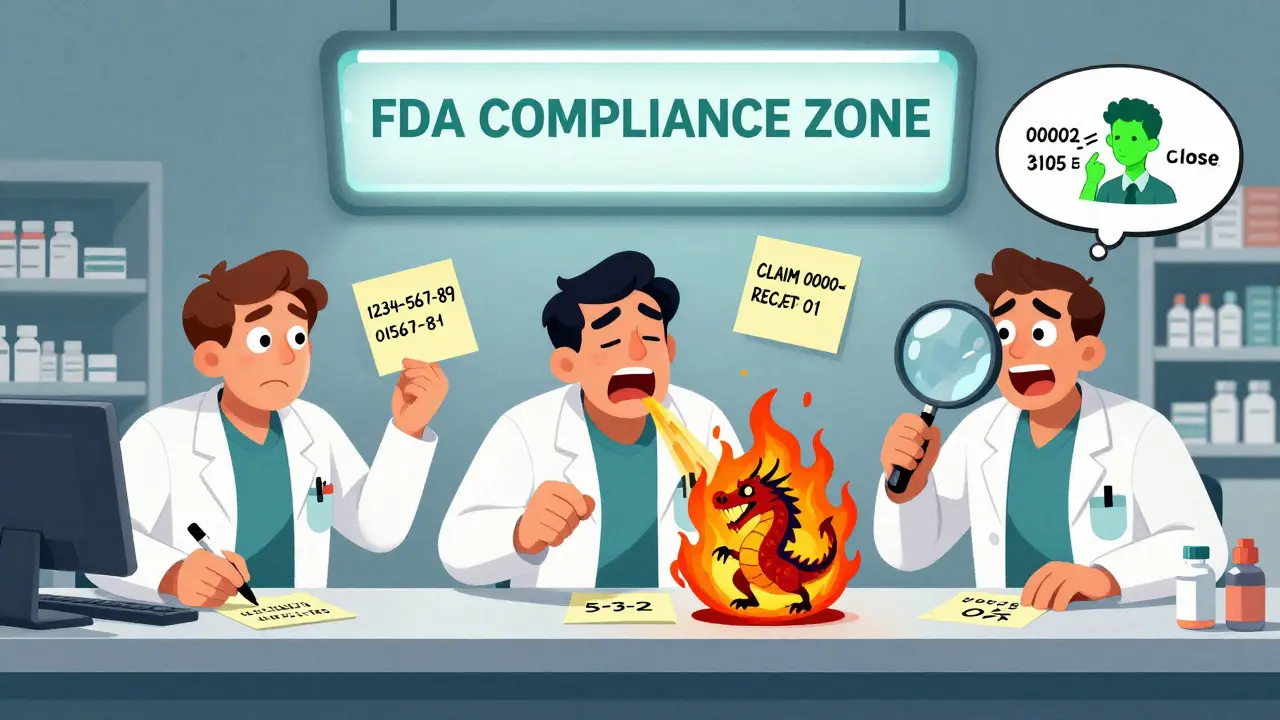
Example: 00002-3105-01 is already in 5-4-2 format - no change needed. But 1234-567-89 (4-3-2) becomes 01234-0567-89 (5-4-2) after adding zeros.
Miss this step, and your claim gets rejected. Worse, if you misread the original format, you might convert the wrong segment. That’s how a 5-3-2 code can become a completely wrong 11-digit number - and a patient gets the wrong drug.
How to Verify the NDC Before Dispensing
Never assume the NDC matches the prescription. Always check it against three things:
- The prescription order: Does the drug name, strength, and form match the NDC product code? If the script says "sertraline 50mg tablet" but the NDC product code points to a 100mg capsule, stop.
- The manufacturer: If the labeler code doesn’t match the brand you expect (e.g., a generic from a different company), verify it’s approved. The FDA’s NDC Directory lists all legal products.
- The package size: Is the quantity you’re handing out the same as what was ordered? A 90-day supply shouldn’t be a 30-day bottle.
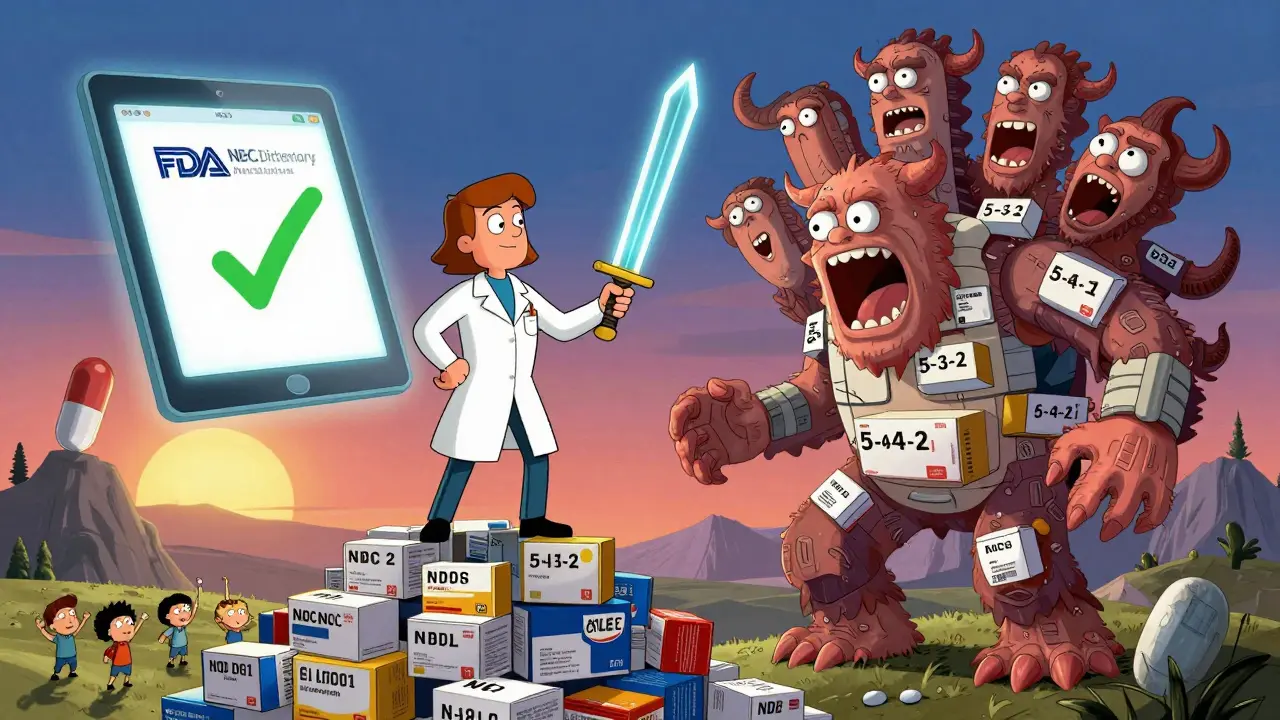
Use the FDA’s free NDC Directory - available online or via their mobile app - to cross-check. Type in the full 10-digit NDC, and it returns the drug name, strength, dosage form, and even the marketing category. It’s faster than guessing.
Many pharmacies now use automated systems that flag mismatches. But if you’re in a small clinic or doing manual checks, never skip the verbal double-check. Say the segments out loud: "Labeler 00002, product 3105, package 01." Hearing it helps your brain catch what your eyes miss.
Why This Matters - Real Errors, Real Consequences
According to the Institute for Safe Medication Practices (ISMP), about 12% of all medication dispensing errors are tied to NDC misreading. The most common mistake? Confusing the product code with the package code. A pharmacist once nearly gave a patient 20mg of Prozac instead of 10mg because they saw "4465" and thought it was a package code - not realizing it was the strength identifier.
The American Society of Health-System Pharmacists (ASHP) requires NDC verification at three points: when the drug arrives, when it’s prepared, and right before it’s given. That’s not overkill - it’s the standard. A time-motion study found that two-person verification adds 37 seconds per dose, but it cuts errors by over 60%.
And it’s not just pharmacies. Hospitals, nursing homes, and even home care nurses rely on this number. If you’re administering medication, you’re responsible for confirming it. The NDC is your legal and professional shield.
What to Watch Out For
Even with all the rules, problems persist:
- Discontinued NDCs: The FDA removes about 8,500 codes each year. If you see an old NDC, check if it’s still active. Some repackagers use outdated codes.
- Multiple NDCs for the same drug: A drug might have 5 different NDCs because of different bottle sizes, packaging, or manufacturers. Always match the product code, not just the brand.
- Inactive ingredients: The NDC doesn’t tell you about fillers or dyes. Two drugs with identical active ingredients can cause allergic reactions if one has a different excipient. The NDC won’t warn you - so always check the full prescribing info.
Also, watch for look-alike NDCs. For example, 00002-3105-01 and 00002-3106-01 look almost identical. One is 10mg, the other is 15mg. A quick glance can miss the difference.
What’s Changing? The 12-Digit Future
The FDA announced in 2022 that by 2025, all NDCs will be standardized to 12 digits. No more 4-4-2, 5-3-2, or 5-4-1 formats. Everything will be 6-4-2. This will eliminate conversion errors and make electronic systems more reliable. But until then, you need to master the current system.
Already, 98.7% of pharmacies use NDCs daily. And with the Drug Supply Chain Security Act (DSCSA) fully in place, every package must be traceable by its NDC. If you’re not using it correctly, you’re not just risking a mistake - you’re breaking federal law.
Pro Tips for Daily Use
- Always verify the NDC against the prescription - don’t rely on memory.
- Use the FDA’s NDC Directory app on your phone. It’s free and updated daily.
- When in doubt, call the FDA’s NDC hotline: 1-855-543-3784.
- Train new staff for at least 2-3 weeks on NDC formats. Don’t rush it.
- Never skip the two-person check for high-risk drugs like insulin, anticoagulants, or opioids.
Every time you handle a medication, the NDC is your silent partner in safety. Learn it. Respect it. Use it.
What does the NDC number tell me about a medication?
The NDC number has three parts: the labeler code (who made it), the product code (what the drug is, its strength, and form), and the package code (how it’s packaged). Together, they uniquely identify the exact medication product.
Why do I need to convert the NDC to 11 digits?
Medicare and most insurance systems require an 11-digit NDC in 5-4-2 format for billing. The 10-digit version on the package may be in a different format (like 4-4-2 or 5-3-2), so you must add leading zeros to the appropriate segment to meet the billing standard.
Can two different drugs have the same NDC?
No. Each NDC is unique to a specific manufacturer, drug, strength, dosage form, and package size. If two drugs have the same active ingredient but different packaging or manufacturers, they will have different NDCs.
How do I know if an NDC is still active?
Check the FDA’s National Drug Code Directory online or via their mobile app. It’s updated daily and shows which codes are active, discontinued, or pending. Never assume an old code is still valid.
Does the NDC tell me about side effects or allergies?
No. The NDC only identifies the drug’s manufacturer, strength, form, and packaging. It does not include information about inactive ingredients, allergens, or side effects. Always consult the full prescribing information for those details.
What should I do if the NDC on the package doesn’t match the prescription?
Stop. Do not dispense. Contact the prescriber or pharmacy that sent the order. The mismatch could mean a wrong drug, wrong strength, or wrong product entirely. Verify with the FDA’s NDC Directory before proceeding.
Alec Stewart Stewart
February 3, 2026 AT 15:35Been working ER for 8 years and this still trips people up. I once saw a nurse hand out insulin because the NDC looked close enough to another drug. 😅
Demetria Morris
February 3, 2026 AT 19:44It's appalling how many healthcare workers treat the NDC like a suggestion rather than a legal requirement. This isn't optional knowledge-it's the difference between life and death. If you're not verifying every single time, you're not just negligent-you're dangerous.
Geri Rogers
February 4, 2026 AT 01:31YESSSS! 🙌 I teach this to new techs every Monday and I swear half of them roll their eyes until they almost give someone 20mg instead of 10mg. Now they come to me with a Starbucks and say 'thank you' 😘
Pro tip: Say the digits out loud like a rap-'zero-zero-zero-zero-two, three-one-oh-five, zero-one.' It sticks better than reading it silently. And yes, the FDA app is your new best friend. Bookmark it. Print it. Tattoo it. 📱💉
Samuel Bradway
February 4, 2026 AT 03:30Man, I didn't realize how many formats there were until I got my first claim denied. Took me three days to figure out why. Just added a sticky note to my scanner now: 'Check format before you bill.' Simple fix, huge difference.
Justin Fauth
February 4, 2026 AT 22:06Look, I don't care if you're from Vermont or Texas-if you're handling meds and you don't know your NDCs, you shouldn't be on the clock. This isn't 'maybe' stuff. This is American healthcare, and we don't have room for sloppy. If you can't do this right, get out. No excuses.
Lorena Druetta
February 6, 2026 AT 21:42It is imperative that all personnel engaged in the dispensing and administration of pharmaceutical agents adhere to the highest standards of verification. The National Drug Code serves as a critical identifier, and its accurate interpretation is not merely a procedural formality-it is a fundamental ethical obligation.
Furthermore, the conversion to an 11-digit format is not a suggestion but a regulatory mandate under Title 21 of the Code of Federal Regulations. Failure to comply may result in financial penalties, legal liability, and most importantly, compromised patient safety.
Zachary French
February 7, 2026 AT 09:50Okay, so lemme get this straight… the whole system’s built on a 10-digit number that can be written 3 ways, and then we gotta turn it into 11 digits for billing? 🤯
Who designed this? A drunk wizard? I swear, if I had to convert one more NDC, I’d start writing it in binary. And don’t get me started on the ‘look-alike’ codes-00002-3105-01 vs 00002-3106-01? That’s not a typo, that’s a horror movie waiting to happen. 😵💫
Also, the FDA app? Legend. I use it while waiting for my coffee. It’s like my little digital bodyguard. 🤖💊
Daz Leonheart
February 8, 2026 AT 01:43One thing I’ve learned the hard way: never trust your eyes alone. I used to think I was good at reading NDCs-until I almost gave a patient the wrong dose because I misread a 5 as a 6. Now I always read it twice, out loud, and write it down. Takes 5 extra seconds. Saves lives.
You don’t have to be perfect. You just have to be consistent. And if you’re helping someone else learn this? Pat yourself on the back. You’re doing the real work.
Coy Huffman
February 8, 2026 AT 06:51It’s funny how something so technical becomes almost spiritual when you’ve seen what happens when it’s ignored. The NDC isn’t just data-it’s a promise. A promise that someone, somewhere, cared enough to label it right.
And when you verify it? You’re not just checking a box. You’re honoring that promise. Maybe that’s why I say the numbers out loud sometimes. Like a quiet prayer before I hand over a life-changing pill.