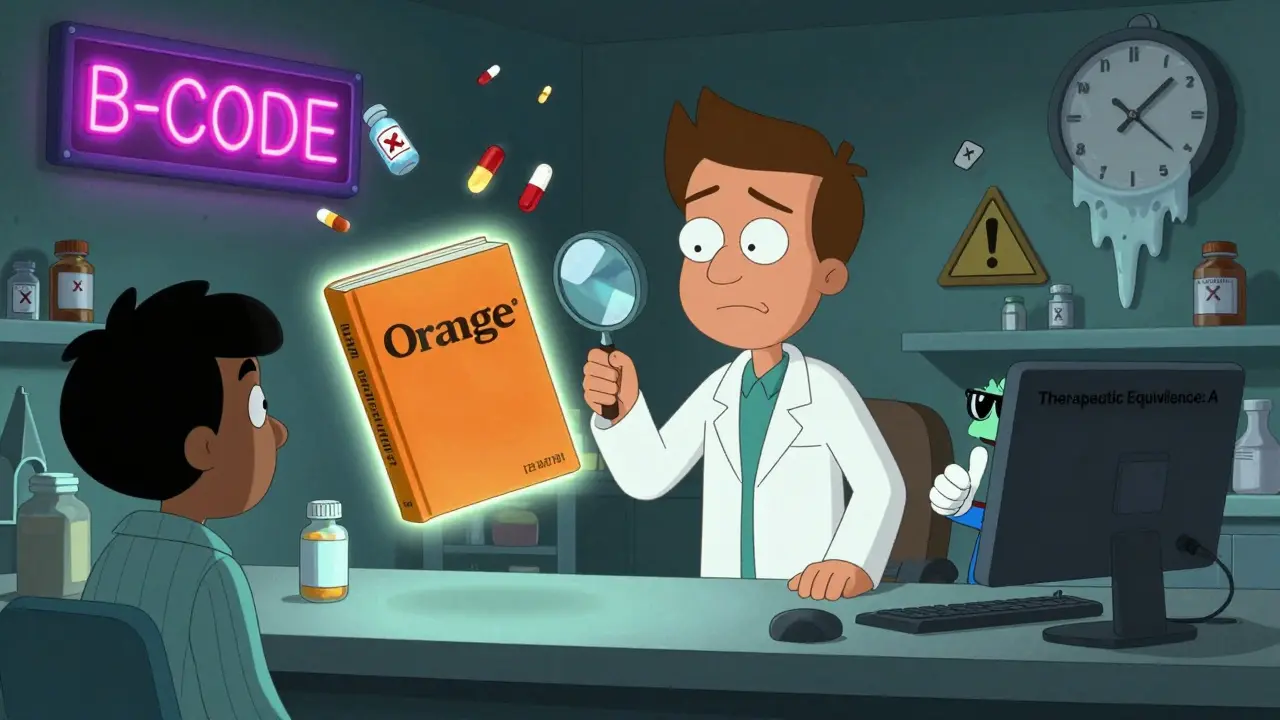
When it comes to drug safety in the U.S., two under-the-radar tools do more heavy lifting than most people realize: the FDA Orange Book and the FDA Purple Book. These aren’t marketing brochures or promotional guides. They’re official, legally mandated databases that tell you exactly which drugs are safe to use, which ones were pulled for good reason, and which biosimilars can be swapped in without risking patient harm. If you’re a pharmacist, prescriber, or even a savvy patient, skipping these resources is like driving without checking your mirrors.
What the Orange Book Actually Tells You About Drug Safety
The FDA Orange Book, officially called Approved Drug Products with Therapeutic Equivalence Evaluations, is the go-to source for small-molecule drugs - the kind you get as pills or injections that aren’t made from living cells. It’s been around since 1985, updated every month, and lists over 20,000 approved drugs as of late 2023. But here’s what most people miss: Section II of the Orange Book isn’t just a list of active drugs. It’s a graveyard of unsafe products. Every drug withdrawn from the market for safety or effectiveness reasons shows up here with a clear footnote: “Federal Register determination that product was discontinued or withdrawn for safety or efficacy reasons.” As of September 2023, that section includes 127 discontinued products. Some were pulled because of contamination. Others because they caused dangerous heart rhythms or liver failure. You won’t find these details in a drug label or on a pharmacy website - only in the Orange Book. Therapeutic equivalence codes are another safety lifeline. Each generic drug gets a two-letter code. The first letter tells you if it’s safe to substitute. An “A” means it’s therapeutically equivalent to the brand-name drug - same active ingredient, same dose, same absorption rate. That’s the green light for substitution. But if you see a “B,” that’s a red flag. It means the generic hasn’t proven it works the same way. For drugs with a narrow therapeutic index - like warfarin, levothyroxine, or lithium - even tiny differences in absorption can cause overdose or treatment failure. The Orange Book flags these cases so pharmacists don’t accidentally swap a “B”-coded generic into a high-risk patient’s prescription.The Purple Book: Safety for Biologics and Biosimilars
If the Orange Book handles pills and injections made chemically, the Purple Book handles biologics - complex drugs made from living cells. Think insulin, rheumatoid arthritis drugs like Humira, cancer treatments like Herceptin. These aren’t simple to copy. That’s where biosimilars come in. The FDA Purple Book, launched in 2014 and fully searchable since 2022, lists every licensed biological product and shows which ones are biosimilar or interchangeable. But its real safety power is in comparison. Each biosimilar is grouped under its reference product. So if you’re looking at a biosimilar of Humira, you can instantly see the safety data from the original drug - and whether the FDA has approved the copy as safe to switch to. The FDA doesn’t just say “this is close enough.” It requires proof. A biosimilar must show “no clinically meaningful differences in terms of safety, purity, and potency” compared to the reference product. That’s not a marketing claim - it’s a regulatory requirement backed by clinical trials. The Purple Book tells you which ones passed that bar. If a product says “Interchangeable,” it’s even stricter: the FDA has determined you can switch back and forth between the biosimilar and the original without increasing safety risks. But here’s the catch: the Purple Book doesn’t show real-time adverse events. If a biosimilar starts showing a spike in injection-site reactions six months after launch, that won’t show up here until the next update. You need to cross-check with FDA MedWatch alerts for emerging safety signals.How to Search the Orange Book for Safety Warnings
You don’t need special training to use the Orange Book. Go to the FDA’s website, find the Orange Book database, and follow these steps:- Use the search bar to find the brand name or generic name of the drug.
- Look at the “Therapeutic Equivalence Code” column. If it starts with “B,” stop. Don’t substitute.
- Scroll down to the “Discontinued Drug Products” section. Click “Filter by Reason for Discontinuation” and select “Safety.”
- If the drug you’re checking appears here with a safety note, it was pulled for a reason - and you shouldn’t prescribe or dispense it.
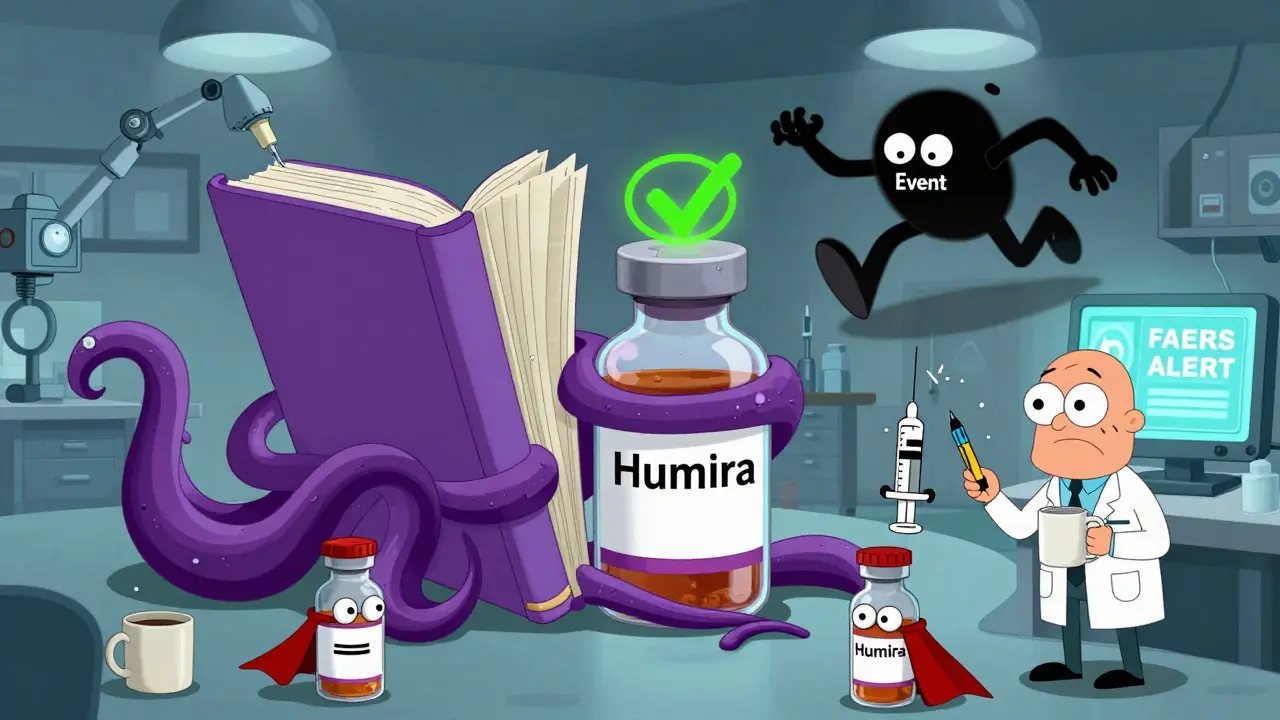
How to Use the Purple Book to Evaluate Biosimilar Safety
Using the Purple Book is a bit more involved, but it’s just as critical:- Search for the reference product - for example, “Adalimumab” (Humira).
- Look at the list of products under it. You’ll see the original brand and any biosimilars.
- Check the “Biosimilarity or Interchangeability” column. If it says “Yes,” the product has passed FDA safety equivalence testing.
- If it says “Interchangeable,” you can substitute it without prescriber approval - and the safety profile is considered equivalent.
- Don’t forget to check the “Reference Product Exclusivity” date. If that date has passed, the biosimilar has had time to accumulate real-world safety data.
What These Books Don’t Tell You - And What to Do About It
Neither the Orange Book nor the Purple Book shows you adverse event reports, patient complaints, or post-market safety signals. That’s the job of the FDA’s Adverse Event Reporting System (FAERS) and MedWatch alerts. You need to use them together. For example: The Orange Book might list a generic drug as “A”-coded and active. But if MedWatch just issued a warning about that same drug causing sudden liver failure in elderly patients, you need to know both. The same goes for biosimilars - the Purple Book says it’s interchangeable, but if there’s a surge in autoimmune reactions reported in the last month, you need to pause and investigate. Also, neither book tells you about off-label uses. A drug might be safe for epilepsy, but if you’re using it for migraines off-label, the equivalence data doesn’t apply. Always check the approved indications.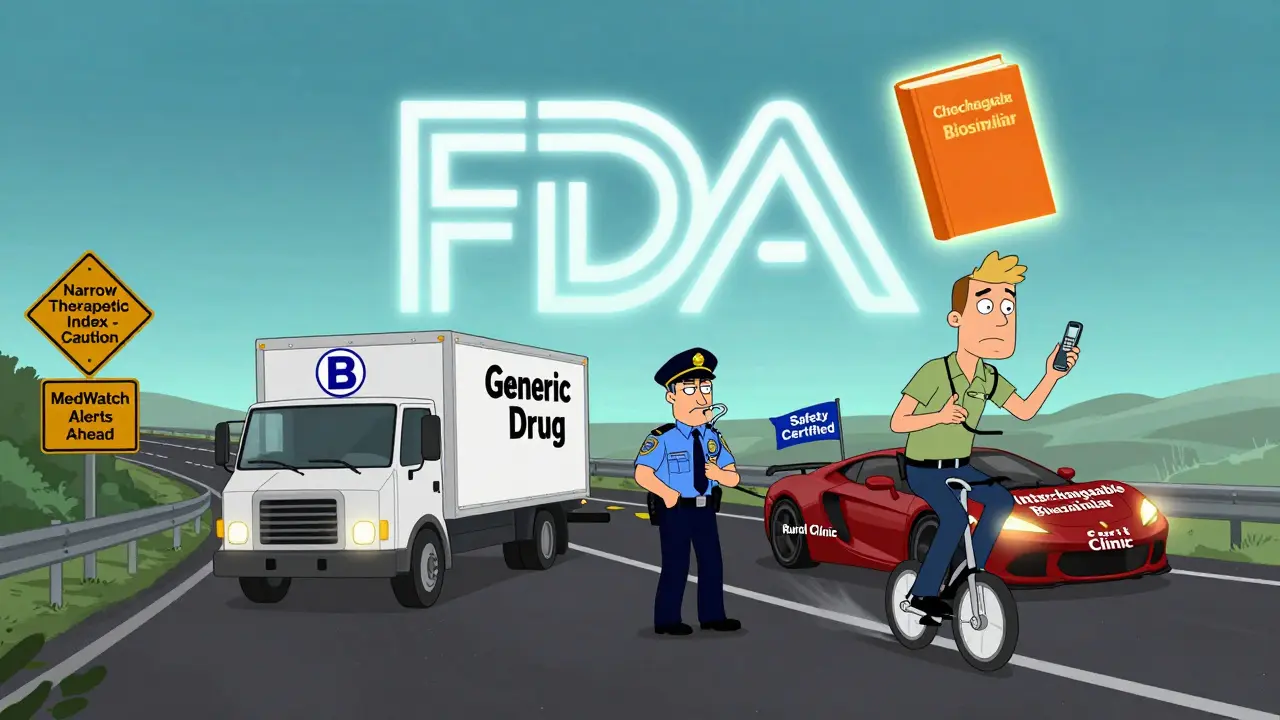
Who Uses These Tools - And Why
Ninety-eight percent of U.S. pharmacies use the Orange Book daily, according to the National Community Pharmacists Association. That’s not optional - it’s how they avoid liability. If a patient has a bad reaction to a substituted generic, and the Orange Book showed it was a “B” code, the pharmacist could be held responsible. In biotech, 76% of companies cite the Purple Book in regulatory filings. Why? Because the FDA now requires proof of biosimilarity before approving a new product. If you can’t show your drug matches the reference product’s safety profile, you don’t get approved. Smaller clinics and rural pharmacies lag behind - only 62% regularly check these resources. That’s a gap. A patient in a small town might get a generic drug that was withdrawn for safety reasons because no one checked the database. That’s not negligence - it’s a system failure.Recent Updates and What’s Coming
In 2023, the FDA added “Safety Signal” flags to the Orange Book. These highlight drugs with emerging concerns - like a pattern of kidney injury in elderly patients - before they’re officially withdrawn. It’s a new early-warning system. The Purple Book’s update cycle is slower - every 60 days - compared to the Orange Book’s 30 days. That’s a known issue. The FDA’s 2023-2025 plan includes using machine learning to pull safety signals from FAERS data and auto-flag products in both books. That could cut the delay in half. Congress allocated $5.2 million in 2023 to improve how safety data is displayed. That means better filters, clearer warnings, and mobile-friendly tools coming soon.Final Checklist: Your Safety Action Plan
Before prescribing or dispensing any drug, do this:- For small-molecule drugs: Check the Orange Book. Confirm the therapeutic equivalence code is “A.” Search the discontinued section for safety withdrawals.
- For biologics: Go to the Purple Book. Find the reference product. Verify the biosimilar is marked “Biosimilar” or “Interchangeable.”
- Always cross-check: Look up the drug on MedWatch and FAERS for recent safety alerts.
- For high-risk patients: Don’t substitute without double-checking - even if the code is “A.”
- Stay updated: The FDA offers free 90-minute training webinars quarterly. Take one.
Is the FDA Orange Book free to use?
Yes, the FDA Orange Book is completely free and publicly accessible through the FDA’s website. No subscription, login, or payment is required. The same applies to the Purple Book. Both are maintained as public resources under federal law to ensure transparency in drug safety and substitution.
Can I trust generic drugs listed in the Orange Book?
You can trust generics with an “A” therapeutic equivalence code - they’ve been proven to be bioequivalent to the brand-name drug in terms of safety and effectiveness. But “B”-coded generics have not met that standard. Never substitute a “B”-coded drug unless directed by a prescriber who understands the risks. For drugs with a narrow therapeutic index, like blood thinners or seizure medications, even “A”-coded generics should be used cautiously and monitored closely.
What’s the difference between biosimilar and interchangeable in the Purple Book?
A biosimilar is highly similar to the reference product and has no clinically meaningful differences in safety or effectiveness. An interchangeable biosimilar meets an even higher standard: the FDA has determined it can be substituted for the reference product without the prescriber’s involvement, and switching between them won’t increase safety risks. Interchangeable products are rarer - only about 40 out of over 400 listed in the Purple Book as of 2023 have that status.
Do the Orange and Purple Books include side effect data?
No, neither book lists specific side effects or adverse events. The Orange Book shows if a drug was withdrawn for safety reasons. The Purple Book shows whether a biosimilar matches the reference product’s safety profile. For details on side effects, you must consult the drug’s official prescribing information, FDA MedWatch alerts, or the FAERS database.
How often are the Orange and Purple Books updated?
The Orange Book is updated monthly, usually within 30 days of new approvals, withdrawals, or changes. The Purple Book is updated every 60 days. This difference exists because biologics take longer to review and approve. The FDA is working to shorten the Purple Book’s update cycle using automated systems, but for now, monthly checks are recommended for high-risk medications.
If you're managing prescriptions, advising patients, or working in drug safety, these two books are your frontline defense. Don’t rely on memory, apps, or third-party databases. Go straight to the source - the FDA’s Orange and Purple Books. They’re free, authoritative, and designed to keep people safe.

Kerry Howarth
January 3, 2026 AT 19:18Just checked the Orange Book before filling a script today. Found a B-coded generic for warfarin that slipped through our EHR. Saved a patient from a bleed. These tools aren't optional-they're lifelines.
Haley Parizo
January 4, 2026 AT 17:15You people treat these databases like sacred texts, but let’s be real-the FDA is slow, underfunded, and reactive. The Orange Book still lists drugs pulled years ago without context. The Purple Book? Half the biosimilars have zero real-world data. We’re trusting regulatory paperwork over actual clinical outcomes. That’s not safety-that’s institutional laziness.
Brittany Wallace
January 5, 2026 AT 18:26Ugh, I love how this post makes me feel like a superhero just for checking a database 😊 But seriously-thank you. My grandma’s on lithium, and I used to just trust the pharmacist. Now I check the Orange Book every time. Small effort, huge peace of mind. 🙏
Ian Ring
January 6, 2026 AT 20:15Thank you for this. I’m a UK pharmacist, and we don’t have an equivalent to the Orange Book-so I’ve been using this as a reference for my U.S. colleagues. The therapeutic equivalence codes are brilliant. The Purple Book’s structure? Even better. You’ve just made my job easier-and safer.
erica yabut
January 7, 2026 AT 14:08Oh, so you think reading a government spreadsheet makes you a ‘savvy patient’? How quaint. Most patients don’t even know what ‘bioequivalence’ means. This isn’t empowerment-it’s performative medicine for people who think ‘googling’ counts as research. Real safety? That’s when prescribers actually know pharmacology-not when they copy-paste FDA tables.
Vincent Sunio
January 7, 2026 AT 16:19The premise of this article is fundamentally flawed. The Orange Book does not determine ‘safety’-it determines therapeutic equivalence. Safety is assessed through post-marketing surveillance, clinical trials, and pharmacovigilance systems. To conflate these is a dangerous oversimplification. Furthermore, the Purple Book’s ‘interchangeable’ designation does not guarantee clinical interchangeability in all patient populations-particularly those with autoimmune comorbidities. This is misinformation dressed as guidance.
Shanahan Crowell
January 7, 2026 AT 17:27YES! This is the kind of info we need to shout from the rooftops! 🚨 I used to think generics were all the same-until I saw a B-code on a thyroid med and realized my clinic had been swapping it for years. Now I print the Orange Book page for every high-risk script. It takes 3 minutes. It saves lives. Do it.
Palesa Makuru
January 9, 2026 AT 07:50Why are we still using paper-based thinking in 2025? These books are static. Real-time adverse event data should be auto-pushed to EHRs. If a drug gets flagged in MedWatch, why isn’t the Orange Book updating within 24 hours? This is like using a rotary phone to call 911. You’re not safe-you’re just slow.
Hank Pannell
January 10, 2026 AT 06:26There’s a deeper epistemological layer here: we treat regulatory databases as objective truth, but they’re constructed artifacts-filtered, delayed, and politically negotiated. The Orange Book’s ‘discontinued for safety’ tag is a legal conclusion, not a clinical one. It doesn’t capture subclinical hepatotoxicity or delayed neurotoxicity. The Purple Book’s ‘no clinically meaningful difference’ is a statistical artifact, not a biological guarantee. We’re outsourcing clinical judgment to a spreadsheet. That’s not safety-it’s institutionalized epistemic humility.
Lori Jackson
January 11, 2026 AT 02:57It’s pathetic that we need to rely on two archaic, poorly designed government websites to prevent medical malpractice. And yet, 62% of rural clinics still don’t use them? That’s not ignorance-it’s negligence. If you’re not checking the Orange Book, you’re not a clinician-you’re a liability waiting to happen. And don’t get me started on how the FDA still hasn’t integrated FAERS data into these databases. This is 2025. We’re still using Word documents to save lives.
Wren Hamley
January 12, 2026 AT 11:03Look-I’m not a pharmacist. But I’m a patient with Crohn’s on Humira. My biosimilar got switched last year. I Googled the Purple Book, found the ‘Interchangeable’ tag, and breathed easier. Then I checked MedWatch-no new alerts. Did it take 10 minutes? Yeah. But I didn’t end up in the ER. So yeah, I’ll check the damn books. It’s not rocket science. It’s just… common sense.