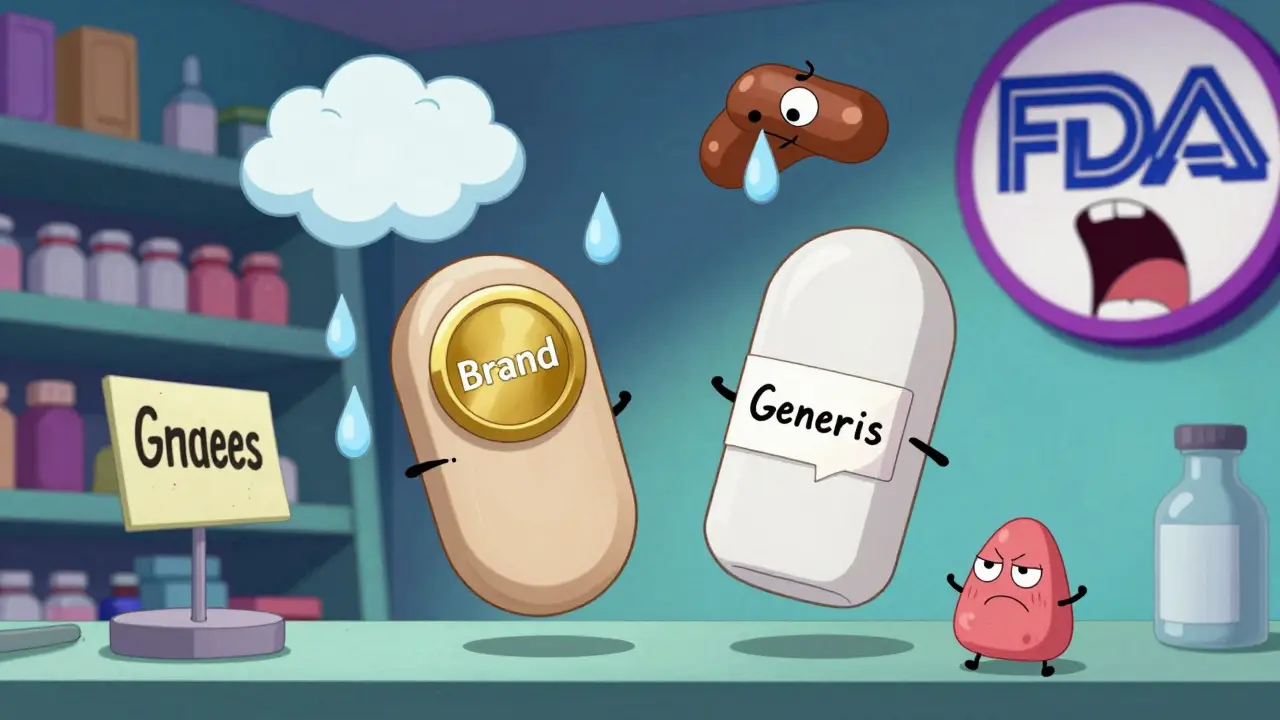
When you pick up a prescription, do you ever wonder if the generic version you’re handed is really the same as the brand-name drug you used to take? Many people assume they are. But what if switching to a cheaper generic suddenly makes you feel worse? More fatigue, more anxiety, more dizziness? You’re not imagining it - and you’re not alone.
The truth is, generic drugs are legally required to be bioequivalent to their brand-name counterparts. That means the active ingredient, dosage, and how fast it enters your bloodstream must be nearly identical. The U.S. Food and Drug Administration (FDA) says the difference can’t be more than 20% in absorption. For most people, that’s fine. But for others - especially those on drugs with a narrow therapeutic index - that small gap can mean big problems.
What Does "Bioequivalent" Really Mean?
The FDA’s standard for generics is strict but not perfect. To get approved, a generic must deliver 80% to 125% of the brand-name drug’s concentration in the blood. That’s a 45% range. Think of it like two cars going the same route. One is a luxury sedan, the other is a budget model. Both get you to the same city, but one might take a few extra minutes, hit a few potholes, or run a little hotter. For blood pressure meds or antidepressants, that’s usually okay. For drugs like warfarin, levothyroxine, or phenytoin, even a 5% shift can throw your levels out of range.
A 2018 study in PLOS Medicine looked at over 38 trials and found no meaningful difference in outcomes between brand and generic versions of heart drugs, diabetes meds, or bone treatments. But here’s the catch: the study couldn’t rule out individual reactions. One patient might handle a generic just fine. Another might have a spike in side effects after switching - not because the drug is broken, but because the inactive ingredients changed.
Inactive Ingredients Matter More Than You Think
Generics contain the same active ingredient as the brand-name drug. But they don’t have to use the same fillers, dyes, or binders. That’s where things get tricky. A 2022 study from Ohio State University found that generics made in India - which supply a large chunk of U.S. drugs - were linked to 54% more severe adverse events, including hospitalizations and deaths. Why? The researchers pointed to inconsistent quality control in manufacturing, especially for older, well-established drugs that have been on the market for years.
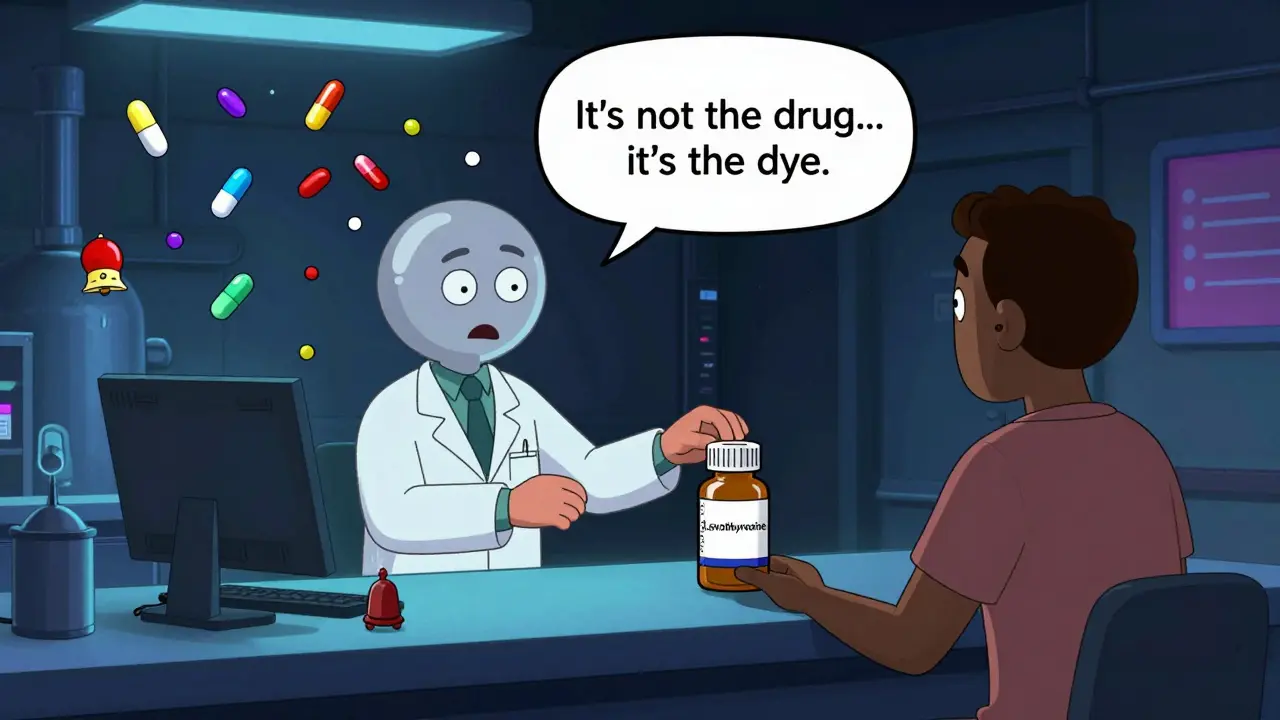
Pharmacists often hear patients say: "I switched to the generic and now I can’t sleep." Or: "I feel like I’m floating." In many cases, it’s not the active ingredient. It’s the lactose, the coloring, or the coating. People with allergies, sensitivities, or digestive issues can react to these additives. One patient might tolerate a generic made by a U.S. factory but break out in hives from the same drug made in a facility in China.
The Nocebo Effect: When Your Mind Makes You Sick
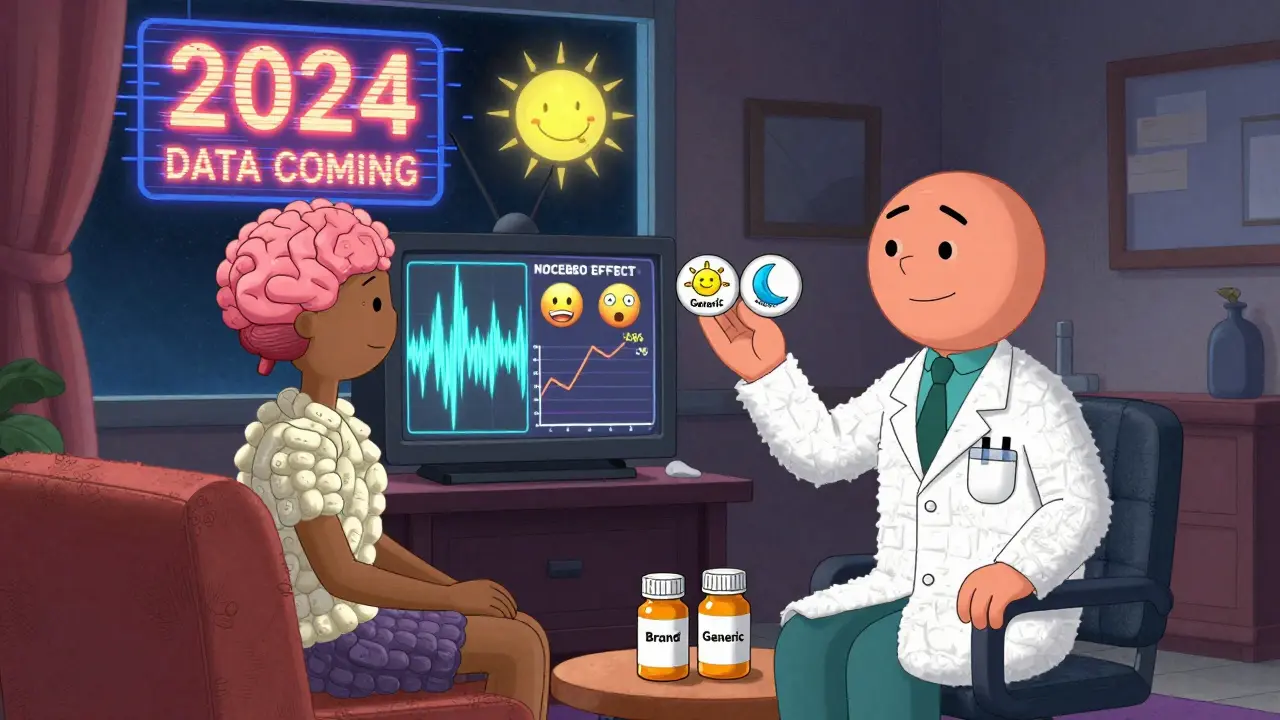
It’s not just chemistry. Psychology plays a huge role. The nocebo effect - the opposite of placebo - means if you believe a drug will make you feel bad, your body might respond accordingly. A 2012 study tested this by giving patients identical placebo pills, but labeling half as "generic" and half as "brand-name." Those who thought they were taking generics reported significantly more side effects - even though they were just sugar pills.
Another study in 2016 had patients take identical pain relievers, but one group was told they were getting a generic. That group reported higher pain levels and were 54% more likely to stop taking the drug early. The same pattern shows up with bupropion (Wellbutrin) and levothyroxine (Synthroid). Reddit threads are full of stories: "I switched to generic bupropion and became anxious. Switched back - vanished."
It’s not all in your head. But your head can make it worse.
Real-World Data: What Do the Numbers Say?
Let’s look at hard data. A 2018 NIH analysis of over 27,000 adverse event reports found:
- For amlodipine (a blood pressure drug), generics made up 14% of reports - but authorized generics (made by the original brand) only 1.5%.
- For simvastatin (a cholesterol drug), brand-name users had a 43% discontinuation rate. Generic users? Only 28%.
That’s right. People quit the brand-name version more often. Why? Because the generic worked better - or at least, felt better. The same study found patients on generic simvastatin had fewer heart attacks and strokes. For some drugs, generics are not just cheaper - they’re better tolerated.
But then there’s warfarin. Patients switching between generic manufacturers often report unstable INR levels. Why? Because each manufacturer’s version absorbs slightly differently. Even if they’re all "bioequivalent," your body remembers the exact formulation you were stable on. Switching between generics - even from one approved manufacturer to another - can cause dangerous fluctuations.
Who Should Be Careful?
Not everyone needs to worry. But if you’re taking one of these, tread carefully:
- Levothyroxine - Even a 5% change in absorption can cause fatigue, weight gain, or heart palpitations.
- Warfarin - Tiny changes in blood levels can lead to clots or bleeding.
- Phenytoin - Used for seizures. Too little? Seizures return. Too much? Toxicity.
- Propranolol and metoprolol - Beta blockers. Some patients report dizziness or low heart rate after switching.
- Bupropion - Antidepressant. Many report increased anxiety or insomnia with generics.
The American Medical Association recommends doctors write "Dispense as Written" on prescriptions for these drugs. It means the pharmacist can’t swap in a different generic without your doctor’s approval. It’s not about distrust - it’s about stability.
What Can You Do?
Here’s what works in real life:
- Stick with one manufacturer. If your generic works, don’t switch unless you have to. The pharmacy might swap it out - ask them to keep the same one.
- Check the pill. Generics look different. If your pill suddenly changes color or shape, ask your pharmacist. It might be a different maker.
- Track your symptoms. Keep a simple log: date, medication, how you felt. If you notice a pattern after a switch, show it to your doctor.
- Ask about authorized generics. These are made by the original brand company under a generic label. They’re chemically identical to the brand but cheaper. Ask your pharmacist if they’re available.
- Get educated. A 2020 study found patients who got a clear explanation about generic equivalence were 37% less likely to report side effects. Knowledge reduces fear.
The Bigger Picture
Over 90% of prescriptions filled in the U.S. are generics. They save billions each year. Most people take them without issue. But the system isn’t flawless. Manufacturing happens in 1,700 facilities worldwide - 63% outside the U.S. The FDA inspects them, but resources are stretched thin. And while regulations are tight, real-world quality varies.
The FDA says differences are "not clinically meaningful." But for the 1 in 10 people who react - whether because of chemistry, psychology, or manufacturing - that difference matters a lot.
There’s no blanket answer. For most drugs, generics are safe. For a few, they’re not. And for some people, even a tiny change can trigger a cascade of symptoms. The key isn’t fear. It’s awareness.
What’s Next?
Researchers are now tracking half a million patients across the U.S. to compare real-world outcomes between brand and generic drugs. The data will be released by late 2024. Meanwhile, the FDA is pushing for stricter testing on complex generics - things like inhalers, creams, and extended-release pills - where bioequivalence is harder to prove.
And then there’s pharmacogenomics. A 2023 study found people with a specific gene variation (CYP2D6 poor metabolizers) had 2.3 times higher risk of side effects from generic venlafaxine. We’re moving toward personalized medicine - where your genes, not just your prescription, determine which version of a drug is safest for you.
Are generic drugs less safe than brand-name drugs?
For the vast majority of people, generics are just as safe. The FDA requires them to meet strict bioequivalence standards. But for drugs with narrow therapeutic indices - like warfarin or levothyroxine - small differences in absorption can matter. Also, changes in inactive ingredients can trigger reactions in sensitive individuals. So while generics aren’t inherently unsafe, they aren’t always identical in how your body responds.
Why do some people feel worse after switching to a generic?
There are three main reasons. First, inactive ingredients like dyes or fillers can cause reactions in people with sensitivities. Second, slight differences in how the drug is absorbed - even within FDA limits - can affect drugs that need very precise blood levels. Third, the nocebo effect: if you believe generics are inferior, your brain can amplify symptoms. Studies show people report more side effects when told they’re taking a generic, even when they’re not.
Can I ask my pharmacist to keep the same generic manufacturer?
Yes. Pharmacists can and often do switch between generic manufacturers to save money. But you can ask them to stick with one brand. Some pharmacies let you request a specific manufacturer - especially if you’ve had issues before. You can also ask your doctor to write "Dispense as Written" on your prescription to prevent automatic substitutions.
Are generics made in India less safe?
A 2022 Ohio State University study found generics made in India were linked to 54% more severe adverse events than those made in the U.S. This was especially true for older, mature generics. But the FDA disputes this, saying facility location doesn’t prove quality. The truth is, quality varies by factory - not country. Some Indian facilities meet U.S. standards. Others don’t. It’s not about where it’s made, but who made it and how.
Should I avoid generics altogether?
No. Generics are safe and effective for most people and most drugs. The cost savings are massive - and they help keep healthcare affordable. But if you’re on a drug with a narrow therapeutic index - like thyroid meds, blood thinners, or seizure drugs - pay attention. Stick with one manufacturer. Track your symptoms. Talk to your doctor. Don’t assume all generics are the same.
Jeff Card
March 2, 2026 AT 06:16Zacharia Reda
March 3, 2026 AT 06:42Matt Alexander
March 4, 2026 AT 05:46Gretchen Rivas
March 5, 2026 AT 06:28Mike Dubes
March 5, 2026 AT 18:04Helen Brown
March 7, 2026 AT 04:44John Cyrus
March 8, 2026 AT 00:00John Smith
March 9, 2026 AT 09:14Sharon Lammas
March 10, 2026 AT 04:24marjorie arsenault
March 10, 2026 AT 09:47Deborah Dennis
March 11, 2026 AT 13:12Shivam Pawa
March 12, 2026 AT 07:55