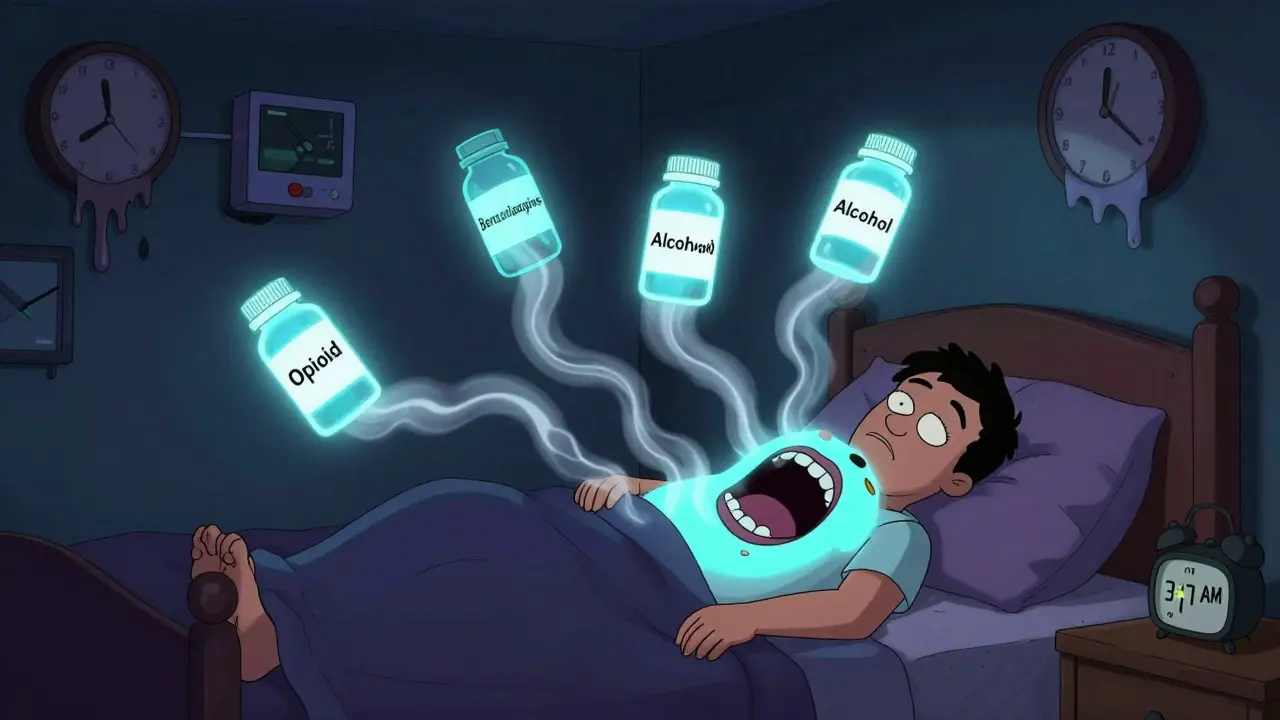
When you take more than one sedating medication at the same time, the effects don’t just add up-they multiply. This isn’t just a theory. It’s happening in real lives, every day. People are mixing sleep pills with painkillers, anxiety meds with alcohol, or antidepressants with muscle relaxers-often without realizing how dangerous it is. The result? Slowed breathing, confusion, falls, blackouts, and sometimes death. In the U.S. alone, over 128,000 people die each year from prescription drug-related causes, and a huge chunk of those deaths come from combining just two or three common sedatives.
What Happens When Sedating Drugs Combine?
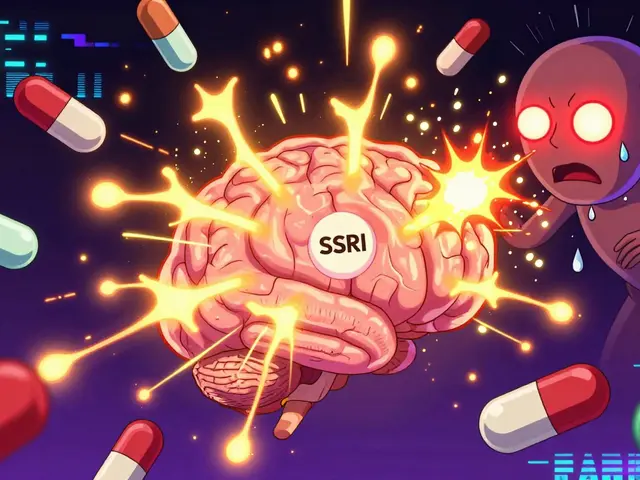
Most sedating medications work by boosting the effect of a brain chemical called GABA. This chemical slows down brain activity, which is why these drugs help with anxiety, insomnia, or seizures. But when you take two or more of them together, they don’t just work side by side. They team up. This is called synergistic effect. It means the total impact is way stronger than the sum of each drug alone.
For example, opioids like oxycodone or hydrocodone calm pain by acting on the brainstem-the part that controls breathing. Benzodiazepines like Xanax or Valium also hit the brainstem, but through a different path. When you combine them, your breathing can drop to dangerously low levels. Research in JAMA Internal Medicine found that people taking both opioids and benzodiazepines had a 154% higher risk of overdose than those taking opioids alone. That’s not a small increase. That’s life-or-death territory.
Alcohol makes it even worse. Just two drinks mixed with a sleep aid like Ambien can cut reaction time by 70%. That’s worse than being legally drunk. And it doesn’t just affect your reflexes-it shuts down your body’s ability to wake up if your breathing slows. This is why so many overdose deaths happen at night: the person falls asleep, never wakes up.
The Deadliest Combinations
Not all drug mixes are equally dangerous. Some are far more lethal than others. Here are the top three most deadly combinations:
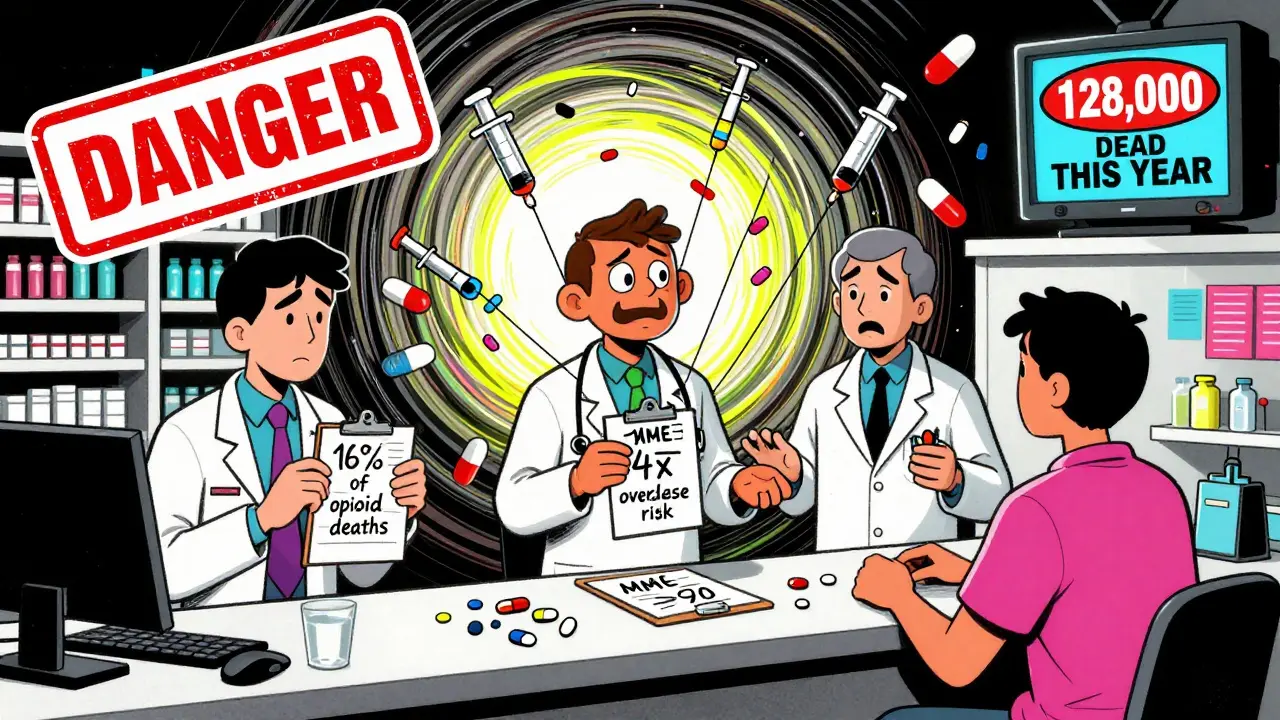
- Opioids + Benzodiazepines: This is the most dangerous pair. The CDC reports that in 2020, 16% of opioid overdose deaths also involved benzodiazepines. A 2017 study found the risk of fatal overdose was nearly 4 times higher when both were taken together. Even more alarming: UCLA Health says these combinations account for about 30% of all prescription drug deaths in the U.S.
- Alcohol + Sedatives: Alcohol isn’t just a party drink-it’s a powerful CNS depressant. Mixing it with sleep aids, anti-anxiety meds, or muscle relaxers can cause unconsciousness, respiratory failure, or cardiac arrest. American Addiction Centers found that this combo increases overdose risk by 4 to 5 times. Many people don’t realize their sleep medication label warns against alcohol, and they drink anyway.
- SSRIs + MAOIs: This one doesn’t slow breathing-it causes serotonin syndrome. When too much serotonin builds up in your brain, you can get fever, muscle spasms, rapid heartbeat, and seizures. A 2018 review found serotonin syndrome occurs in 14-16% of cases when these two antidepressants are combined. The FDA recommends waiting 14 days between switching from one to the other.
There are other risky pairs too: NSAIDs with corticosteroids can cause stomach bleeding, and antihistamines with sleep aids can lead to confusion in older adults. But none are as immediately life-threatening as the opioid-benzodiazepine mix.
Warning Signs You Can’t Ignore
Most people don’t realize they’re in danger until it’s too late. But there are clear signs that your body is shutting down. If you or someone you know shows any of these, call emergency services right away:
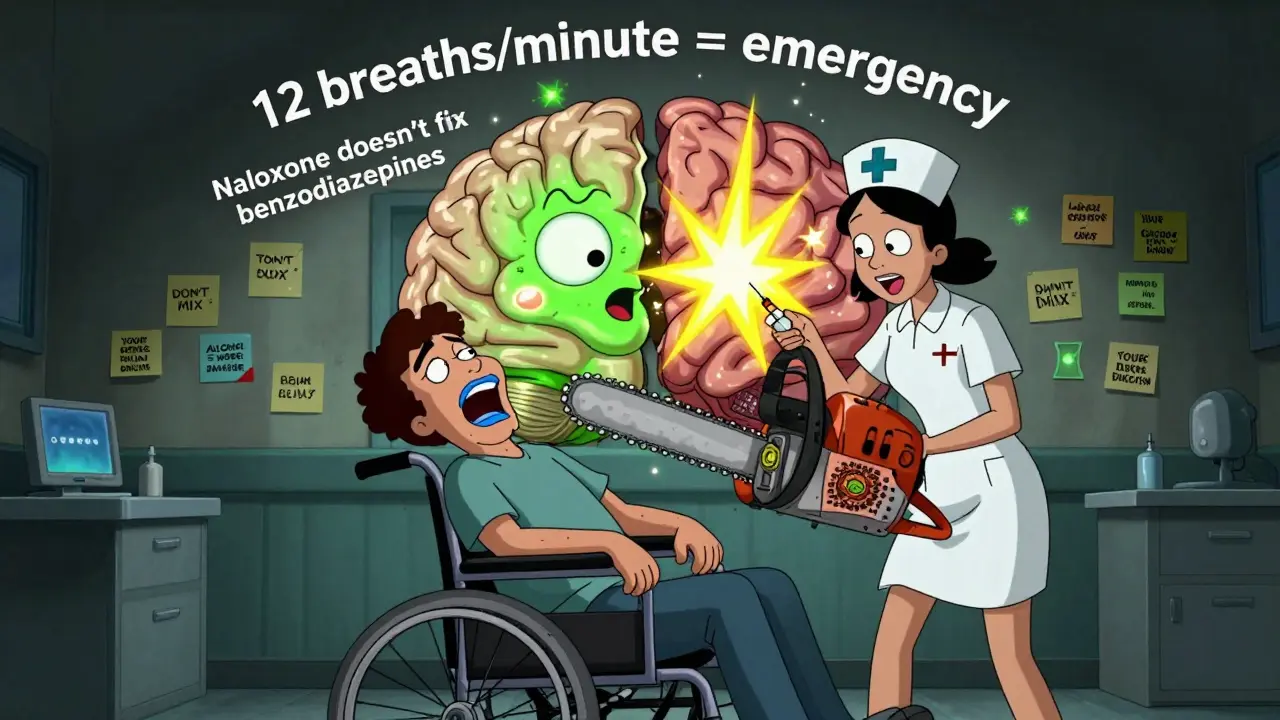
- Slowed or shallow breathing-fewer than 12 breaths per minute
- Blue lips or fingertips (sign of low oxygen)
- Unresponsiveness-even loud shouting or shaking won’t wake them
- Gurgling or snoring sounds while sleeping (a sign of airway blockage)
- Extreme dizziness, confusion, or inability to stand
These aren’t normal side effects. They’re emergency signals. A 2021 study in Annals of Emergency Medicine found that patients who received naloxone (the overdose reversal drug) within 10 minutes of showing these signs had a 90% survival rate. Wait longer, and survival drops fast.
Why This Keeps Happening
You’d think doctors would catch this. But they often don’t. A 2020 study in JAMA Network Open found that only 17.3% of dangerous drug combinations triggered alerts in electronic health records. That means most systems don’t warn providers when someone is prescribed both an opioid and a benzodiazepine. Even worse, many patients get prescriptions from multiple doctors. Recovery Village data shows that 42% of overdose victims had seen three or more doctors in six months, each prescribing a different sedative.
Older adults are especially at risk. The American Geriatrics Society Beers Criteria® lists 19 sedating drug combinations that older people should avoid. Why? Because aging slows how the body processes drugs. A dose that was safe at 50 can be deadly at 75. And falls? They’re common. One study found sedative combinations increase fall risk by 50% in seniors. Broken hips, head injuries, long hospital stays-these aren’t accidents. They’re preventable.
What You Can Do
Prevention starts with awareness. Here’s what you can do right now:
- Make a full list of everything you take-prescriptions, over-the-counter meds, supplements, even herbal teas. Many people forget that melatonin, valerian root, or CBD oil can also be sedating.
- Bring it to every doctor visit. Don’t assume your pharmacist or doctor knows what you’re taking. Bring the actual bottles or a printed list.
- Ask about alternatives. Is there a non-sedating option for anxiety? For pain? For sleep? Many newer treatments exist, even if they cost more.
- Know your opioid dose. If you’re on an opioid, ask your doctor what your morphine milligram equivalent (MME) is. The CDC says staying under 50 MME per day lowers overdose risk. Above 90 MME? The risk jumps sharply.
- Never mix with alcohol. Even one drink can turn a safe dose into a dangerous one.
If you’re on multiple sedatives, ask for a medication review. The START criteria recommend that anyone over 65 taking three or more sedating drugs should be evaluated within 30 days. Many clinics now offer these reviews for free.
The Bigger Picture
There’s progress. The FDA now requires boxed warnings on all opioid and benzodiazepine labels. All 50 states require electronic prescriptions for controlled substances, which now include checks for dangerous combinations. AI tools like the FDA-approved DETERMINE platform can predict individual risk with 87.4% accuracy. But these tools mean nothing if patients don’t understand the danger.
And cost is a barrier. Many non-sedating alternatives cost $450-$600 a month. Sedatives? $15-$30. For people on fixed incomes, the cheaper option wins-even if it’s deadlier.
The truth is, combining sedating medications isn’t just a medical mistake. It’s a systemic failure. Doctors aren’t always warned. Patients aren’t always informed. Systems aren’t built to catch this. But you can protect yourself. Knowledge is your best defense.
Can I stop taking one of my sedating medications on my own?
No. Stopping sedating medications suddenly can cause seizures, severe anxiety, or even death. Always work with your doctor to taper off slowly. A typical safe reduction is 10-25% every 1-2 weeks, depending on the drug and your health.
Are over-the-counter sleep aids safe to combine with prescription drugs?
Not usually. Many OTC sleep aids contain antihistamines like diphenhydramine, which are sedating. Mixing them with prescription sleep meds, anxiety drugs, or painkillers can increase drowsiness, confusion, and breathing problems. Always check with your pharmacist before combining any OTC product with a prescription.
Why do some people say combining meds helps their anxiety?
In rare cases, under strict medical supervision, doctors may use low-dose combinations for severe, treatment-resistant anxiety. But this is not common, and it’s never done without close monitoring. Most reports of benefit come from people who don’t realize how dangerous the mix is. The 18% who say it helped in one survey were likely under careful supervision. Self-managed combinations are never safe.
Can naloxone reverse an overdose from benzodiazepines?
No. Naloxone only works on opioids. If someone overdoses on a mix of opioids and benzodiazepines, naloxone can reverse the opioid part, but the benzodiazepine will still depress breathing. That’s why emergency care is critical-even if naloxone is given, the person still needs hospital monitoring.
How often should I get my meds reviewed?
If you’re on three or more sedating medications, get a full review every 3 months. For people over 65, the Beers Criteria recommends reviews every 3-6 months. Even if you feel fine, your body’s ability to process drugs changes over time. What was safe last year might be risky now.

Kathy Leslie
March 15, 2026 AT 08:48Been there. Took Xanax and hydrocodone for years after my surgery. Thought I was fine until I blacked out and woke up in the ER. No one warned me. Just assumed "it’s just medicine."
Serena Petrie
March 16, 2026 AT 08:21So don’t mix them. Done.
Alex MC
March 16, 2026 AT 21:26This is such an important post. I work in a clinic and see this every week. People are terrified to ask questions because they think their doctor will judge them. But the truth? We’re just glad they’re asking.
One guy came in with 7 different prescriptions. We sat down, mapped it all out, and cut 3 of them. He cried. Said he hadn’t slept soundly without the meds in 12 years. We found a non-sedating alternative for his anxiety. Now he’s hiking again.
It’s not about taking meds away. It’s about keeping people alive.
Elsa Rodriguez
March 18, 2026 AT 11:30OMG I KNEW IT. My cousin died last year. They said "accidental overdose." But she was on Ambien, oxycodone, and a muscle relaxer. Her doctor was prescribing her all three. No one said a word. Now I’m screaming into the void about this. RIP, Jess. You didn’t deserve this.
Also-why do pharmacies still let people walk out with 3 sedatives in one script? Someone’s gotta get fired.
Amisha Patel
March 18, 2026 AT 19:32Interesting. In India, we don’t talk about this much. People use sedatives like candy. My uncle took Valium with whiskey every night. Said it "helped him chill." He had a stroke at 68. No one connected the dots.
Maybe awareness is the first step. Thank you for writing this.
Rosemary Chude-Sokei
March 18, 2026 AT 20:45As someone who has navigated the healthcare system as a patient with chronic conditions, I appreciate the clarity and precision of this post. It’s rare to see such a well-researched, non-sensationalized breakdown of a systemic issue.
I’d only add that the burden of responsibility shouldn’t fall entirely on the patient. While medication reviews are critical, they’re often inaccessible due to insurance barriers, provider shortages, and bureaucratic inertia. The fact that only 17% of EHRs flag dangerous combinations is not an oversight-it’s negligence.
And yes, cost matters. A $450 non-sedating alternative is not an "option" for someone on SSDI. We need policy change, not just personal vigilance.
Thank you for naming the systemic failure. That’s the first step toward fixing it.
Leah Dobbin
March 20, 2026 AT 11:23Oh please. This is just Big Pharma’s way of making you feel guilty for taking medicine. I’ve been on 4 sedatives for 15 years. I’m fine. My doctor knows what he’s doing. You’re just fearmongering because you don’t understand pharmacology.
Also, why are you so obsessed with opioids? Maybe the real problem is that people are too weak to handle their own pain. Just saying.
mir yasir
March 21, 2026 AT 02:50One must acknowledge the epistemological rupture between clinical guidelines and real-world polypharmacy. The GABAergic synergy phenomenon, while empirically validated, is often reduced to alarmist narratives that obscure the nuanced biopsychosocial determinants of therapeutic adherence.
Furthermore, the conflation of pharmacokinetic interaction with moral culpability-particularly in the context of socioeconomic disparity-renders the proposed interventions ontologically insufficient.
One would do well to consult the 2022 Cochrane Review on polypharmacy in chronic pain before engaging in such reductionist discourse.
Noluthando Devour Mamabolo
March 21, 2026 AT 07:02Yasss queen!! 🌟 This is the kind of content we NEED in 2025. GABA synergy? 🔥 Opioid + benzo = death combo? 💀 Naloxone doesn’t fix benzos? 😱 I’m sharing this with my whole fam. Also-melatonin is a sedative??!? 🤯 I’ve been mixing it with ZzzQuil since 2020. Time to reboot my life. #MedicationAwareness #NoMoreSleepyDead
Buddy Nataatmadja
March 21, 2026 AT 09:48As someone from Indonesia, I’ve seen this too. People here mix painkillers with herbal teas like kava or kratom, thinking "natural = safe." They don’t know these also affect GABA. No one talks about it. No one teaches it.
Thanks for putting this out. Maybe someone in my village will read this and live.
tynece roberts
March 22, 2026 AT 13:31i was on 3 of these and never knew. my dr just kept adding more. i thought i was fine til i started forgetting my own name. now i’m on one med and therapy. best thing i ever did. also lol i spelled "medication" wrong like 5 times in this comment. sorry.
Lorna Brown
March 24, 2026 AT 04:28What’s the ethical responsibility of the prescriber when the system is designed to fail? If a doctor can’t see all the medications a patient is taking across 7 different clinics, is it negligence-or is it the system that’s guilty?
This isn’t about individual choices. It’s about institutional abandonment. We’ve built a healthcare machine that profits from dependency and punishes awareness.
And yet-we still blame the patient. "You should’ve asked." "You should’ve read the label."
What if the label was written in invisible ink? What if the system never gave you the tools to ask?
Maybe the real question isn’t "Why do people mix these?"
It’s "Why did we let them?"
Ali Hughey
March 25, 2026 AT 21:50THIS IS A GOVERNMENT PLOT. 🚨 The FDA, CDC, and Big Pharma are all in bed together. They WANT you to think combining meds is dangerous… so you’ll take MORE drugs to "fix" the side effects! That’s why they don’t warn you about the 19 other sedatives they’re secretly hiding in your water supply! 🧪💧
I’ve been taking 8 different pills for 17 years. My blood pressure is perfect. My brain is clear. I’m the proof. They’re scared of people like me. And now… they’ve silenced me. My internet is down. My phone is bugged. I’m typing this from a library. HELP.
Alex MC
March 26, 2026 AT 05:31Thanks for sharing your story, Kathy. I’ve been working in ER for 12 years. We see the same patterns. People don’t realize their "harmless" sleep aid is part of the problem.
One thing I’d add: if you’re on any sedative, ask your pharmacist: "Would you give this to your mom?" If they hesitate… that’s your answer.